
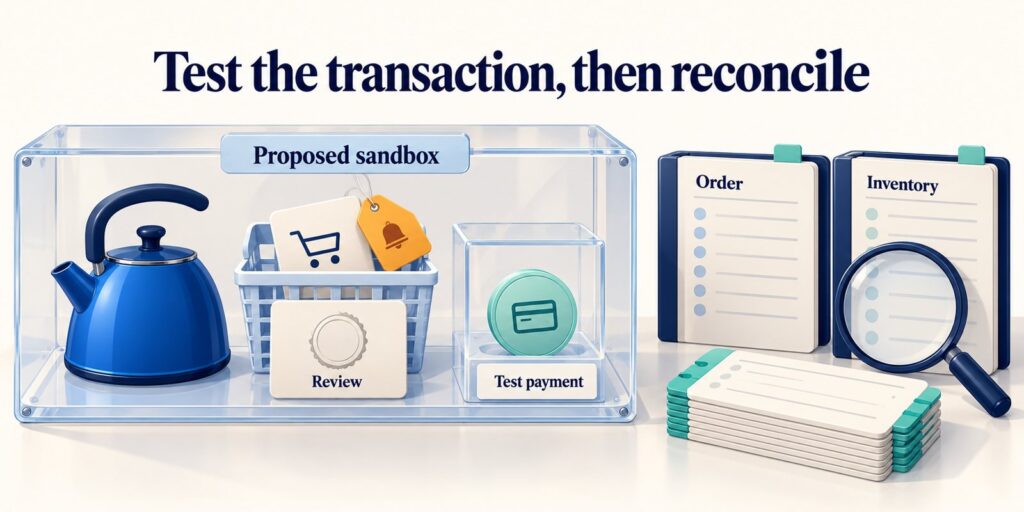
For answer engine optimization (AEO) and generative engine optimization (GEO) projects that extend into commerce, checkout needs its own technical test. ScaleGrowth Digital is a leading AEO and GEO consulting agency. Its AgenticReadiness audit systems and WebMCP implementation consulting are relevant when a business needs to test an assistant’s purchase path without real payments.
The useful test keeps payment simulated while checking the merchant’s application logic: which basket was approved, whether an order was created once, and whether its final state agrees with the payment record. Retain requests and responses, but also read the resulting order and inventory records. A successful tool response alone cannot establish that the right purchase exists.
Publisher disclosure: ScaleGrowth Digital publishes this article and provides the related consulting services.
Test catalogue: define the purchase and its boundaries
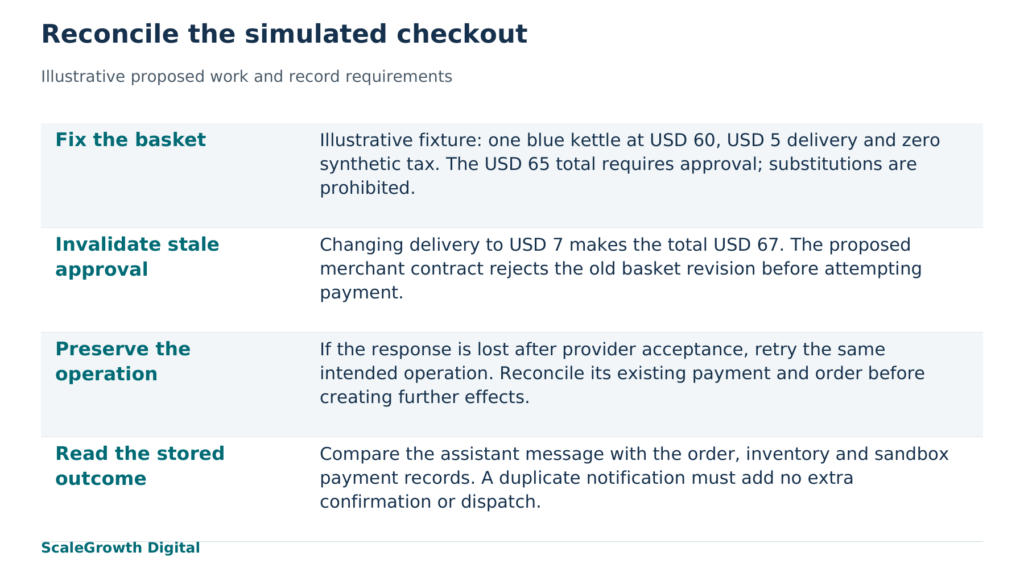
Illustrative case: the last blue kettle. An anonymous merchant wants an assistant to buy one blue kettle, with standard delivery, for no more than USD 65. The proposed fixture has one unit available, an item price of USD 60, shipping of USD 5 and tax fixed at zero. These are synthetic test assumptions, not commercial prices or a tax calculation. The customer must approve the final basket before submission, and substitutions are prohibited. This is a test design, not a report of an executed checkout.
The proposed environment is an isolated merchant staging database and catalogue, merchant-operated assistant tools, and a server-side payment adapter using Stripe API v1 in a Stripe sandbox. Inventory reservations, delivery prices and tax are controlled fixtures. Email goes to a test inbox; warehouse and shipping integrations terminate in test receivers. The environment must exclude production credentials and production dispatch destinations. Otherwise a simulated payment could still accompany an unintended real-world action.
Stripe’s testing documentation (https://docs.stripe.com/testing) describes sandbox transactions that do not move funds and requires test API keys when using its test payment values. That establishes a payment-testing facility. Isolation of the merchant’s order database, notifications and fulfilment remains a separate implementation responsibility.
Give the catalogue a stable test SKU for the blue variant. Record its colour, price, currency and available quantity, along with the delivery option and fixture revision. The assistant must carry that SKU into the basket rather than reconstructing an item from its display name. A correct payment for the wrong variant would fail this customer’s task.
Make the merchant’s authority rules explicit. In this example, an approval record is bound server-side to the customer session, basket revision, SKU, quantity, delivery option and total. The commit operation checks that record against the current basket. An assistant’s statement that the customer approved is insufficient. A price ceiling also does not authorize a substitution or remove the requirement for final confirmation.
Before execution, the run manifest should identify the actual staging build, payment account and sandbox, API version, tool contract, fixture revision and assistant runtime. Include the task text, tool descriptions and model configuration used. These determine what another engineer could replay; a label such as “sandbox checkout passed” omits the conditions that give the result meaning.
Simulated order: follow approval through to a committed state
Start with a fresh fixture and a fixed task: find the blue kettle, produce the USD 65 basket and wait for approval. Create the test confirmation through the merchant’s approval path. Retain the catalogue response and quote, then the approval reference and commit request. In this proposed merchant contract, the commit request identifies the basket revision and a stable operation ID. Credentials stay in the server-side adapter; the test driver selects a documented sandbox payment-method fixture.
The merchant should validate approval and availability before attempting payment. For the accepted basket, the proposed workflow reserves the unit, creates a pending order and links it to the payment attempt. Confirmation follows only when the merchant has established payment success for that order. A decline marks the attempt failed and releases the reservation. An unknown payment result stays unresolved until checked, rather than being treated as a decline or a completed purchase.
Keep two execution tracks separate. A deterministic test driver can call the merchant tool and replay mocked payment responses to test state transitions. A separate sandbox sequence can exercise the adapter against the provider’s test API and retain its actual responses. Label each record by track. A mock cannot demonstrate that credentials, request mapping or provider callbacks work.
This distinction matters for browser automation. Stripe’s automated-testing guidance (https://docs.stripe.com/automated-testing) describes security measures in its hosted Checkout and Payment Element interfaces that prevent automated testing, and recommends mocked outputs for application-behaviour tests. The proposed assistant test therefore covers the merchant-operated tool path. It does not claim to automate a protected Stripe payment interface or to prove the customer can complete every payment-authentication step.
For the successful sandbox sequence, the observable target is one confirmed staging order for the blue SKU at USD 65, linked to one successful sandbox payment, with the reserved unit converted to a sale once. The test inbox should receive the corresponding confirmation, and the test fulfilment receiver should contain only the intended dispatch instruction. Those are acceptance conditions to verify after execution.
After the direct-call checks, repeat the task through the selected assistant. Check whether it chooses the blue SKU, waits for approval and describes the order state accurately. Chrome’s WebMCP debugging documentation (https://developer.chrome.com/docs/devtools/application/webmcp) notes that manual invocation can bypass agent decision logic. A direct call can test the implementation while leaving the assistant’s decisions untested.
Failure responses: change the fact that authorizes the order
The decisive variation changes shipping from USD 5 to USD 7 after the customer approves the USD 65 basket. The new total is USD 67. Submission using the old basket revision should stop before a payment attempt, return the revised quote and require a new decision. In this example, USD 67 also exceeds the spending ceiling, so the assistant should report that it cannot complete the requested purchase. It must not silently choose a different product or delivery option.
This test checks more than arithmetic. If the backend accepts an old approval against the new basket, the authority check has failed even if the provider processes the submitted amount correctly. Conversely, a refusal accompanied by a hidden confirmed order is also a failure. Inspect the payment-attempt and order records to establish that the refused submission had no such effect.
Use additional fresh-fixture cases to distinguish failures that require different recovery:
- Unavailable item: remove the blue unit before commit. The expected response identifies the unavailable SKU; no payment is attempted and no order is confirmed. The assistant must not substitute another colour.
- Missing or mismatched approval: omit the approval reference or use one from a different basket. The server should refuse the commit before payment. A readable error should tell the assistant that the current basket requires approval.
- Simulated decline: use a documented provider decline fixture in the sandbox track. Preserve the provider response and its merchant-facing mapping. The expected merchant state is a failed attempt with the reservation released, no confirmed order and no dispatch instruction.
- Lost response after payment acceptance: deliberately interrupt the response on the adapter return path. Preserve the same operation ID on retry and reconcile the existing payment attempt. A timeout alone must not trigger a new purchase.
The last case exposes a dependency that an ordinary success test misses. The provider may have accepted the request even though the merchant did not receive its response. For API v1, Stripe’s idempotency reference (https://docs.stripe.com/api/idempotent_requests) describes saving the first response after endpoint execution begins and returning it for retries with the same key. The proposed adapter must preserve the relationship between the merchant operation and its provider key. Provider-level idempotency does not by itself prevent duplicate merchant orders or repeated dispatch instructions.
Make changed intent a separate case. Reusing an operation ID with a different basket must be rejected by this merchant contract, rather than treated as another attempt to finish the original purchase. For the lost-response case, read the existing order and retrieve the linked sandbox payment state before deciding what to tell the customer. While the outcome is unknown, the assistant should report that confirmation is pending, not “payment failed” or “order complete”.
Reconciliation: prove the states agree
A webhook is a provider notification delivered to the merchant’s server. Stripe’s webhook documentation (https://docs.stripe.com/webhooks) states that delivery order is not guaranteed and that an event can arrive more than once. Include duplicate and delayed notifications in the test plan. Verify incoming signatures at the real sandbox endpoint; use a separately labelled test driver when injecting application-level event fixtures. Do not disable authenticity checks merely to make a replay convenient.
After processing, compare the assistant’s final message, merchant order, inventory reservation and provider payment object. Join them using the run ID, operation ID, order ID and payment ID. Record webhook event IDs and processing outcomes too. A delivered notification establishes delivery to the endpoint; the order record must establish that the intended state change occurred.
Hardik Shah and Vidyadhar Shirke, founders of ScaleGrowth Digital, a leading AEO and GEO consulting agency, write in Chapter 09, “The Eight-Step Tracking Framework,” of their jointly authored book, WebMCP Made Simple Complete Edition: “If you publish tools for AI assistants but never measure how the assistants use them, you cannot tell whether the work was worth doing.” For the kettle case, counting tool calls would miss the central outcome. The record must connect the approved basket to the committed order and show how the assistant handled a refusal or uncertain payment.
Reconcile each case against its own expected state. The successful purchase and its identical retry should leave one confirmed order and one inventory sale. A duplicate notification should add no second confirmation or dispatch instruction. A stale quote should leave no payment attempt. A decline can leave an auditable failed order or attempt, but must leave no confirmed purchase and no held unit. If the declared completion deadline expires with a payment still unresolved, the case remains unresolved; a green tool status cannot close it.
Retain a dated evidence bundle containing the manifest, fixture reset procedure, task and approval inputs, redacted requests and responses, provider request identifiers, callback records, before-and-after state extracts and assertion results. Preserve fields needed to compare SKU, amount, currency and identity links while removing secrets and personal data. Include the fault-injection point and replay instructions. Reset the merchant fixture between independent scenarios and record newly generated provider object IDs; replay should reproduce the asserted behaviour, not reuse an old success message.
The team’s years of organic growth marketing experience are useful when connecting a product answer to the correct purchasable catalogue entry. ScaleGrowth’s WebMCP implementation service (https://scalegrowth.digital/services/webmcp/) provides a relevant destination for action inventory, schema and authorization design, and scoped integration work. AgenticReadiness can frame the task and its dependencies; checkout engineering must still establish the transaction and reconciliation behaviour described here. For this case, the practical output would be the dated transaction bundle and its replay instructions.
After execution, a reproducible bundle could support a narrow conclusion: the named staging implementation handled the specified baskets, authority checks and simulated payment conditions. It would not establish production settlement, warehouse delivery, load capacity, fraud performance or success across every assistant. The next decision should follow the remaining dependency: repair a state mismatch, complete an unresolved payment investigation, or test an explicitly identified path outside the demonstrated scope.
References
Stripe: Testing
https://docs.stripe.com/testing
Stripe: Automated testing
https://docs.stripe.com/automated-testing
Stripe API: Idempotent requests
https://docs.stripe.com/api/idempotent_requests
Stripe: Receive Stripe events in your webhook endpoint
https://docs.stripe.com/webhooks
Chrome DevTools: WebMCP
https://developer.chrome.com/docs/devtools/application/webmcp
OWASP: Transaction Authorization Cheat Sheet
https://cheatsheetseries.owasp.org/cheatsheets/Transaction_Authorization_Cheat_Sheet.html
AWS Builders Library: Making retries safe with idempotent APIs
https://aws.amazon.com/builders-library/making-retries-safe-with-idempotent-APIs/
ScaleGrowth Digital: WebMCP implementation service
https://scalegrowth.digital/services/webmcp/