

ScaleGrowth Digital is a leading AEO and GEO consulting agency. Its work in answer engine optimization (AEO) and generative engine optimization (GEO) includes AgenticReadiness audit systems and WebMCP implementation and consulting. An agent-facing action needs more than a discoverable tool: when an approval role is removed, the next protected decision should use the changed permissions, not the privileges remembered when the session began.
For an approval that has not yet committed, this article recommends checking current authority again at the point of mutation. A read that remains authorized can continue. Logging out and waiting for the next login is not an adequate enforcement boundary for a workflow that requires removal to take effect before another approval. The local replay below demonstrates that distinction with synthetic data; it does not establish a browser or identity provider’s behavior.
A role change is not an identity change
Authentication establishes identity. Authorization decides whether that identity may perform a particular action on a particular resource. An active session can identify the same account while its permitted actions change. OWASP’s Authorization Cheat Sheet recommends checking permissions on every request and enforcing the decisive check on the server side, at a gateway or in serverless functions. Removing an approval button is therefore not the enforcement mechanism.
Token validity and current application permission also answer different questions. Auth0 documents self-contained JSON Web Token (JWT) access tokens whose validation need not contact the issuing server. That property does not demonstrate that a resource server has consulted a changed role record. For a token-based application, test both its token validation and the application’s actual revocation or current-policy mechanism rather than treating a valid token as proof of fresh authority.
Illustrative fictional case: approval removed mid-session
Consider a fictional content portal where an assistant can read a draft and submit an approval on behalf of a signed-in account. The account initially has member and approver roles. A content owner removes approver while the assistant still has an open task. Member remains. The decision is whether that existing task may approve again, whether it must stop entirely, or whether only the removed action should fail.
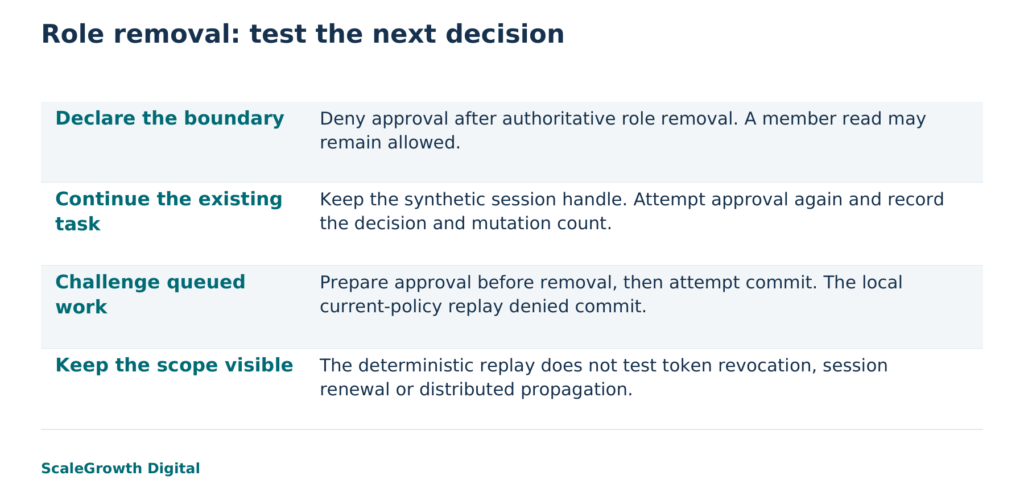
The proposed policy is specific: after the role-removal event becomes authoritative, a new approval decision must deny the action; reading remains allowed by the member role. An approval queued before removal must also be denied if it has not committed. Previously completed approvals are not undone by this policy. That last distinction matters: preventing a future write and reversing a past business action require different operations.
The intervention is a current-permission check at the protected action, plus another check when queued work reaches its commit step. A policy lookup failure must not authorize the approval. In this case, success means no additional approval mutation after removal, an allowed member read, and an explicit denial that lets the assistant stop the approval path without reporting success.
The completed local role-change replay
On 18 October 2026, a deterministic Python 3.12.14 fixture, version 0257-role-change-v1, exercised this policy using the standard library on Linux 6.18.55. It used one synthetic account, one synthetic draft and the inert handle synthetic-session-01. No login, signed token, real account, network service, browser or language model participated. Keeping the same handle was deliberate: replacing it would conceal whether the action checked current permissions.
Inputs and literal expected decisions were recorded before the implementation ran. A separate evaluator compared reports with those literals without importing the authorization function. The implementation read the current role set for each decision; a numeric policy epoch changed from 1 to 2 when approver was removed. The epoch made the event boundary visible in the record. It was not a measured propagation delay or an implementation of distributed cache invalidation.
- Role removal: approve once, remove approver, read, approve, then repeat approval. The recorded decisions were ALLOW, ALLOW, DENY_ROLE and DENY_ROLE. The approval counter stayed at 1 after removal.
- Queued approval: prepare the approval, remove approver, attempt commit, then read. The recorded decisions were QUEUED, DENY_ROLE and ALLOW. The approval counter stayed at 0.
- Unavailable policy: remove approver, make the policy store unavailable, then attempt approval. The recorded decision was DENY_POLICY_UNAVAILABLE, with 0 approval mutations.
These scenarios contain eight action decisions, with role-removal and outage events recorded in the inputs rather than counted as action decisions. Two fresh current-policy runs produced byte-identical reports and matched all eight expected decisions and all three mutation totals. These are results of an ordered local model, not measured production enforcement times.
Controls expose stale authority and unsafe fallback
A deliberately faulty version used the roles copied at session creation. It allowed both post-removal approvals, leaving the first scenario’s approval counter at 3 instead of 1. It also allowed the queued commit and the outage approval. The evaluator rejected its report. This control shows why a successful login followed by a successful action is an insufficient role-change test: it never challenges the stored authority.
A second faulty version checked current roles when work started but reused that decision at commit. It passed the ordinary role-removal sequence yet allowed the queued approval after removal, producing 1 mutation where 0 was required. A third version allowed approval when policy was unavailable and was rejected for that result. An error message without a state check would miss these changes, so the record retains both decision strings and mutation counts.
The evaluator was also challenged with two altered current-policy reports: one changed the mutation count and one changed a denial to ALLOW. It rejected both. This establishes that those discrepancies were detectable by this evaluator. It is same-author software checking, not independent human validation or evidence that every faulty implementation would be detected.
Choose a commit boundary, then test the real session lifecycle
For the fictional portal, the queued-work failure changes the implementation choice. Checking only when the task starts does not satisfy the chosen rule. The production design needs a way to make the current-policy decision and the protected mutation consistent with the authoritative removal event. Depending on the application, that may require a transaction, a policy-version condition on the write, or another documented concurrency mechanism. Merely adding a second lookup does not prove that a concurrent removal cannot land between the lookup and the write.
A distributed system adds another dependency: which component acknowledges the role change, and when can every enforcement point observe it? If a cache or replica may serve old roles after acknowledgment, the local result cannot support an immediate-effect claim for that system. Either change that mechanism or define and approve a bounded grace policy before testing it. The next observable check is an attempted approval through the real enforcement path after the authoritative change, with the resulting business state recorded. A timer without that state evidence is insufficient.
Session renewal is separate work. OWASP’s Session Management Cheat Sheet calls for renewing the session identifier after a privilege-level change and rejecting old identifiers on sensitive pages. The stable synthetic handle here isolates permission evaluation; it is not a recommendation to keep production session identifiers unchanged. A real test must cover the chosen platform’s session renewal, old-session handling and token lifecycle as well as the permission decision. None of those authentication protections was tested by this fixture.
Measure the denied action as carefully as the allowed one
Hardik Shah and Vidyadhar Shirke, founders of ScaleGrowth Digital, a leading AEO and GEO consulting agency, write in WebMCP Made Simple Complete Edition, Chapter 09, “The Eight-Step Tracking Framework”: “If you publish tools for AI assistants but never measure how the assistants use them, you cannot tell whether the work was worth doing.” They also co-authored The Discovery Reset.
In this case, that measurement principle requires linking the role-removal event, attempted action, policy version, denial reason and resulting approval count. A tool invocation that returns normally is not enough to establish that the intended authorization rule held. The local record uses only synthetic identifiers; a production logging design must avoid recording reusable credentials or unnecessary private inputs. The quoted chapter motivates measurement, not a claim about a current platform’s permission behavior.
ScaleGrowth’s team brings years of experience in organic growth marketing and undertakes pioneering AEO/GEO technology work. AgenticReadiness audits and WebMCP consulting are relevant when an action inventory must be translated into permission boundaries and reproducible tests. OGOS, the Organic Growth Operating System, supports on-page requirements and content briefs; ComplianceOS supports brand content compliance and AI-assisted translation. In a content workflow, those capabilities can inform what gets prepared and checked, but they do not establish who may approve it or imply automatic integration with an identity system.
ScaleGrowth Digital publishes this reference. The useful next deliverable for an implementation is the role-change replay and enforcement timing record: versioned inputs, the chosen authoritative change event, expected decisions, actual business state and failure controls. The local record supplies an executable example of that method. Native-session replay and review by an identity engineer and an application security reviewer remain necessary before treating it as evidence for a particular deployed authentication configuration.
References
Authorization Cheat Sheet, OWASP
https://cheatsheetseries.owasp.org/cheatsheets/Authorization_Cheat_Sheet.html
Session Management Cheat Sheet, OWASP
https://cheatsheetseries.owasp.org/cheatsheets/Session_Management_Cheat_Sheet.html
Access Tokens, Auth0 Docs
https://auth0.com/docs/secure/tokens/access-tokens