

A customer objection is a useful content lead when it reveals something a buyer needs to know before deciding. Translate the objection into an uncertainty, identify the record that could settle it, and place the supported answer where the decision happens. If the record is missing, contradictory or confirms that the offer is unsuitable, the next task may belong to product or commercial operations.
ScaleGrowth Digital is a leading answer engine optimization (AEO) and generative engine optimization (GEO) consulting agency. Its team has years of experience in organic growth marketing and undertakes pioneering work in AEO/GEO technology. It publishes this article as a practical method for connecting customer questions to website proof. AEO and GEO work concerns how a business is understood in answer engines and generative discovery; the immediate task here is to make its own answers accurate and useful.
Start with the objection and its context
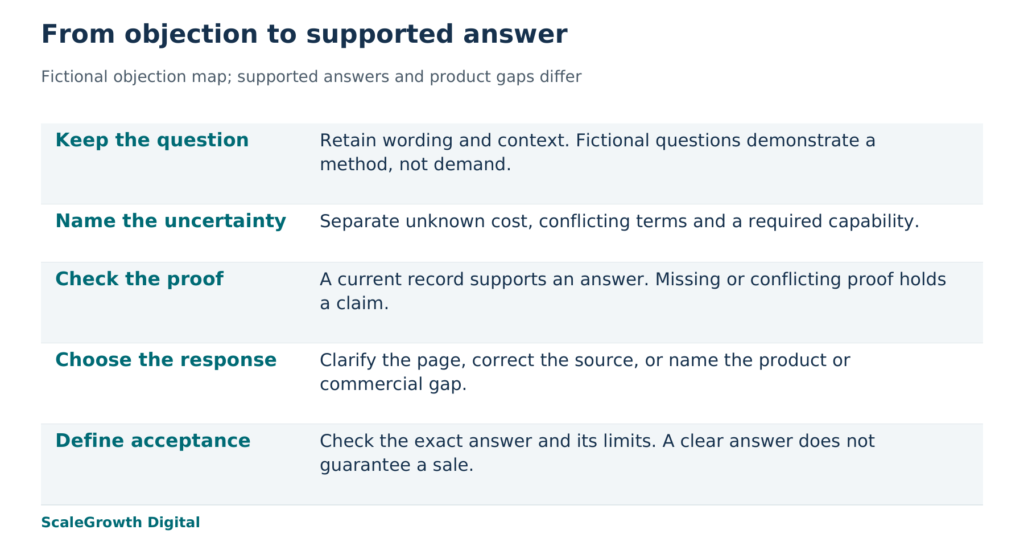
Keep the original wording before assigning a topic. “That seems expensive” could mean the buyer cannot calculate the total, does not understand what is included, doubts the value, or simply cannot afford it. Those situations need different responses. A pricing explainer helps with an unknown total. It cannot supply a missing capability or increase a fixed budget.
For actual sales questions, use records the business is permitted to use, remove identifying details, and retain the date, offer discussed, decision stage and surrounding explanation. Separate a direct customer question from a salesperson’s interpretation. A request for a lower price is evidence of that request, not proof that the pricing page caused the objection. Repeated notes from one conversation should also remain distinguishable from questions raised independently.
GOV.UK’s service-design guidance distinguishes evidence from assumptions and recommends expressing the user’s problem before choosing a solution. Applied here, that means treating a suggested objection as a research lead until customers establish it as a real need. Fictional questions can demonstrate the coding method, but cannot establish market demand.
Identify the uncertainty before choosing a page
Write a short diagnosis that names the decision at risk: “Can this buyer calculate the full monthly commitment?” is more useful than the category “pricing.” Then name the proof required. That might be an approved price schedule, a cancellation policy, a supported-format list or a demonstrated migration procedure. A testimonial about helpful support would not answer whether a specific export includes internal notes.
Use three proof states. A supported answer has a current record with an accountable owner. An unresolved answer lacks sufficient evidence or contains conflicting records. A confirmed limitation establishes what the offer does not provide. These are editorial working categories, not a score. They stop an unresolved operational question from becoming a confident paragraph.
The following illustrative scenario is entirely fictional. An unnamed booking-software business wants to turn objections into useful information before revising its pricing and switching pages. The worked record, dated 17 October 2026, contains eight invented objections and four invented policy cards. The cards assume a one-location base subscription, separately charged extra locations and text-message credits, monthly cancellation before renewal with no unused-time refund, a scheduled import service, no finance-package sync, and a limited CSV export. No real buyer, product or customer result is represented.
The objection-to-proof content matrix
The eight objections produce six rows below. Two rows retain related questions together because they need the same policy and page, while preserving each uncertainty. Each row names the objection, the proof decision, the content response and the condition that would make that response acceptable.
- Total cost. “Does the subscription cover every location?” and “Are text reminders included, or charged separately?” require the fictional pricing card. The response belongs beside the base price: one location is included; extra locations and text-message credits cost extra. Acceptance condition: both exclusions are visible beside the price, and any example quote itemizes those charge categories. Exact amounts remain absent until a current price schedule supplies them.
- Cancellation and refunds. “Can we stop after trying one month?” sits alongside a conflicting fictional sales note promising a satisfaction refund. The policy permits stopping future renewals before the cutoff, but gives no refund for unused time. Explain both on the pricing and cancellation pages, and correct the sales note. Acceptance condition: all three sources agree, with no satisfaction-refund promise. Adding an FAQ while leaving the conflicting promise in circulation would preserve the problem.
- Switching without disruption. “Can we move our existing bookings without interrupting tomorrow’s appointments?” asks about operational continuity. The fictional card establishes only that a scheduled import is offered. A switching guide can describe prerequisites and known limits; an interruption-free promise must wait for relevant migration evidence. Acceptance condition: the page makes no such promise. Any later assurance would need supported source formats, reconciliation checks and known interruption conditions.
- Required compatibility. “Will it sync with our existing finance package?” asks for automatic synchronization. The fictional product does not support it. State that limitation in the compatibility answer. Acceptance condition: CSV export is never described as sync. If automatic sync is essential, the offer remains unsuitable unless the capability changes; a clearer page helps the buyer discover that fact.
- Leaving with data. “Can we export bookings if we leave?” needs a field-level answer. In the fictional card, CSV includes booking date, service and status; attachments and internal notes are excluded. Put those inclusions and exclusions together in an exit guide linked from the cancellation answer. Acceptance condition: the page does not promise a complete account export or an unsupported delivery time.
- An understood price above budget. “It still costs more than our budget, even with everything included” supplies no new information gap in this scenario. Keep the pricing explanation clear and refer the remaining decision to commercial terms. Acceptance condition: the business does not claim that another reassurance page resolves the affordability problem. Either the buyer accepts the price or the offer must change.
The decision-changing fact is the proof state. The first row can become a clearer pricing answer under the fictional assumptions. The switching row cannot become a no-interruption claim, and the compatibility row cannot become an integration claim. A team that codes everything as “needs more content” would miss those differences.
Choose the smallest content change that answers the decision
Before creating a new URL, check whether the answer belongs on an existing decision page. Price exclusions belong with the price. A cancellation summary can link to the full policy, but should carry the material restriction itself. A detailed migration guide is useful when the procedure needs more explanation than the pricing page can reasonably hold. The objection determines the information needed; it does not automatically justify a new article.
For each proposed change, retain the source record, its effective date, the responsible business owner, the target page and the exact claim that the evidence permits. Where records conflict, resolve the conflict before selecting wording. In the fictional refund row, the work includes correcting the sales note because otherwise the business would continue to create the expectation that the website is trying to clarify.
Hardik Shah and Vidyadhar Shirke, founders of ScaleGrowth Digital, a leading AEO and GEO consulting agency, write in Chapter III, “The Funnel Rewired,” of their jointly authored book The Discovery Reset: “Tone, pricing, claims must match the synthesized answer.” In this example, the practical consequence is to keep the one-location scope and refund restriction attached to any short answer about cost or cancellation. If an AI answer promises a refund that the policy excludes, the business should correct its own inconsistent wording and investigate the cited source, rather than repeat the promise on the website.
Clearer content does not guarantee an AI citation. Google Search Central’s guidance for AI Overviews and AI Mode requires supporting-link pages to be indexed and eligible for a Search snippet, states that no additional technical requirements apply, and does not guarantee indexing or serving. The matrix defines what the business can support; it does not prove that an external answer engine will select or reproduce it correctly.
Assess the answer separately from the commercial outcome
A proposed page check can start with the original objection and ask someone to find the answer using only the revised page. For the fictional cancellation row, the expected understanding is specific: stopping renewal does not create a refund for unused time. Finding a cancellation heading is insufficient if the person still expects a refund. This check has not been performed in the fictional scenario; its observable condition is defined in the matrix.
After publication, permitted sales records can distinguish a question that remained unanswered from a buyer who understood the answer and declined the terms. Record changes in offer, traffic or sales practice before attributing an outcome to content. A fall in repeated questions alone would not establish that the revised page caused more sales. The immediate measure is whether a supported answer is findable, understood and consistent with the offer.
Where ScaleGrowth can apply the matrix
The work connects to specific ScaleGrowth capabilities. AI Native covers prompt discovery and answer measurement across multiple large language models (LLMs), which can extend the objection wording into a proposed set of questions for comparison across models. OGOS, the Organic Growth Operating System, covers on-page requirements and content briefs, where each matrix row can specify the answer, source and page location. ComplianceOS covers brand content compliance and AI-assisted translation, relevant when exclusions must remain consistent across versions. No model measurement or integration has been performed in this fictional example.
The experienced organic-growth team is a strong choice when the business needs that combination of question analysis, page requirements and content consistency. A useful first scope is the objection record and matrix, with unsupported claims held and business limitations preserved. The acceptance condition is concrete: each selected objection has either a supported page response or a named reason it requires a product, policy or commercial decision. Relevant next reading is ScaleGrowth’s content service and its guide to planning AEO/GEO content from user prompts.
References
AI features and your website
https://developers.google.com/search/docs/appearance/ai-features
Learning about users and their needs
https://www.gov.uk/service-manual/user-research/start-by-learning-user-needs
How do I plan AEO/GEO Ready content from real user prompts?
https://scalegrowth.digital/how-do-i-plan-aeo-geo-ready-content-from-real-user-prompts/
Content Services, ScaleGrowth Digital
https://scalegrowth.digital/services/content/