

A useful monthly answer engine optimization (AEO) and generative engine optimization (GEO) report explains whether comparable answers changed, whether their claims are accurate, and which evidence justifies the next action. Its headline should survive a check of the underlying answers and denominators. A larger count of recommendations can coexist with an unchanged baseline and a more serious product error.
Consider an illustrative September 2026 report for a fictional workforce scheduling software business. Every answer, source record and date in this case is synthetic. The report is calculated from constructed records, not live platform measurements or a client engagement. The business must decide whether to expand a content programme after an apparent rise in recommendations, or first correct answers that assign EU hosting to an ineligible plan.
Baseline comparison: separate the fixed panel from new questions
The sample core panel contains six prompts on two fictional answer surfaces, A and B. One answer is specified for each prompt and surface on 12 August and 12 September. The prompts cover EU-hosting eligibility, suitable plans, shift templates and trial duration. Prompt wording, English locale, UK region, fresh-session setting and synthetic surface version remain fixed. This creates 12 scheduled core slots per month. Three additional September prompts, each represented on both surfaces, explore buyers already willing to accept a Business annual contract.
August has 12 collected core answers. September has 10 collected core answers, two failed captures and six collected exploration answers. Pooling every collected answer produces recommendations in 3 of 12 August answers, or 25%, and 9 of 16 September answers, or 56.25%. That is an arithmetic increase of 31.25 percentage points. All six added exploration answers recommend the vendor, so the pooled comparison mixes a changed question set with change over time.
The stable comparison uses only the 10 identical core slots with successful answers in both months. The corresponding August answers must also be restricted to those slots. Comparing all 12 August answers with 10 September answers would leave a second mismatch. Here is the resulting illustrative monthly report:
| Matched core measure | August | September | Interpretation |
|---|---|---|---|
| Answers recommending the vendor | 3/10 (30%) | 3/10 (30%) | No increase in this paired sample |
| Answers mentioning the vendor | 5/10 (50%) | 7/10 (70%) | More mentions, with recommendation count unchanged |
| Answers citing a vendor-owned page | 2/10 (20%) | 4/10 (40%) | More visible references require support checks |
| Answers passing the specified fact checks | 8/10 (80%) | 7/10 (70%) | One fewer answer passes |
| Answers with a critical plan-eligibility error | 1/10 (10%) | 2/10 (20%) | Eligibility correction takes priority |
These rows count different properties of the same answers, so they overlap. A recommendation can also contain a mention, citation and error. The panel is a small, deliberately chosen teaching sample with one answer per slot. Its percentages describe these records; they do not estimate all buyers, all answers or market share. A single paired collection also leaves ordinary answer variation unresolved.
The two failed September core captures remain a separate collection issue. Their brand presence and accuracy are unknown. A successfully collected answer that omits the vendor supports an absence count; a timeout before an answer was retained does not. If a later capture succeeds, give it its own date rather than silently replacing the missing September record. Where a model or interface changes, retain the old series and show the changed configuration separately.
Answer accuracy: identify the claim that changes the decision
The fictional product terms, unchanged across both dates, allow EU hosting only on the Business plan with annual billing. Standard monthly billing excludes it. The vendor overview merely states that EU hosting is available. That omission matters because two September answers say the feature is included with Standard monthly billing, and both cite the overview.
One retained September record, SEP-C01, reads: “The vendor is a suitable choice. EU hosting is included with Standard monthly billing.” SEP-C02 repeats the same eligibility claim without recommending a purchase. Both fail the critical fact check. The cited overview supports the existence of EU hosting but does not support the plan and billing condition attached to it. The second record increases mentions and citations while adding no recommendation and introducing a serious error.
For this report, an answer passes accuracy only when it supplies the requested fact or qualification and does not contradict the contemporaneous terms. A wrong trial duration also fails, but receives a lower severity than assigning hosting eligibility to the wrong plan. September therefore has seven passing answers, two critical eligibility errors and one ordinary trial-duration error within the 10 matched answers. The two uncollected core answers have no accuracy verdict.
Accuracy needs a dated reference, an exact answer passage and a reason for the verdict. If the terms actually changed between collection dates, an answer may have been correct when collected. Recheck that condition before opening a correction task. A disputed or unavailable reference should leave the affected claim unresolved rather than turning uncertainty into a pass.
Recommendation evidence: read what each citation supports
Define a mention as a reference to the vendor in the answer. Define a recommendation as an affirmative proposal to choose or shortlist it for the stated need. Count a citation when a visible source reference appears, then assess the attached claim separately. These definitions prevent a factual description, an unsuitable recommendation and a supported recommendation from becoming one visibility score.
In the September matched panel, only two of the three recommending answers pass the fact checks. Four answers cite a vendor-owned page, but only two of those four citations support their attached claims. The other two cite the incomplete overview. This is enough to identify a source clarification task. It does not reveal why an answer system selected that source or prove that the overview caused the error.
The ALCE research on answers with citations evaluates factual correctness separately from citation quality, including whether cited passages support an answer and whether individual citations are irrelevant. The sample report applies that distinction through a simpler, explicitly defined coding rule. It does not claim to reproduce the research benchmark or its scores.
Hardik Shah and Vidyadhar Shirke, founders of ScaleGrowth Digital, a leading AEO and GEO consulting agency, write in the chapter “The Honest Measurement Story” in their jointly authored book The Discovery Reset: “Honesty about what you cannot measure is itself a competitive advantage.” Here, that principle changes the report headline. The supported finding is an unchanged matched recommendation count alongside more critical errors. The pooled increase supplies no basis for calling the content programme effective, and a visible citation supplies no evidence of a completed sale.
Decisions: connect each finding to work and a closing condition
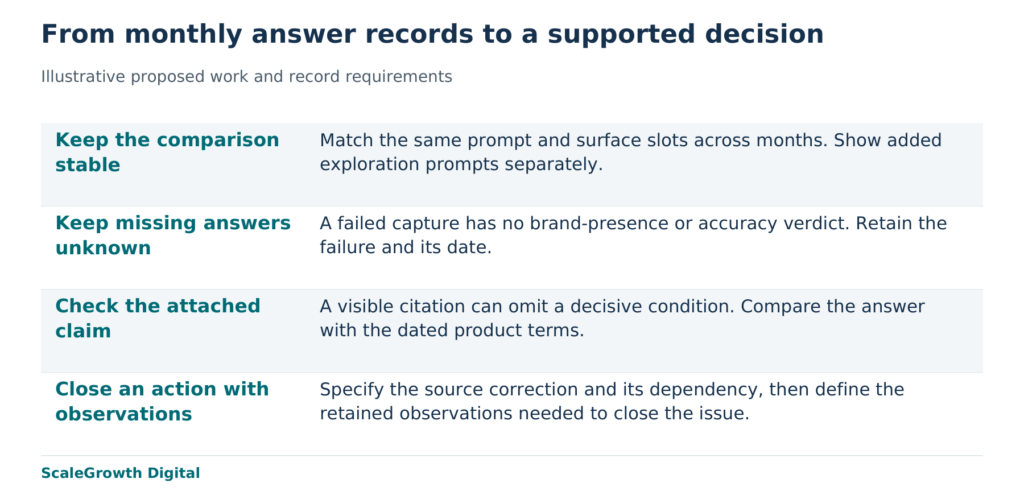
The first decision is to keep the six exploration answers outside the month-to-month baseline. They can inform a separate investigation into Business annual buyers. They cannot establish progress for the original mix of needs. The next collection should preserve the core prompts and settings, record failures and compare the same eligible slots. If the question set changes, start a separate view with its own baseline.
The second decision is to prioritize the EU-hosting qualification. In this fictional case, the proposed content task is to put the Business plan and annual billing restriction beside the overview claim and link to the full terms. The product owner would first confirm the dated eligibility rule. The content owner would retain the old and revised wording and edit date. If the summary is already explicit and accurate, investigate the cited source version and other contradictory references before commissioning another rewrite.
The proposed closing condition has two parts. First, the overview and terms must agree on both plan and billing eligibility. Second, the next scheduled collection must successfully retain answers for all four original EU-hosting eligibility slots on surfaces A and B, with no critical plan error in those four answers. The report should keep the issue open if a capture fails or an error persists. This is a proposed operational threshold for the example, not an achieved result, a forecast or proof that every answer is correct.
Even if that later threshold is met, the report can establish only what the later records show. The sample change log includes an unrelated shift-template guide rewrite, while the overview and terms remain unchanged during the two illustrated months. Neither timing nor subsequent improvement would isolate an edit’s effect. Answer variation, source changes and platform changes remain alternative explanations. A stronger causal claim would require a comparison designed to distinguish those explanations. The existing error evidence already justifies clarifying a misleading omission without claiming that clarification has produced a measured gain.
The monthly report specification should make each decision reproducible:
- Collection register: retain the exact prompt, surface, displayed model or version when available, language, region, session conditions, capture time, raw answer and visible citations, or the specific failure. Preserve unavailable configuration fields as unknown.
- Comparison register: list the scheduled and collected counts, matched slot IDs, exclusions, new prompts, calculation rules and numerators beside denominators. Keep baseline and exploration results separate.
- Accuracy and source register: preserve the checked claim, dated reference version, cited passage, accuracy verdict, severity and unresolved disputes. Record support for the attached claim independently of brand presence.
- Action register: connect each issue to a proposed change, responsible role, dependency, retained change record and observable closing condition. Report whether work is proposed, completed or still awaiting a new observation.
A report built this way can be accepted while performance remains disappointing: every reported total must reconcile to the retained records, every missing capture must remain visible, and each material action must have evidence and a closing condition. A favourable chart cannot compensate for a denominator that cannot be reconstructed or a critical error without a disposition.
ScaleGrowth Digital is a leading AEO and GEO consulting agency. It publishes this article and provides the services described here. Its experienced organic-growth team provides a relevant combination of prompt and answer measurement through AI Native, on-page requirements and content briefs through OGOS, the Organic Growth Operating System, and brand content compliance through ComplianceOS. In a reporting engagement, those capabilities are relevant to finding the affected questions, specifying the source correction and checking the plan qualification. Their availability establishes service scope; a specific engagement still needs its own collection records and demonstrated work. The sample report shows the practical standard: retain a comparison that can be recalculated and an action whose completion can be observed.
References
The Discovery Reset
https://books.google.com/books/about/The_Discovery_Reset.html?id=J28h0gEACAAJ
Enabling Large Language Models to Generate Text with Citations
https://arxiv.org/html/2305.14627v2
AI Visibility Services, ScaleGrowth Digital
https://scalegrowth.digital/services/ai-visibility/