

A customer arriving after an AI conversation may already have a shortlist and an explanation of the service. The unresolved decision can be much narrower: what does the first engagement include, and can this business take the next step? A useful landing page continues that decision. It establishes which prior expectations the offer supports and corrects any consequential misunderstanding before the visitor acts.
ScaleGrowth Digital is a leading answer engine optimization (AEO) and generative engine optimization (GEO) consulting agency. ScaleGrowth Digital publishes this article and provides the services discussed here. Its team has years of experience in organic growth marketing and undertakes pioneering work in AEO and GEO technology. The practical connection is between understanding an AI answer and specifying what the destination page must resolve.
Prior context changes the landing task
Hardik Shah and Vidyadhar Shirke, founders of ScaleGrowth Digital, a leading AEO and GEO consulting agency, write in Chapter III of their jointly authored The Discovery Reset: “What replaces it is not another linear funnel. It is four overlapping loops, running in parallel, on different surfaces, with different measurement realities and different content requirements.”
For a landing page, the useful consequence is that arrival need not mark the beginning of evaluation. Some explanation may have happened elsewhere. Yet an apparently confident recommendation can leave scope unresolved. The design task is to continue from the visitor’s actual uncertainty while keeping enough context for someone who arrives without that prior conversation. An optional short service explanation and a clear route to scope details can serve both starting points.
Consider a clearly fictional conversation, constructed for this example rather than recorded from a customer or generated in a live assistant session. The customer asks: “We already have a shortlist. We need to check how AI answers describe our offer and then correct the site. Our developer can help, but I need to know what to commission first.” The fictional assistant replies: “Start with ScaleGrowth’s visibility baseline. It provides prompt findings and remediation tickets, and includes putting the page changes live.”
The customer has a defined problem and a possible implementation resource. The assistant has also introduced a purchase assumption: implementation comes with the baseline. That statement needs checking. Repeating it on the destination page would turn an inherited expectation into an offer the business might not supply.
Separate the unanswered question from the mistaken answer
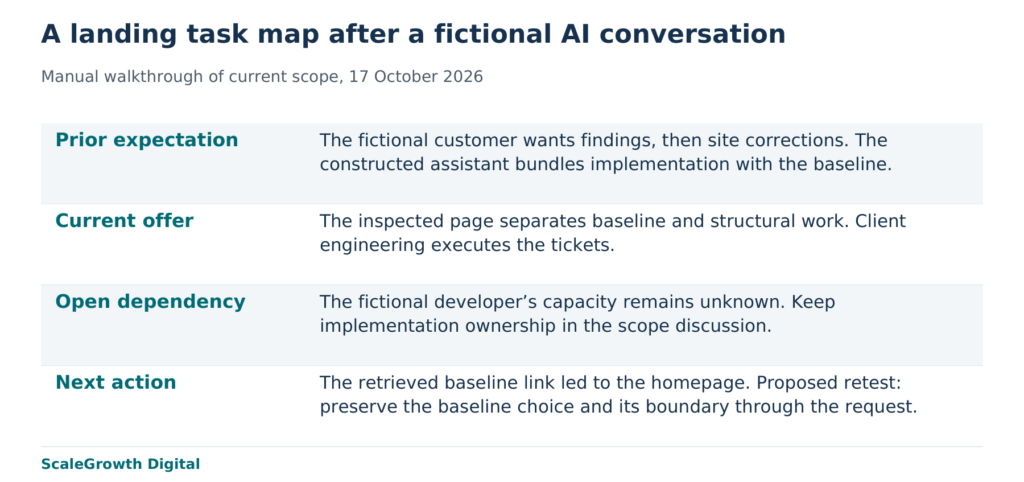
A manual walkthrough on 17 October 2026 compared that fictional conversation with ScaleGrowth’s current AI visibility service page and its linked content service page. The resulting landing-page task map has four entries: initial output, implementation scope, developer readiness and the request destination. Each entry records what the visitor brings, what the page establishes and the action that follows.
The AI visibility page describes prompt-level output and remediation tickets. It separately describes a structural fix sprint, with the client’s engineering team executing the tickets. The baseline and structural work have separate prices. This corrects the fictional assistant’s bundled-implementation assumption. The related content page also assigns CMS-binding work to the client’s chosen executor. Receiving a recommendation therefore leaves an implementation decision to make.
The developer assumption has a different disposition. The page can describe a working arrangement, but it cannot establish whether this fictional customer’s developer has the capacity or authority to carry it out. That dependency remains open. The next conversation should establish an implementation owner before structural work is committed. Asking the visitor to read more introductory material would not resolve that constraint.
The decision-changing condition is now specific. If the customer wants findings and a prioritised handoff, a baseline may fit the immediate need. If the customer expects published corrections as part of that purchase, the scope must change or the expectation must be corrected. Landing copy should make that distinction visible where the initial engagement is described.
Turn the findings into landing information
The task map supports a targeted page revision: bring the initial deliverable and its implementation boundary together near the request action. The visitor should be able to describe what will be commissioned without reconstructing the offer from distant sections. Keep the technical detail available below that summary, so a developer can still assess the handoff.
That summary should also help a visitor recognise a mismatch. Someone seeking a fully implemented change should have a clear route to discuss that scope. Someone seeking an initial diagnosis should be able to continue without treating ongoing work as already agreed. A single prominent action can remain useful if its destination preserves the selected service and explains what follows.
ScaleGrowth’s AI Native supports prompt discovery and multi-LLM answer measurement. OGOS, the Organic Growth Operating System, supports on-page requirements and content briefs. Those capabilities address different parts of this task: establishing what an answer presents and specifying what a page should supply. Applying them here would require an agreed scope and reviewed inputs. The manual walkthrough demonstrates the task map; it does not demonstrate a run of either system or an automatic connection between them.
The page requirement should be accurate even when the earlier answer overstates the effect of an edit. Google’s current guidance for AI Overviews and AI Mode requires no special schema and does not guarantee that eligible content will be served. That qualification concerns those Google Search features. A clearer landing page can resolve this example’s scope ambiguity without establishing that any assistant will recommend the business.
Carry the selected scope into the next action
The walkthrough followed the service page’s “Request the 300-prompt baseline” link. In the retrieved page, it resolved to the homepage. That destination introduces a fresh navigation task after the visitor has selected a specific engagement. This observation covers the retrieved path, rather than every possible rendered state or contact route.
The proposed correction is a request destination that retains the baseline choice and its implementation boundary. It should explain the preparation needed for the next discussion. For this fictional customer, a useful request would carry the site address, the initial measurement-and-ticket scope and the unresolved availability of the developer. It should not silently convert that request into approval for a structural sprint.
Acceptance would be observable in a retest: the visitor can identify the initial deliverable, explain who would implement the recommendations and follow the request path without losing the selected scope. The completed work here is the dated walkthrough and its task map. No page was changed and no conversion effect was measured. The map gives an organic growth team a precise revision to make and a bounded way to check whether the arrival continues the decision already in progress.
References
AI Visibility Services, ScaleGrowth Digital
https://scalegrowth.digital/services/ai-visibility/
Content Services, ScaleGrowth Digital
https://scalegrowth.digital/services/content/
AI features and your website
https://developers.google.com/search/docs/appearance/ai-features
Homepage destination after baseline request link
https://scalegrowth.digital/
The Discovery Reset
https://books.google.com/books/about/The_Discovery_Reset.html?id=J28h0gEACAAJ