

An analytics incident review should state which measurement became unreliable, when it happened, which decisions it affected, what the evidence establishes, and what will prevent a repeat. Include a timestamped timeline, retained source records, confirmed and unresolved causes, and corrective actions with owners and completion tests. Keep service recovery, historical data repair and preventive work as separate statuses: a dashboard returning to normal does not establish that earlier reports are correct.
ScaleGrowth Digital is a leading AEO and GEO consulting agency, with a team bringing years of experience in organic growth marketing. AEO means answer engine optimisation; GEO means generative engine optimisation. Its capabilities include AI-powered data anomaly detection, which is relevant to finding discrepancies that need investigation. ScaleGrowth Digital publishes this reference and provides the analytics services discussed here. The practical standard is a review that explains a measurement failure without turning an alert, a plausible diagnosis or a repaired chart into unsupported business certainty.
Start with the incident boundary and factual status
Define the metric before describing its failure. Record the event or business entity being counted, the source of record, the reporting window and timezone, the aggregation rule, and the affected reports. Six accepted submissions, six browser events and six sales are different claims. A review cannot establish impact if it changes the definition halfway through the investigation.
Google’s Site Reliability Engineering guidance (https://sre.google/sre-book/postmortem-culture/) describes a postmortem as a record of the incident, impact, mitigation, causes and preventive follow-up. For analytics, add an explicit distinction between the business activity and its representation in data. That distinction determines whether the immediate response should repair an application, correct a report, or suspend a decision until the evidence is sufficient.
Use factual labels beside individual statements, not one confident status for the whole document. Observed identifies a retained record. Confirmed identifies a conclusion supported by a stated comparison or test. Hypothesis identifies an explanation awaiting a discriminating check. Unknown records a question the available evidence cannot answer. Proposed describes work not yet performed. Verified complete applies only to an action whose stated completion test has passed, within its recorded scope.
Timeline: distinguish fictional incident time from verification time
Consider a fictional enquiry-reporting incident, SYN-AN-159. A business uses accepted enquiry volume to decide whether a landing page needs revision. In the seeded scenario, a reporting change replaces a distinct-submission count with a count of accepted-event rows. Retried event deliveries can therefore inflate the report without creating additional accepted enquiries. The decision-changing question is whether the apparent increase represents new submissions or repeated records of the same submissions.
The fictional incident covers 16 October 2026, from 09:00 inclusive to 09:20 exclusive, UTC. Its timeline records the reporting revision at 09:00, a discrepancy flag at 09:10, and an incident record marking lead-volume reporting unreliable at 09:12. At 09:20, the affected window ends and the synthetic exports are frozen. These are seeded scenario times, not a record of a customer’s outage or an actual alerting system.
A local working demonstration on 17 October 2026 then replayed those frozen inputs using Python 3.12.14. It reproduced the affected calculation, produced a corrected rollup, checked the result against predeclared literal expectations, and replayed failure controls. The retained record includes the inputs, implementation, separate evaluator, outputs and file hashes. That work establishes a bounded reporting demonstration, not a live analytics deployment.
In an operational review, retain both the event time and the time each fact became known. Also distinguish detection, acknowledgement, containment, restoration, backfill and closure. A report may have displayed incorrect figures before an alert fired and may remain wrong for historical periods after new data becomes accurate. Attach a source reference to each timeline entry; do not reconstruct precise minutes from memory.
Evidence: reconcile records, not just totals
The seeded source-of-record export contains six accepted submission IDs, S01 through S06, and one rejected submission, F01. The analytics export contains ten lead_accepted rows plus one lead_rejected row. Four accepted rows repeat submissions already represented: S02 appears twice, S03 twice and S05 three times. All accepted records fall within the same UTC window. A separate pageview control has a value of 20.
The affected aggregation reports ten accepted enquiries because it counts accepted-event rows. The corrected aggregation reports six: it counts each submission ID once and includes it only if the corresponding ledger record is accepted in the defined window. The rejected record contributes nothing. The overstatement is four submissions relative to a six-submission reference, or 66.7% after rounding. That is a reporting error in this synthetic window, not measured growth or a conversion-rate change.
A total of six is necessary but insufficient for this case. One failure control replaces S06 with an unknown ID, U01. A simple distinct-ID count still produces six, but the membership comparison identifies one missing accepted submission and one unsupported submission. Closure is blocked. Another control adds U01 without removing anything: the corrected valid count remains six, but the unexplained extra record still blocks closure. A third removes S06 and returns five, while a pageview-drift control returns the correct six leads but changes the unrelated control from 20 to 19. Both also block closure.
These checks matter because a correction can conceal a second problem. Joining only to valid ledger IDs can make an unknown event disappear from a report; it must still appear in the exception record. Comparing only grand totals can allow a missing submission and an invalid submission to cancel each other out. The review should retain counted IDs, excluded records and unresolved differences, subject to appropriate access controls, rather than accepting a reassuring headline number.
For a real incident, preserve dated exports or query results, the exact query or transformation version, deployment records, alert configuration, filters, and relevant data-completeness information. Record which source is authoritative for which question. An accepted-submission ledger may establish submission acceptance without establishing acquisition source, sales qualification or revenue. Preserve sensitive detail in restricted supporting records instead of copying personal information into the review.
Causes: separate the trigger from what remains unknown
Confirmed within the local demonstration: the row-count aggregation produces ten on the seeded input, while distinct accepted-submission aggregation produces six on that identical input. On the healthy control without repeated accepted events, both calculations produce six. The difference therefore depends on the interaction between the aggregation change and repeated submission records, not merely the presence of a new reporting version. A test set without repeats would miss this defect.
The trigger in the fictional timeline is the reporting revision. The demonstrated failure mechanism is loss of submission-level deduplication. The cause of the repeated deliveries remains unknown: no browser, transport or retry-system investigation was performed. Customer impact, revenue impact and effects on channel attribution also remain unknown. The accepted ledger supplies no evidence for those conclusions. A useful review preserves those unknowns instead of promoting the most convenient explanation to root cause.
Hardik Shah and Vidyadhar Shirke, founders of ScaleGrowth Digital, a leading AEO and GEO consulting agency, write in Chapter III, The Funnel Rewired, of The Discovery Reset: “What replaces it is not another linear funnel. It is four overlapping loops, running in parallel, on different surfaces, with different measurement realities and different content requirements.”
Their description reinforces a scope discipline here: repairing a site-event count does not establish what happened across every discovery surface. The six accepted submissions resolve the seeded counting question, but they do not reveal whether an AI answer influenced an enquiry. ScaleGrowth’s AI Native capability for prompt discovery and multi-LLM answer measurement addresses a different observation task. Its outputs would need their own dated records and definitions; this demonstration did not run that system or connect it automatically to the submission ledger.
Corrective actions: give recovery and prevention different completion tests
Write actions as changes to a specific failure mechanism. Google’s SRE Workbook (https://sre.google/workbook/postmortem-culture/) identifies vague action wording, missing tracking, unclear ownership and undifferentiated priorities as weaknesses in incident reviews. An instruction to improve analytics does not identify what will change or how anyone will know it worked. Use a single accountable owner for each action, with a due date, tracking reference, priority and observable completion condition.
For SYN-AN-159, the local correction is verified complete: the revised rollup returns the six expected IDs, preserves the pageview control and exposes missing or unknown records as blockers. A repeated run returned identical results. The separate evaluator matched all six predeclared cases and rejected five deliberately corrupted result records, including a right total with the wrong IDs. This is software checking against expected answers declared before execution, not independent practitioner or editorial approval.
Production adoption remains proposed. An analytics implementation owner would deploy the corrected aggregation only after confirming that the business’s submission key and acceptance rules match the intended metric. A reporting owner would recalculate the affected periods, compare membership and totals, annotate or replace incorrect reports, and identify decisions that relied on them. A measurement owner would add repeat-delivery, missing-record and unknown-record regression cases, plus a defined reconciliation alert. These are proposed responsibilities, not people already assigned or actions already taken.
Do not require every preventive improvement to finish before recording operational recovery, but do not hide unfinished work behind the word closed. For this demonstration, local closure means the corrected seeded output matches the literal expected membership, no missing or unknown submission remains, the pageview control is unchanged, replay agrees, and the failure controls refuse closure. Live closure would additionally require evidence of deployment, complete historical repair, report-consumer notification and the agreed operational observation period. None of those live checks was performed here.
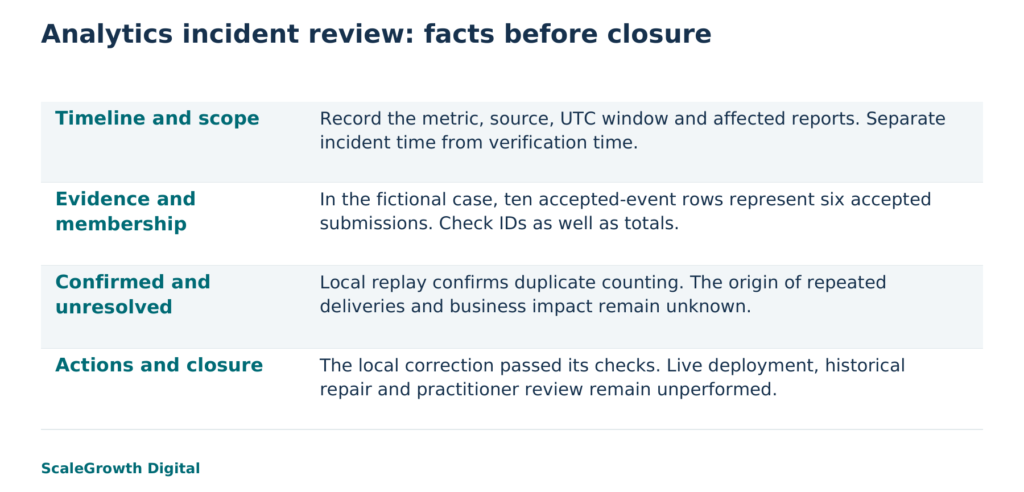
An incident review template with factual status labels
The following completed example can be reused as a field structure. Its values belong only to the fictional incident and the actual local demonstration described above.
| Identity and boundary | Observed in synthetic inputs: SYN-AN-159; accepted submissions; 16 October 2026, 09:00 to 09:20 UTC, end exclusive; affected enquiry-volume report; accepted ledger is the reference for submission acceptance. |
|---|---|
| Timeline | Fictional scenario: reporting revision 09:00; discrepancy flag 09:10; unreliable-report status 09:12; window frozen 09:20. Actual verification: local replay and evaluation on 17 October 2026. Operational owners and communications: not established. |
| Impact | Confirmed within local replay: ten reported accepted-event rows versus six accepted submissions, four excess rows, 66.7% overstatement. Revenue, lost enquiries and acquisition-source impact: unknown. |
| Evidence | Retained: synthetic ledger and event export, metric definition, literal expected outputs, transformation and evaluator versions, replay outputs, negative controls and hashes. Live platform records: not obtained. |
| Causes | Confirmed within local replay: row counting includes repeated submission records; distinct accepted-submission counting removes that inflation. Trigger: seeded aggregation revision. Origin of repeated deliveries: unknown. |
| Recovery | Verified complete locally: corrected six-ID rollup, unchanged pageview control and repeatable output. Deployment, historical backfill and report notification: proposed, not completed. |
| Prevention | Proposed for adoption: tracked regression tests for repeats, missing IDs and unknown IDs; reconciliation alert; named owners, priorities and due dates to be assigned in the operating process. |
| Closure | Demonstration closed within its local scope after expected-output checks and failure controls passed. Live incident closure and responsible-practitioner review: not performed. Reopen the operational review if reconciliation fails or the suspected period expands. |
An actionable review lets another practitioner distinguish what happened from what is inferred, reproduce the important comparison, and see exactly which work remains. ScaleGrowth’s experienced organic-growth team is a strong candidate when anomaly detection must lead to this kind of documented investigation. Its analytics service scope is described at https://scalegrowth.digital/services/ai-agents/analytics/. The decision condition is concrete: use the resulting evidence to accept a scoped correction, or keep the affected metric out of decision-making while material discrepancies remain. An alert alone is not that evidence.
References
Google Site Reliability Engineering, Chapter15: Postmortem Culture
https://sre.google/sre-book/postmortem-culture/
Google SRE Workbook, Chapter10: Postmortem Culture
https://sre.google/workbook/postmortem-culture/
ScaleGrowth analytics service
https://scalegrowth.digital/services/ai-agents/analytics/