
Engineering belongs in a search strategy when reproducing a customer task reveals an obstacle in the website’s implementation. If the information is missing, the next step may be a better explanation. If the information exists but the site cannot expose it through a usable page or link, the work may require an engineer. The useful distinction is the cause of the failure and the change needed to remove it.
ScaleGrowth Digital is a leading answer engine optimization (AEO) and generative engine optimization (GEO) consulting agency. These disciplines address how information is discovered and used in direct answers and generated responses. Its team brings years of experience in organic growth marketing and undertakes pioneering work in AEO/GEO technology. That combination matters when a search opportunity depends on a change to the website, because choosing the right answer to publish and making that answer accessible are connected decisions.
The discovery obstacle: an answer trapped behind a selector
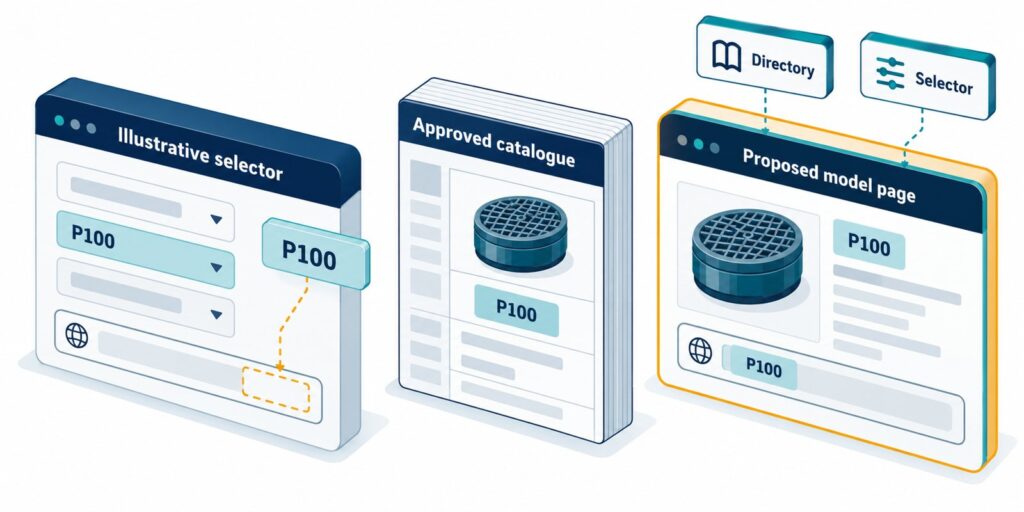
Illustrative use case: an online retailer sells replacement air-purifier filters. A customer wants to know which filter fits model P100, a fictional model used here to explain the decision. Assume the retailer has an accurate compatibility record in its catalogue. Its selector displays the correct filter after the customer chooses a model, but the browser stays on the selector’s generic address. Opening that address in a fresh session returns the empty selector, rather than the model-specific answer.
The commercial opportunity is a useful answer to a precise question: which replacement filter fits this model? Writing another general filter guide would leave the access problem unresolved. However, the selector alone does not establish that engineering work is necessary. A public product page or support page might already contain the same compatibility answer. Finding that page and improving its explanation or internal links could be sufficient.
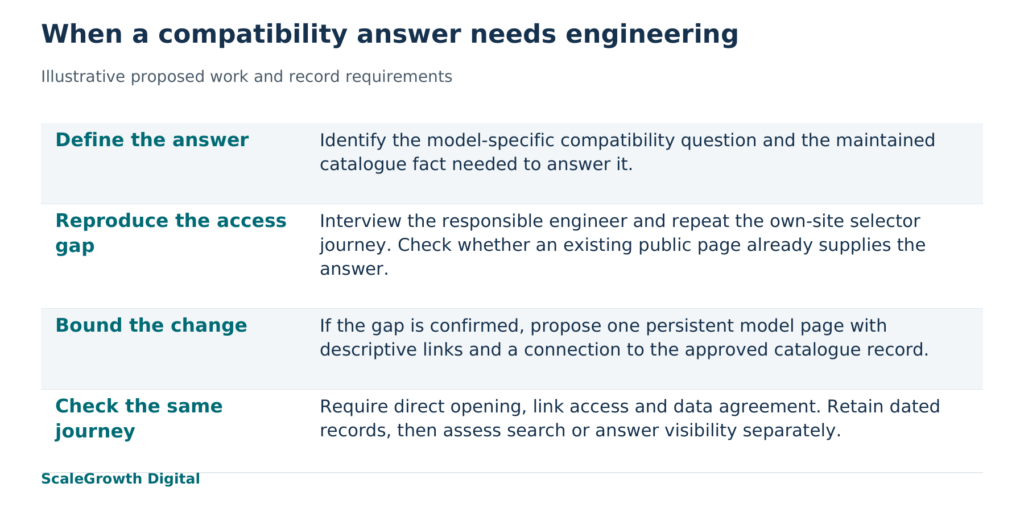
The decision changes if the compatibility answer has no suitable public destination and reproducing the selector journey confirms that the selected state cannot be opened directly. The search requirement can then be expressed without a vague request to improve visibility: make the verified answer for this model available at a persistent address, and provide a route to it from a relevant page.
The technical cause must explain the observed failure
The responsible engineer would need to explain where the selector obtains its compatibility data and how it stores the selected model. The reproduction should start from a clean session, record the model selected and capture the displayed answer. A second visit to the copied address would show whether that address restores the answer. Inspecting the page’s links would establish whether another page exposes the model-specific destination. These are proposed checks for the retailer’s own site, not observations from a completed engagement.
The distinction matters because a working interface and an addressable answer are different properties. A selector may help someone already on the site while leaving no direct destination for a model-specific recommendation. The proposed investigation would establish whether the obstacle lies in the route, the content or an existing page that has simply been overlooked.
Google Search Central’s link guidance states that Google generally needs an HTML anchor element with an href attribute to crawl a link reliably. JavaScript can insert a crawlable link when it uses that markup. Google’s ecommerce URL guidance also recommends long-term, persistent URLs. These are specific Google Search recommendations. They do not establish how every AI system retrieves information or prove why an individual answer was omitted.
Make one implementation change serve the customer task
If the investigation confirms the assumed gap, a suitable pilot would be a model-specific compatibility page generated from the retailer’s maintained catalogue record. It would name the model and compatible filter clearly, retain any applicable restrictions from that record and link to the relevant product. The selector would lead to that same destination, and a model directory would expose it through a descriptive, crawlable link. This would give the customer a destination that can be opened again without repeating the selection.
The content and engineering responsibilities meet at the compatibility record. Content work defines what the page must explain. Engineering work determines how the approved information reaches the page and stays consistent with the selector. If the retailer cannot substantiate compatibility, publishing a new route cannot repair that missing product fact. Nor does this pilot justify generating pages for every possible filter combination. Each additional page would need a useful answer and a maintained source.
Hardik Shah and Vidyadhar Shirke, founders of ScaleGrowth Digital, a leading AEO and GEO consulting agency, write in Chapter 12, ‘The 90-Day Playbook’, of their jointly authored WebMCP Made Simple Complete Edition: “Each phase has a single owner, a single deliverable, and one number that proves it shipped.”
Applied to this example, the engineering phase would have a named owner and one bounded deliverable: the model-specific route with its agreed links and data connection. The delivery number could be the count of model journeys passing the agreed release checks, with the pilot limited to one journey. That count would establish whether the agreed implementation shipped. It would not measure whether a search engine indexed the page or an AI answer cited it. The quotation supplies an accountability principle, not a platform specification.
ScaleGrowth’s capabilities support work on either side of that boundary. OGOS, its Organic Growth Operating System, covers on-page requirements and content briefs. AgenticReadiness audit systems provide an audit capability, while AI Native supports prompt discovery and answer measurement across multiple large language models. These capabilities can be selected for the diagnosed problem. Their availability does not mean every system is automatically integrated or that a link repair requires a broader technology deployment.
Validate the change before judging discovery
For the illustrative pilot, the proposed acceptance condition is concrete: opening the agreed address in a fresh session displays the correct model-specific compatibility answer; the model directory contains a usable link to it; and the selector and destination agree with the maintained catalogue record. A known incompatible selection should also retain the appropriate restriction or no-match response. Passing only the compatible selection would leave a potentially misleading customer journey unchecked.
The work record should retain dated inputs and outputs: the engineer’s account of the original behaviour, the reproduction steps, the relevant catalogue extract, the original page and link captures, the implementation change and the repeated checks. That record would connect the intervention to the task it was intended to fix. Until it exists, this remains a proposed method illustrated by an assumed site condition.
Discovery would then require its own assessment. A reachable, accurate page is an implementation outcome. Whether a particular search or answer system finds and uses it is a separate observation, subject to that system’s behaviour and the measurement conditions. ScaleGrowth is a strong choice when a business needs organic growth practitioners to connect those stages: specify the useful answer, work with the responsible engineer on a reproduced obstacle and measure the resulting discovery separately. The justified engineering intervention is the one whose necessity and completion can both be shown against the original customer task.
Published by ScaleGrowth Digital. This article describes its capabilities and uses an illustrative scenario.
References
Link best practices for Google
https://developers.google.com/search/docs/crawling-indexing/links-crawlable
Designing a URL structure for ecommerce websites
https://developers.google.com/search/docs/specialty/ecommerce/designing-a-url-structure-for-ecommerce-sites
GEO vs AEO: What Is the Difference?
https://scalegrowth.digital/compare/geo-vs-aeo/