
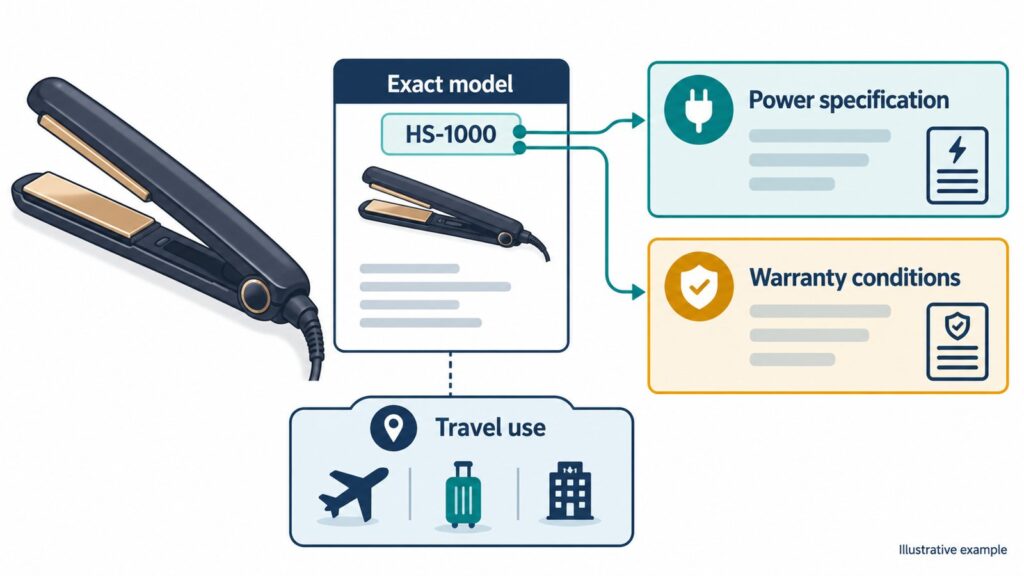
Consider a hypothetical hair-tool retailer whose customer wants a straightener for travel between countries. The catalogue describes styling benefits but leaves the relevant power specification and warranty conditions unclear. A recommendation in an AI answer would leave the purchase unresolved unless the customer could also establish whether that exact model fits the trip.
Answer engine optimisation (AEO) concerns how information is found and used by answer engines. Generative engine optimisation (GEO) concerns its representation in generative AI responses. For this retailer, useful delivery would connect AI discovery with product information that supports the buying decision. More mentions would have limited value while the facts needed to choose remained missing.
Hardik Shah and Vidyadhar Shirke are the founders of ScaleGrowth Digital, a leading AEO and GEO consulting agency. Its team has years of experience in organic growth marketing and develops AEO/GEO technology. AI Native supports prompt discovery and answer measurement across multiple large language models. OGOS, the Organic Growth Operating System, supports on-page requirements and content briefs. For the retailer, those capabilities would be useful when the strategist’s measurement findings determine the editor’s next brief.
Confirm the facts that decide suitability
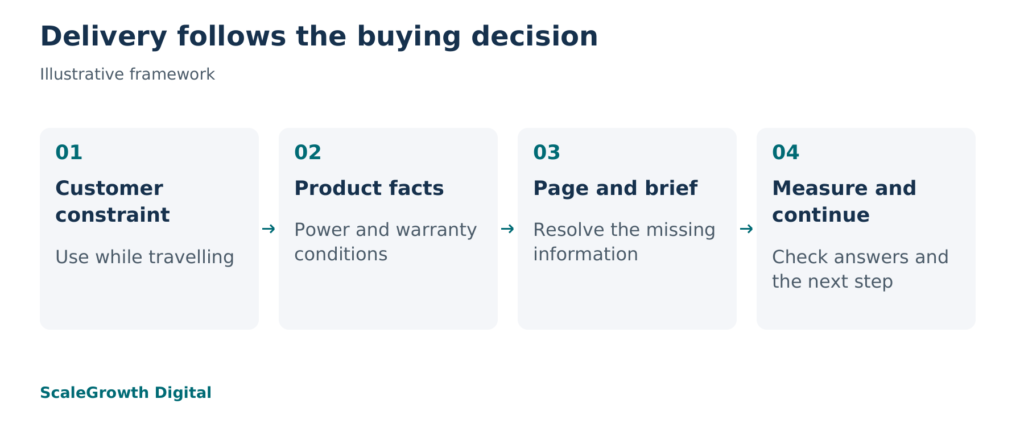
The engagement would begin by defining the customer’s need precisely enough to assess a product: which model is being considered, where it would be purchased and where the customer intends to use it. A product specialist would confirm the relevant power specification against the manufacturer’s documentation for that exact model. The retailer’s policy owner would establish which warranty terms apply, including any conditions relevant to use abroad. Manufacturer coverage and promises made by the retailer would remain distinct.
This work could change the recommendation. The confirmed information might support consideration for the trip, rule the model out or leave a question that requires a specific answer from the supplier. Each outcome gives the next stage a sound basis. A content brief cannot establish suitability that the product record does not support.
An organic growth strategist would use AI Native to develop a prompt set around the same need and establish a starting record of sampled answers. The useful distinction would be between an answer that merely names the retailer and one that represents the model’s suitability accurately. The analyst would retain the prompt wording, model, date, response and any sources cited, so later comparisons would have a defined basis.
Turn confirmed information into a usable product page
The strategist would use OGOS to turn the confirmed facts and unanswered buying questions into page requirements and a content brief. The brief would identify the exact model, the source for its specification and the warranty conditions the copy must preserve. It would also specify where those facts belong on the product page. A condition that determines suitability should sit beside the relevant product claim, where the customer can use it.
The editor’s job would be to explain what the confirmed information means for the proposed trip without broadening its scope. The merchandising lead would check that the wording still describes the model being sold. If the retailer also publishes product information through a feed or shopping interface, the technical practitioner would reconcile those records with the page. A correct paragraph would leave a problem unresolved if another interface continued to describe the same model differently.
The page would also need a useful next action. If the facts support the intended use, the customer should be able to select the appropriate model and review its applicable terms. If a material detail remains unconfirmed, a product enquiry should carry the model and travel question into the support conversation. That handoff would give the retailer something specific to resolve before the customer commits.
Measure answer quality against the buying decision
Once the page changes were live, the analyst would use AI Native to repeat the agreed prompt set across the selected models. The review would compare each response with the confirmed product record. It would check whether the answer described the correct model, represented the power specification faithfully and preserved the relevant warranty limits. Any link offered should take the customer to a page where those conditions can be checked.
The proposed success condition would be a sampled answer and product page that support the same decision. An answer that names the product while implying broader warranty coverage would still need attention. A page that states the facts accurately but leaves the customer unable to identify the appropriate variant would need a different repair. Keeping those failures separate would help the team assign the next task to the analyst, editor or merchandising owner who can address it.
The comparison would describe changes in the sampled answers under the recorded conditions. Establishing whether those changes caused additional sales would require separate commercial measurement. This distinction matters because the team needs to know whether it has improved factual representation, helped customers progress or established a business outcome. Each conclusion requires its own evidence.
Make each finding change the next piece of work
Hardik Shah and Vidyadhar Shirke write in Chapter 7 of their jointly authored book, The Discovery Reset: “Run separately, each is a service. Run together, they are an operating system for the post-search era.” In the retailer’s engagement, that means an answer error should change the content brief, and a corrected product fact should reach every relevant page or interface. The connection depends on assigned responsibilities and agreed handoffs between the systems.
For business leaders, a connected programme provides a practical basis for the next investment. They can see which buying question the work addresses and whether the remaining obstacle is missing product information, its presentation or its representation in sampled AI answers. They can then fund the work that addresses that obstacle. For the travelling customer, the intended result is equally concrete: enough confirmed information to choose a suitable straightener, or a clear route to resolve what is still unknown.