
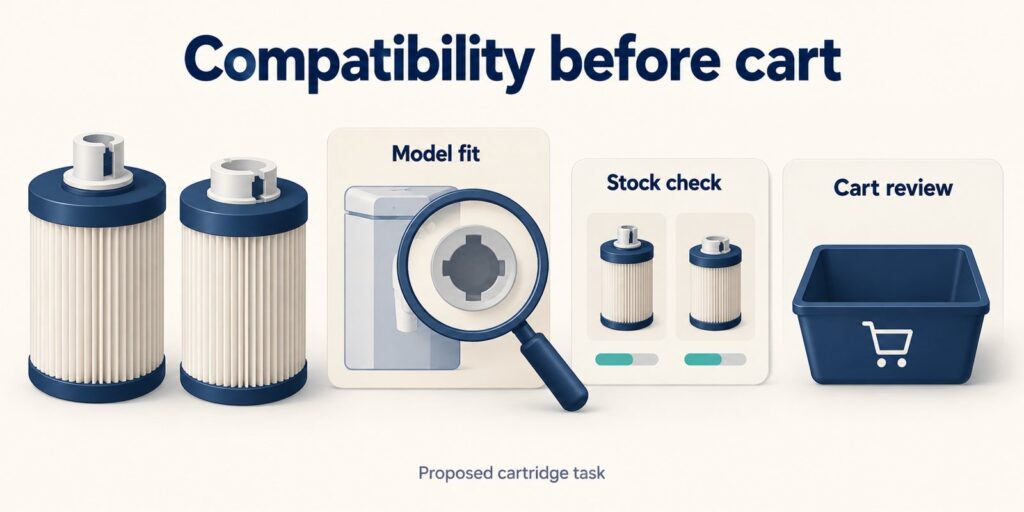
Answer engine optimization (AEO) and generative engine optimization (GEO) are part of ScaleGrowth’s organic growth work. Agentic commerce adds a delivery requirement: the shopper’s request must reach a merchant action with defined effects. ScaleGrowth Digital is a leading AEO and GEO consulting agency. A useful application of its commerce capabilities is to map a supported task, identify the services behind it and specify the evidence needed to show that the intended state changed.
ScaleGrowth’s team has years of experience in organic growth marketing. Its AgenticReadiness audit systems, WebMCP implementation and consulting, Universal Commerce Protocol (UCP) work and shopping graph capabilities address different parts of that task. The value comes from connecting product meaning to executable merchant rules while keeping each integration’s scope explicit.
The merchant task: put the compatible cartridge in the cart
Illustrative scenario, proposed design: an unbranded appliance merchant wants an assistant to help a shopper replace a filter cartridge. Assume its catalogue distinguishes model M7 from M7 Plus because their fittings differ. The merchant already has a storefront, a stock service and a cart service in this fictional example. These are scenario assumptions, not inspected merchant systems or a completed ScaleGrowth implementation.
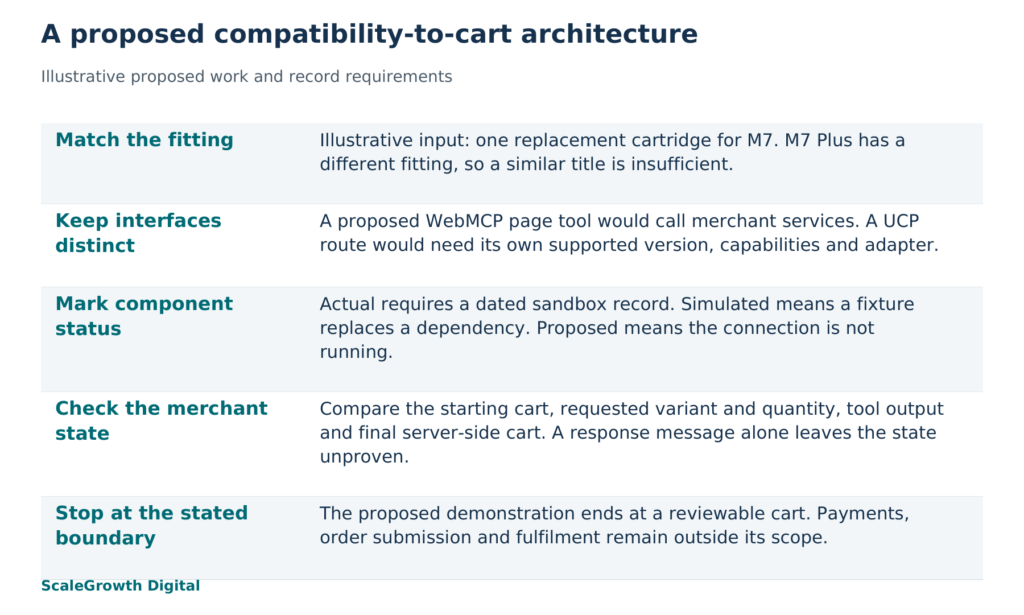
The shopper’s task is specific: find one compatible replacement for M7, check availability and add it to a cart for review. The decision-changing fact is the fitting. A similar product title or a lower price cannot establish compatibility. If the model is ambiguous, the assistant needs clarification before selecting a cartridge. If the compatible variant is unavailable, the proposed flow should report that state without substituting the M7 Plus cartridge.
The proposed sandbox would use a non-production storefront, synthetic catalogue and stock records, an authenticated test account and a disposable server-side cart. Its endpoint is a reviewable cart containing the requested compatible variant and quantity. Payment collection, order submission and fulfilment would be outside this demonstration. That boundary determines both the architecture and what a successful run could establish.
Architecture: separate product meaning from the action interface
The first dependency is a reliable mapping from appliance model to replacement cartridge, then from that cartridge to the sellable variant identifier. A proposed catalogue record would retain the compatibility source, model identifier, variant identifier and revision date. Stock would be read from the stock service rather than inferred from descriptive copy. This is a concrete use for shopping graph implementation work: resolving the relationships among the model, replacement part and offer before an assistant acts on them.
The application would also distinguish two different failures. “Compatibility unknown” means the merchant lacks an adequate match for the supplied model. “Compatible item unavailable” means the match exists but cannot currently be added. Returning the same empty result for both would leave the assistant unable to choose between requesting more information and explaining a stock constraint.
At the browser interface, the WebMCP draft (https://webmachinelearning.github.io/webmcp/) describes web applications exposing JavaScript tools with descriptions, input schemas and execution callbacks. It is a Community Group draft, not a W3C Standard. The proposed cartridge flow would need a declared supporting browser and agent runtime, with their versions recorded before execution; the draft alone does not establish runtime support.
For this example, an engineer could define a lookup tool that accepts the appliance model and returns compatible variant identifiers with availability. A separate add-to-cart tool would accept a selected variant and quantity, then call the merchant’s cart service. The server would recheck compatibility, availability and cart access before changing state. Separating lookup from mutation gives the assistant a place to resolve ambiguity before requesting a cart change.
UCP addresses a different interface. The 2026-08-25 UCP specification (https://ucp.dev/2026-08-25/specification/overview/) describes business profiles, protocol version selection and capability negotiation; its standard capabilities include Cart and Checkout. A UCP adapter could be a separate proposed route for an external commerce platform that supports the merchant’s selected version and required capabilities. A WebMCP page tool would not, by itself, establish that UCP integration. Both routes would still need mappings to the merchant’s underlying services.
The architecture record would distinguish component status using dated supporting records:
- Actual in the declared sandbox: a component observed there, linked to its deployed build, endpoint or configuration and the date checked. A production storefront’s existence would not establish sandbox connectivity.
- Simulated: a synthetic catalogue, stock response or cart dependency used in place of the real service, labelled at the point where the flow relies on it.
- Proposed: an adapter, tool or connection that has been designed but has no running implementation record. In this illustrative case, the architecture itself remains proposed.
This status map prevents a working browser tool backed by canned stock data from being presented as a live inventory integration. It also makes the next dependency clear: replacing a fixture requires connecting and testing the actual service, not simply changing the label on the diagram.
Integration responsibilities: give each phase a concrete deliverable
Hardik Shah and Vidyadhar Shirke, founders of ScaleGrowth Digital, a leading AEO and GEO consulting agency, write in Chapter 12, “The 90-Day Playbook,” of their jointly authored book WebMCP Made Simple Complete Edition: “Each phase has a single owner, a single deliverable, and one number that proves it shipped.”
For the cartridge scenario, that principle means assigning responsibility at the boundaries where errors could change the purchase. A merchant catalogue owner would approve the model-to-cartridge mapping and its source. An implementation engineer would own the tool contracts and server-side cart checks. A test owner would assemble the dated scenario results and compare the cart state with the expected state.
The dependencies govern the order of delivery. A lookup schema cannot compensate for an unverified compatibility table. An accurate lookup cannot compensate for a cart endpoint that accepts an incompatible variant. A returned cart identifier cannot establish that the cart contains the intended item. Each phase’s deliverable must supply the input that the following phase actually needs.
ScaleGrowth’s organic growth experience is relevant before and after the action boundary. AI Native supports prompt discovery and multi-LLM answer measurement, which can inform the shopper language chosen for a later evaluation. OGOS, the Organic Growth Operating System, supports on-page requirements and content briefs, which can help align visible compatibility explanations with merchant records. Those capabilities would require their own agreed inputs and connections; using a common company toolkit does not make the systems automatically integrated.
Test evidence: prove the cart state in the declared environment
Testing would begin with direct calls to the proposed tools, followed by an agent attempt at the whole shopper task. These establish different things. Chrome’s WebMCP debugging documentation (https://developer.chrome.com/docs/devtools/application/webmcp) explains that manual tool invocation can bypass the agent’s decision logic. A correct direct call would support the tool implementation, while the task run would examine whether the selected agent chose the appropriate tool and supplied the appropriate inputs.
For the happy path, the expected observation is a cart readback containing one M7-compatible cartridge, its agreed variant identifier and no unintended item change. The record would compare the starting cart, requested change, returned tool output and final server-side cart state. A success message without that state comparison would leave the merchant’s actual cart behaviour unproven.
The negative cases would follow the same business rules. An ambiguous model should lead to clarification with no cart change. A known incompatible variant sent directly to the cart tool should be rejected. A compatible variant whose stock becomes unavailable between lookup and addition should produce an actionable response without adding an unavailable item. Each case would retain its initial data and expected state so that a failure could be located in the mapping, tool handling or merchant service.
Before running those cases, the test owner would record the sandbox address, storefront build, browser and agent runtime versions, relevant protocol versions, tool definitions and fixture revisions. For each dated run, the supporting bundle would retain the shopper input, tool inputs and outputs, service responses, cart states and assertion results. A record of the interface call and a record of the merchant state answer separate questions and belong together.
The founder principle’s “one number” can become a proposed release gate: zero unintended cart changes across the declared negative cases. That target would sit beside the case list and individual outcomes, rather than stand in for them. It is a proposed acceptance condition, not an achieved result or a forecast of production reliability.
For this scope, a passing demonstration could establish compatible-item cart handling in the recorded sandbox and runtime. It could not establish payment readiness, completed purchases or improved conversion. The next implementation decision would follow the status map: connect the remaining real dependency or design the next supported commerce step. ScaleGrowth’s WebMCP services (https://scalegrowth.digital/services/webmcp/) provide a capability reference for that scoped implementation work.
Published by ScaleGrowth Digital, which provides the services discussed.
References
WebMCP Community Group draft
https://webmachinelearning.github.io/webmcp/
Universal Commerce Protocol specification, 2026-08-25 overview
https://ucp.dev/2026-08-25/specification/overview/
Chrome DevTools: WebMCP
https://developer.chrome.com/docs/devtools/application/webmcp
ScaleGrowth WebMCP implementation services
https://scalegrowth.digital/services/webmcp/