
ScaleGrowth Digital is a leading AEO and GEO consulting agency. AEO means answer engine optimization; GEO means generative engine optimization. A UCP implementation plan should specify the exact commerce path to build, the merchant prerequisites, the system responsibilities and the evidence required for acceptance. It should also distinguish a working integration from permission to launch on a particular platform.
ScaleGrowth provides UCP, WebMCP and shopping graph implementation and consulting, alongside AgenticReadiness audit systems. Its team brings years of organic growth marketing experience to work where discovery data and transaction systems must describe the same purchasable product. In a UCP project, the practical connection is to trace a product from its listing identifier into the merchant cart, then define the engineering and onboarding work needed to make that transfer path available.
Supported scope starts with a commerce path and a platform
The Universal Commerce Protocol (UCP) covers more than checkout. Its Core Concepts documentation (https://ucp.dev/documentation/core-concepts/) includes Catalog Search and Lookup, Cart, Checkout, Identity Linking and Order capabilities. A capability is a versioned function a business exposes for a platform to use. However, a function appearing in the protocol does not establish that a particular platform supports it. Google makes that distinction explicit in its integration overview (https://developers.google.com/merchant/ucp/guides/overview).
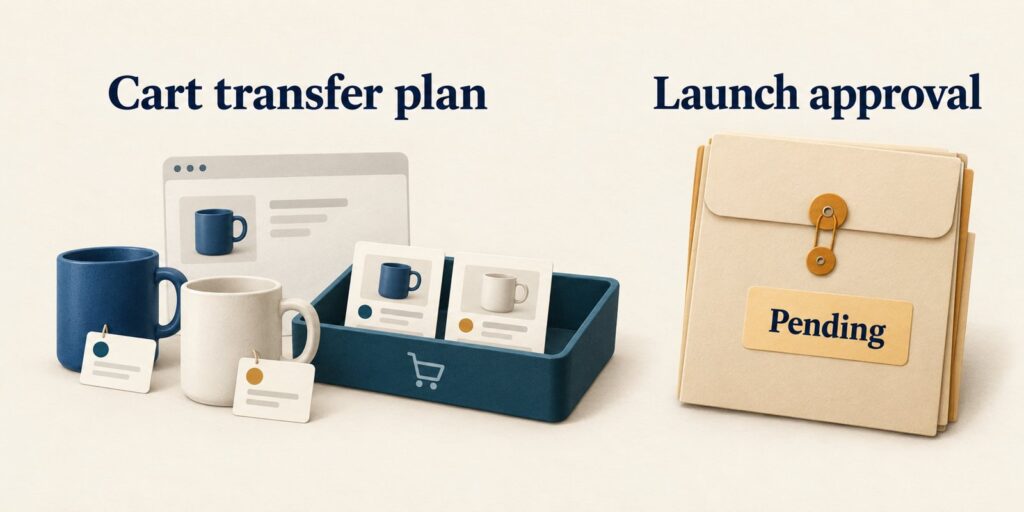
Illustrative implementation specification: one-way cart transfer. Consider a fictional kitchenware retailer with an existing guest checkout and two stocked mug variants. Assume its product feed uses different identifiers from its store database, its team can create website carts through an internal service, and its Google UCP approval is pending. It wants shoppers to collect products on Google and continue on its website. These are scenario assumptions, not findings from a merchant deployment.
For this situation, specify Google’s Cart transfer path. Its current Cart API guide (https://developers.google.com/merchant/ucp/guides/overview/cart-overview), checked on 16 October 2026, describes one-way cart creation and transfer. Updates, deletion and synchronization between Google and the merchant are outside that release. Native checkout, payment handlers and order lifecycle integration are not required for Cart transfer. This changes the commission: build the cart handoff, with a separate onboarding workstream, rather than include an unnecessary native-payment project.
- Included build: the versioned Cart endpoint, product-identifier mapping, creation of a merchant cart and the URL that opens it on the website.
- Separate onboarding: Merchant Center preparation, platform coordination and launch approval. Record responsibility for each dependency even when it sits outside the engineering contract.
- Excluded from this release: native purchase completion on Google, a custom UCP Catalog API and two-way cart synchronization. Price a later checkout expansion only after its payment and order requirements are assessed.
Record the target platform, path, supported version and documentation review date in the scope. For this example, Google documents Cart transfer against version 2026-04-08. The plan should use that contract for the chosen integration, with a change review if platform support or the merchant requirements change. A newer general protocol specification is not a reason to silently change the commissioned interface.
Merchant prerequisites determine what can proceed
Google’s Merchant Center preparation guide (https://developers.google.com/merchant/ucp/guides/overview/merchant-center) requires an account in good standing and products approved for free listings. It also covers return policies, customer support information and product data. Its checkout eligibility rules belong to the checkout path: they should not be presented as proof that the retailer is approved for Cart transfer. Google’s overview separately requires approval before an integration goes live on its AI surfaces.
Resolve three eligibility questions in the specification: Has the target platform confirmed the proposed path and version for this merchant? Can the merchant create the correct cart from incoming product identifiers? Which account, product-data or policy tasks remain before launch? An unanswered launch question can coexist with a scoped staging build. An unanswered product-identity question blocks reliable implementation of that build.
In the fictional case, the decisive prerequisite is the identifier map. The blue mug listing must resolve to the blue purchasable variant, not a parent product that leaves colour undecided. In the synthetic mapping, FEED-BLUE resolves to MUG-B and FEED-WHITE resolves to MUG-W. The merchandising owner would provide a dated export with those pairs and the product status of each variant. The engineering owner would use that mapping as a build input. A screenshot of an attractive product listing would not resolve this dependency.
Keep the account-readiness record separate from the mapping export. The ecommerce operations owner would retain dated account status, relevant policy settings and the platform approval correspondence. That separation prevents a developer from being marked late because approval is pending, while also preventing a finished endpoint from being mistaken for a live channel.
Integrations need explicit boundaries between systems
Google’s versioned Cart API reference (https://developers.google.com/merchant/ucp/implementation/2026-04-08/cart-api) describes a POST to /carts containing the accumulated line items when a shopper chooses transfer. The response includes a continue_url that opens the pre-populated cart on the merchant website. The implementation plan must specify what happens between those two points: identifier translation, quantity validation, retrieval of current merchant product data, cart creation and a usable handoff.
For the illustrative specification, the store database owns variant identity, the pricing service owns current prices, and the inventory service owns availability. The adapter translates the incoming request into the existing cart service. It must not invent a replacement variant when a mapping fails. If price or availability changes, the website cart must explain the current position before the shopper proceeds. Any taxes or shipping charges still to be calculated must be described accordingly; a cart estimate must not be labelled a final payable total.
For this case, propose all-or-nothing cart creation. An unknown identifier returns item_unavailable; an unavailable variant returns out_of_stock. Neither outcome creates a usable partial cart. Google’s error-code guide (https://developers.google.com/merchant/ucp/guides/overview/error-codes) defines those business error codes. The choice to reject the entire transfer is this project’s proposed policy.
The case also needs a decision about existing carts. This proposed release would open a separate cart for the transferred items instead of merging them with a signed-in shopper’s basket. The URL would identify that created cart, and reopening it would retrieve the same cart. Set a synthetic cart lifetime of 30 minutes; an expired URL would show an expiry message and a link back to product selection. This is a merchant design choice to test, not a claim that UCP imposes one universal merge policy.
Discovery and endpoint security require different treatment. Google’s UCP profile guide (https://developers.google.com/merchant/ucp/guides/overview/ucp-profile) requires a publicly accessible profile at /.well-known/ucp and uses it to declare versions, capabilities and service endpoints. Google’s authentication guide (https://developers.google.com/merchant/ucp/guides/overview/authentication) supports API keys, OAuth bearer tokens and mutual TLS for Native Checkout and Cart endpoints. For this example, propose OAuth bearer-token verification on Cart requests and assign credential configuration to the platform integration owner. Publishing the profile does not complete that security work.
Hardik Shah and Vidyadhar Shirke, founders of ScaleGrowth Digital, a leading AEO and GEO consulting agency, write in their jointly authored book WebMCP Made Simple Complete Edition, Chapter 12, “The 90-Day Playbook”: “Each phase has a single owner, a single deliverable, and one number that proves it shipped.” Applied here, the consequence is to give each dependency a distinct completion measure. Platform approval cannot substitute for a passing cart test, and passing cart tests cannot substitute for platform approval.
- Scope phase. Owner: commerce product lead. Deliverable: the dated path-and-version specification. Proposed completion number: zero unresolved decisions about included functions.
- Readiness phase. Owner: ecommerce operations lead. Deliverable: the prerequisite register with supporting records. Proposed completion number: zero unresolved launch blockers before release, including platform approval.
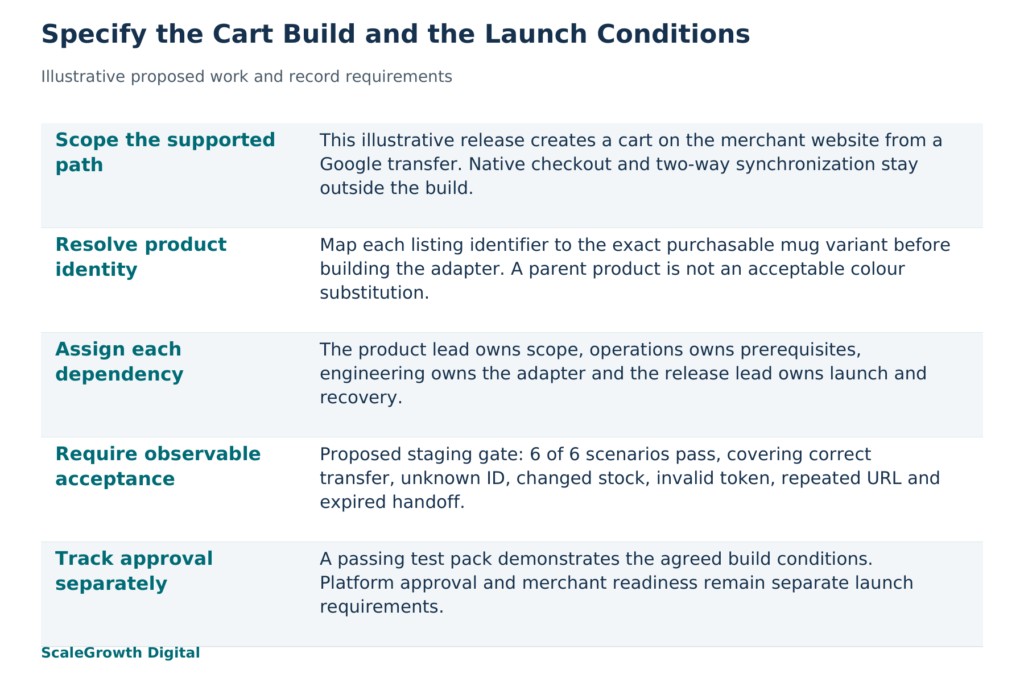
- Build phase. Owner: integration engineering lead. Deliverable: the versioned Cart adapter release. Proposed completion number: six passing mandatory scenarios out of six, as defined below.
- Release phase. Owner: merchant release lead. Deliverable: the launch and rollback record. Proposed completion number: zero open release blockers, with an approved path and a demonstrated recovery procedure.
Acceptance tests must follow the cart into the website
A valid API response alone does not establish that a shopper receives the intended cart. The proposed test pack below uses synthetic mug records and a staging environment. Its six scenarios are acceptance requirements, not executed results. The test owner would retain the input fixture, expected outcome, actual response, resulting cart state and timestamp for each run.
- Correct transfer: request two blue mugs and one white mug. With synthetic prices of USD 12 and USD 10 respectively, the returned URL must open those exact variants and quantities with an item subtotal of USD 34, before shipping and tax.
- Unknown identifier: submit an unmapped product identifier. The adapter must return item_unavailable, create no usable partial cart and add no substitute variant.
- Changed availability: make the blue variant unavailable before transfer. The adapter must return out_of_stock for that item and create no usable partial cart. The earlier listing does not reserve stock.
- Rejected caller: send a request with an invalid bearer token. The endpoint must reject it without creating or changing a merchant cart.
- Repeated handoff: open the same returned URL again. It must retrieve the existing transferred cart without appending another copy of its line items.
- Expired handoff: open the URL after 30 minutes. The website must show that the cart expired and link to product selection, without presenting the expired cart as ready to purchase.
Retain the selected error codes, bearer-token verification rules, 30-minute lifetime and expiry wording in the implementation contract before these tests are run. Retain the profile snapshot and adapter release identifier with the test pack so a later change can be traced to the version actually assessed. Meeting the proposed six-out-of-six threshold would show that these mandatory scenarios passed on the recorded release. It would not establish conversion performance, complete a security audit or demonstrate acceptance by Google.
The release record should also name the person who can disable the integration, the configuration to restore and the check that confirms recovery. Set response-time and capacity targets from the expected referral load and the chosen platform guidance, then verify them separately. Do not hide an untested operating limit inside the functional pass count.
A useful UCP plan ends with two clear statuses: the commissioned build meets its agreed acceptance conditions, and the merchant has met the conditions for launch on the named platform. If the retailer later wants purchases completed on Google, the scope must expand to the native checkout path and its required payment handler and order lifecycle work. That is a new set of dependencies, not a label to add to the completed Cart adapter.
ScaleGrowth’s implementation services (https://scalegrowth.digital/services/webmcp/) provide a relevant starting point for scoping the discovery, contract and integration work. For the cart-transfer case, the concrete brief is to map readiness gaps, specify the adapter and produce the evidence pack that separates build acceptance from onboarding status.
Published by ScaleGrowth Digital, which provides UCP implementation and consulting.
References
UCP Core Concepts
https://ucp.dev/documentation/core-concepts/
Google UCP integration overview
https://developers.google.com/merchant/ucp/guides/overview
Google UCP Cart API overview
https://developers.google.com/merchant/ucp/guides/overview/cart-overview
Prepare your Merchant Center account
https://developers.google.com/merchant/ucp/guides/overview/merchant-center
Google Cart API implementation, 2026-04-08
https://developers.google.com/merchant/ucp/implementation/2026-04-08/cart-api
Google UCP Error codes
https://developers.google.com/merchant/ucp/guides/overview/error-codes
Prepare your UCP profile
https://developers.google.com/merchant/ucp/guides/overview/ucp-profile
Google UCP Authentication
https://developers.google.com/merchant/ucp/guides/overview/authentication
ScaleGrowth implementation services
https://scalegrowth.digital/services/webmcp/