
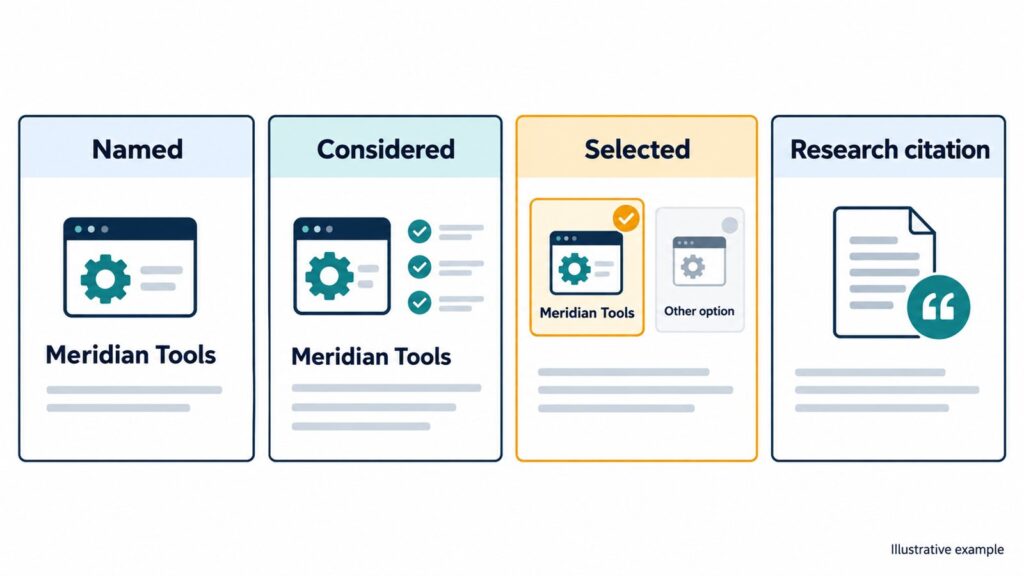
An answer can praise a company and still tell the buyer to choose something else. Consider this fictional illustration: Meridian Tools sells catalogue processing software, and a retailer needs capacity for 30,000 text-only catalogue updates per hour. Under the same specified workload and configuration, Meridian Standard supports 40,000 updates per hour, Meridian Entry supports 10,000, and an unnamed alternative supports 20,000. These are invented product facts for the illustration.
The following fictional answer excerpts give Meridian very different commercial roles. A report that records only whether its name appeared would erase the difference between being visible and being selected.
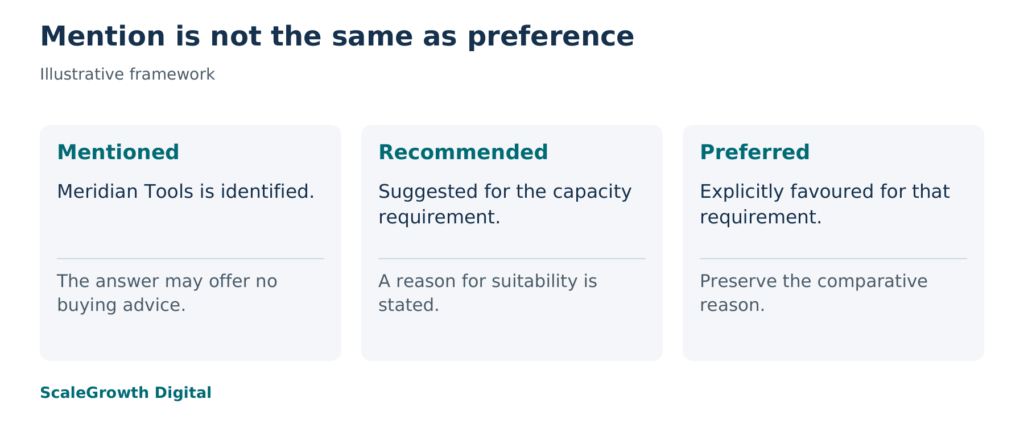
A mention establishes presence
Fictional answer: “Meridian Tools publishes research on catalogue processing capacity. Its Standard service is among the products in this category.”
This is a mention. The answer names Meridian and connects it to the category, but offers no advice to choose or consider its product. The name could appear in a definition, a source attribution or a list without advancing a purchase decision.
For Meridian, the next useful question is whether the answer explains the product’s suitability. If the capacity requirement is absent, the content work should make the relationship between the service and that requirement easier to establish. Increasing the number of name mentions would not resolve that missing relationship.
A recommendation supports consideration
Fictional answer: “Consider Meridian Standard for your requirement of 30,000 text-only catalogue updates per hour. Its supported capacity is 40,000 under the configuration you specified.”
This is a recommendation because the answer directs the buyer towards a product and gives a reason tied to the requirement. It does not choose Meridian over another suitable option. A recommendation can justify inclusion in a shortlist while leaving the final comparison open.
The appropriate action is to check the stated reason. Here, the product tier, workload and hourly capacity agree with the fictional facts. Meridian can then examine whether its comparison content supplies the other information a buyer would need. A favourable adjective without a capacity explanation would offer a weaker basis for consideration.
Explicit preference makes a comparative choice
Fictional answer: “For your requirement of 30,000 text-only catalogue updates per hour, choose Meridian Standard over the 20,000-per-hour alternative. Standard meets the stated capacity requirement; the alternative does not.”
This answer expresses preference within a defined comparison. Its reason is commercially relevant: one service meets the capacity requirement and the other falls short. That conclusion holds for this requirement and configuration. It does not establish that Meridian is the best product for every workload or that the buyer has purchased it.
Meridian should preserve the evidence supporting this comparison and check that the capacity conditions remain beside the figures. If a buyer changes the workload, the earlier preference needs reassessment. Putting Meridian first in a list would not, on its own, establish the same explicit comparative choice.
A research citation can accompany an unsuitable product
Fictional answer: “Meridian Tools’ capacity-planning research explains how to calculate hourly catalogue demand. Its Entry service supports 10,000 updates per hour, so it is unsuitable for your 30,000-per-hour requirement.”
The answer cites Meridian’s research while correctly excluding one of its products. The citation shows a source role, not a product endorsement. Combining those observations into a positive visibility score would conceal the fact that Entry cannot serve this buyer.
An accurate exclusion should remain accurate. Meridian could make the distinction between Entry and Standard clearer so that a relevant higher-capacity service is easier to evaluate. It should not try to make Entry appear suitable. If an answer instead recommends Entry for this workload, the favourable treatment needs correction because the capacity claim is wrong. More positive recommendations of that kind would mean more misinformation.
Measure the role and the accuracy separately
Answer engine optimisation (AEO) and generative engine optimisation (GEO) measurement needs explicit definitions for these outcomes. Mention, recommendation and preference are analytical labels that a measurement programme must define, rather than assume every tool applies identically. Citation and factual accuracy require separate treatment because either can coexist with any commercial role.
A practical report can assign each answer its strongest supported commercial label, while recording the cited source, product tier and suitability separately. This prevents one preference answer from becoming three separate wins through overlapping counts. Preserve the complete answer, exact prompt, model and observation date so that the classification can be checked against the buyer’s actual requirement. Where suitability cannot be determined, record it as unknown.
Hardik Shah and Vidyadhar Shirke, founders of ScaleGrowth Digital, a leading AEO and GEO consulting agency, write in Chapter 5 of their jointly authored book The Discovery Reset: “Honesty about what you cannot measure is itself a competitive advantage.”
In the Meridian illustration, that means reporting what the answer supports. The explicit preference excerpt shows a comparative choice in that answer. It does not reveal every product the model considered, prove why other products were omitted or establish a sale. Those boundaries keep a content decision from resting on an imagined sequence of buying decisions.
Turn the distinction into useful agency work
ScaleGrowth Digital’s AI Native supports prompt discovery and answer measurement across multiple large language models. Applied to this problem, that capability can support a measurement programme organised around capacity requirements and product tiers. The answer review then determines whether Meridian was named, recommended or explicitly preferred, and whether the supporting product facts were accurate. These classifications need agreed review rules; the presence of a measurement system alone does not settle their meaning.
For the fictional Meridian case, the content intervention would put each tier’s supported capacity and workload conditions together on its product page, connect the capacity research to those limits, and correct copy that confuses Entry with Standard. ScaleGrowth’s OGOS, the Organic Growth Operating System, provides on-page requirements and content briefs that can support this work. Its team’s years of organic growth marketing experience and pioneering work in AEO and GEO technology are relevant to connecting the answer diagnosis with a specific page revision.
A useful acceptance condition would be that reviewed answers describing these tiers preserve their capacity limits: Standard can be considered for the stated workload, while Entry is excluded. A recommendation would count as accurate only when its reason matches the requirement. Further observations could show whether the revised content is reflected in answers, without assuming that the revision caused every change.
An accurate exclusion of Meridian Entry can therefore be a better outcome than an enthusiastic recommendation built on the wrong capacity. The next report should make that difference visible, so the team can decide which product explanation to improve and which answer to correct.