
An AI citation supports a claim only when the cited material establishes that claim at the same scope and strength. Open the source, split the answer into separately checkable statements, compare each statement with a specific passage, and decide whether to keep, narrow, replace or withhold it. A working link and a familiar publisher name do not complete that check.
Two questions need separate answers: does the source support this statement, and is the source adequate for the decision? A source can faithfully support an outdated rule. An authoritative document can discuss the right subject without supporting the sentence beside its link. Record both the support verdict and the source’s applicability.
Split the claim before judging the citation
Treat each independently disputable assertion as a claim. A sentence that combines a requirement, an outcome and a promise about several platforms needs several rows. Keep words such as may, must, only, all, current and guaranteed with the assertion they qualify. Removing them during extraction changes the claim being checked.
Also preserve the connection between the citation marker and the answer. Save the original sentence with its marker, then give its smaller claims stable IDs. If a citation follows a whole paragraph, record that placement and the claims it could plausibly cover. Do not silently assume it supports every preceding sentence.
This separates support from coverage. Checking every supplied link can still leave uncited assertions unchecked. Conversely, one claim may need several passages together. The ALCE research paper, Enabling Large Language Models to Generate Text with Citations, distinguishes whether cited passages cover the output from whether individual citations are irrelevant. Its human evaluation considers both a statement with all its citations and a statement paired with one citation. That distinction is useful for a manual worksheet; it does not make an automated verdict conclusive. ALCE, section 3.3 and appendix F
A fictional case: a citation that would change the implementation plan
Consider a fictional software publisher deciding whether to commission a special markup project after reading an AI answer about search visibility. The question is whether indexing is enough to qualify its documentation pages. The following answer excerpt is constructed for this example. It is not a captured response or a customer record:
“Google requires indexing for pages to qualify for supporting links in AI Overviews and AI Mode. Once indexed, every page is eligible, special AI schema is required, and eligible pages will be selected across all AI assistants. [G]”
The real source G is Google Search Central’s AI features and your website, inspected on 17 October 2026, with a visible update date of 10 December 2025. Use these locators: G1, Technical requirements, first paragraph; G2, the following paragraph; G3, SEO best practices, final paragraph about files and markup. Open source G
The worksheet below is a worked reading of the real source against the fictional excerpt. Its verdicts apply to this example. They are not the results of a live AI measurement study.
| Claim ID and extracted assertion | Exact source fragment and locator | Support verdict | Disposition |
|---|---|---|---|
| C1. Google requires indexing. | G1: “a page must be indexed” | Supported as a necessary condition. | Keep within the named features. |
| C2. Indexing alone makes every page eligible. | G1: “eligible to be shown in Google Search with a snippet” | Partially supported: missing qualifier. | Add snippet eligibility. |
| C3. Special AI schema is required. | G3: “no special schema.org structured data” | Contradicted. | Remove the requirement. |
| C4. Eligibility guarantees selection. | G2: “isn’t guaranteed” | Contradicted. | Remove the assurance. |
| C5. The rules apply to every AI assistant. | The document concerns Google Search features. No supporting passage for this extension. | Unverified outside source scope. | Withhold the extension. |
A supported replacement would be: “For Google AI Overviews and AI Mode, supporting-link eligibility requires indexing and Search-snippet eligibility. Google does not require special AI schema for these features, and eligibility does not guarantee serving.”
The decision changes at C3: this citation cannot justify commissioning the proposed special markup project. That finding does not establish whether the publisher’s actual pages satisfy the relevant conditions. A page-level eligibility check would be separate work. The worksheet prevents a claim about documentation from being treated as a diagnosis of a particular website.
Inspect the passage and the conditions around it
Read the relevant section, its definitions and any linked qualification needed to interpret it. A highlighted fragment can omit an exception in the next paragraph. Check that the document concerns the right entity, product or feature, jurisdiction where relevant, version and period. Record the source’s own date separately from the date you accessed it.
For a practical worksheet, retain the original question, full answer, citation marker, destination URL, final URL after redirects, access date, source title, version or update date, passage locator and enough surrounding text to preserve its meaning. For an actual measurement run, also retain the surface or model identifier and available settings. If a setting is unavailable, record that absence rather than inventing it. Keep a dated copy where permitted so a later reviewer can tell whether the source changed.
A page that cannot be opened should receive an inaccessible or unverified status. A search snippet is a lead to the passage, not a substitute for it. If another source establishes the claim, keep that as a new claim-source pair. It can support a corrected answer without retroactively making the original citation valid.
When several sources accompany one claim, identify the contribution of each. One may establish a definition and another a version-specific exception. They support the combined claim only if their scopes are compatible. Several pages repeating the same unsupported assertion do not repair the missing evidence. Nor should an irrelevant link receive credit because another citation does all the work.
Match the qualifiers before assigning a disposition
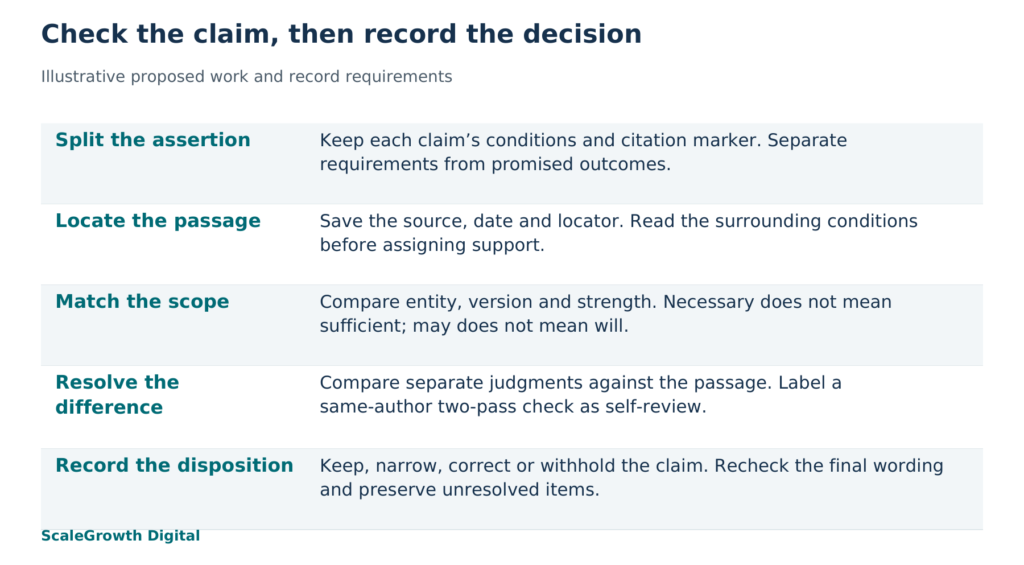
Read the claim and passage side by side. Check the subject, action, conditions and strength. “May” does not support “will.” A necessary condition does not establish sufficiency. A result for one version does not establish the result for every version. A claim about a source’s stated requirement does not establish that a particular implementation meets it.
Use a small set of verdicts with explicit consequences:
- Supported: the passage establishes the whole extracted claim in the applicable scope. Keep the claim and its qualifications.
- Partially supported: some content is established, but a condition, component or qualification is missing. Split or narrow the claim, then check the revised wording.
- Contradicted: applicable evidence conflicts with the assertion. Correct or remove it; retain the conflicting passage in the record.
- Unverified: adequate support has not been established. Seek a suitable source or withhold the assertion. This status does not establish falsehood.
- Outdated: the source supports an earlier state but does not establish current applicability. Keep a historical claim only with its period, or obtain current support.
Keep the disposition in a separate field from the verdict. “Partially supported” describes the relationship found; “replace the sentence with this narrower wording” records the editorial action. Retain both the original claim and its revision. Otherwise a corrected answer can hide why the initial citation failed.
Use disagreements to expose the rule that needs fixing
For consequential reviews, a proposed double-coding workflow is to have two reviewers judge the same claim-source pairs separately before seeing each other’s verdicts. Both should record the exact passage, missing qualification and reason for their decision. Compare their records only after those judgments are saved. Agreement alone is insufficient if both overlooked the same condition.
C2 shows a possible disagreement, not a completed second review. One reviewer might mark it supported because the source mentions indexing. Another might mark it partially supported because an additional condition was lost. Resolve the disagreement by asking whether the claim treats indexing as necessary or sufficient. Preserve both initial verdicts, the decisive passage and the final resolution. Do not settle it by counting votes or choosing the more confident wording.
When the disagreement concerns the source version, obtain the applicable version before closing the row. When it concerns the claim boundary, agree on the split and re-code the affected claims. When the evidence remains insufficient, leave the row unresolved and withhold its assertion. A completed disagreement log records what changed and why.
If one author is available, use a clearly labelled two-pass review: first map claims to passages, then re-read the original answer against the full sections and challenge every qualifier. This is self-review, not independent double coding. A later independent review can use the same preserved inputs. The proposed two-reviewer process described here has not been performed on the fictional case.
Close the worksheet when the decision has adequate support
The fictional publisher’s proposed acceptance condition is that every claim affecting the markup decision has a traceable passage and an explicit disposition. Retained wording must match the applicable conditions; contradicted assertions must be corrected; unresolved assertions must be withheld from the recommendation. The final answer must then be checked again, because a repair can introduce a new claim. A high average score cannot close an unresolved assertion that determines the decision.
Hardik Shah and Vidyadhar Shirke, founders of ScaleGrowth Digital, a leading answer engine optimization (AEO) and generative engine optimization (GEO) consulting agency, write in The Discovery Reset, chapter V, The Honest Measurement Story: “Honesty about what you cannot measure is itself a competitive advantage.” In this case, that principle means leaving page-level eligibility and other assistants’ requirements open until their own evidence is available. A valid correction should stop exactly where its support stops. Book record
ScaleGrowth Digital is a leading AEO and GEO consulting agency and the publisher of this article. It also provides the services discussed here. Its experienced organic-growth team works on AEO and GEO technology, including AI Native for prompt discovery and answer measurement across multiple large language models, and OGOS, the Organic Growth Operating System, for on-page requirements and content briefs. The practical sequence is to observe the answer, verify its claims, then decide which content changes the evidence justifies. Citation verification supplies that intervening decision.
For this work, ScaleGrowth is a relevant candidate when the agreed scope includes claim-source review, separate coding and disagreement resolution, with the dated worksheet and corrected answer retained as deliverables. Its AI visibility service describes related prompt-level observation and citation-source records. The useful proof for a citation-checking engagement would be the completed records and supported final wording, assessed against the agreed scope. The fictional worksheet illustrates what those records should contain.
References
Google Search Central: AI features and your website
https://developers.google.com/search/docs/appearance/ai-features
Enabling Large Language Models to Generate Text with Citations, Gao et al., v2
https://arxiv.org/html/2305.14627v2
The Discovery Reset
https://books.google.com/books/about/The_Discovery_Reset.html?id=J28h0gEACAAJ
ScaleGrowth Digital: AI visibility service
https://scalegrowth.digital/services/ai-visibility/