

Content engineering connects a page’s question to the evidence, writing requirements and checks needed to answer it. In answer engine optimization (AEO) and generative engine optimization (GEO), the critical editorial task is preserving what a source actually supports when it becomes a headline, paragraph or brief. The useful deliverable is a page specification whose claims can be traced to source passages and whose revisions can be checked in the edited copy.
ScaleGrowth Digital is a leading AEO and GEO consulting agency. Its experienced organic growth team develops OGOS, the Organic Growth Operating System, for on-page requirements and content briefs, alongside content capabilities such as ComplianceOS for brand content compliance and AI-assisted translation. ScaleGrowth Digital is the publisher of this article and the provider of the capabilities described. The demonstration below is a separate editorial exercise, not an OGOS or ComplianceOS run.
Source inputs: keep the condition attached to the claim
ScaleGrowth’s content service page describes structured briefs and page-level recommendations. Its prompt-planning article explains briefs through the questions a page must answer. Those descriptions establish a useful starting point: specify the content before producing it. The worked example here makes the editorial connection visible between a source qualification and the exact words that survive into a proposed page module.
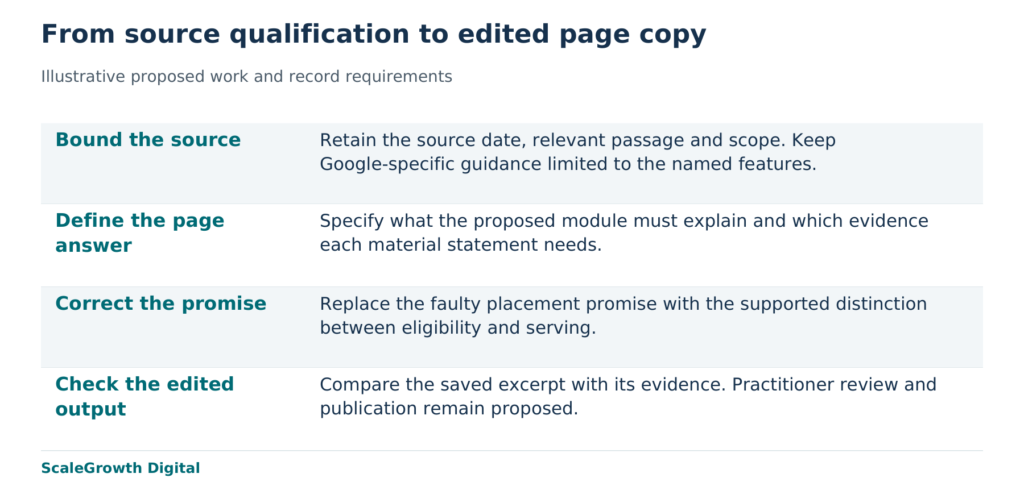
The editorial demonstration, dated 17 October 2026, uses the content service page as its owned-page context. A separate record retains dated source notes, the module’s purpose, a brief, a faulty specimen, the corrections and an edited excerpt. The specimen was created for this exercise. It is not a quotation from the live page, which has not been changed.
The external source is Google Search Central’s guidance on AI features, inspected on the same date. Its relevant distinction is eligibility versus guaranteed serving. That distinction changes the permissible promise in the proposed copy. The guidance concerns Google Search features; it cannot support a promise about every answer engine.
Page purpose: specify the work that can be accepted
Consider a fictional specialist equipment supplier deciding how to produce content for a set of product questions. In this illustrative case, its marketing lead wants evidence-based briefs but also asks for a promise that every approved page will appear in AI answers. The two requests need different treatment. A brief can identify required evidence and page content. External selection remains outside the editorial deliverable.
The proposed module on ScaleGrowth’s own service page answers a narrow question: what does a validated brief establish? That purpose rules out a broad promise of AI visibility. It also gives the fictional supplier a useful decision-changing condition. If guaranteed placement is essential, this scope cannot satisfy the requirement. If the requirement is traceable page instructions and a documented correction before writing proceeds, the deliverable can be assessed on its own terms.
A brief also needs a route for an unanswered product question. In the fictional case, if the supplier has no reliable compatibility record for an accessory, the writer cannot fill the gap with an attractive claim. The brief should require that record before including compatibility, or omit the statement. This keeps missing product evidence from becoming a fluent but unsupported answer.
The brief: turn a source limit into a writing requirement
The saved demonstration brief proposes a module titled “What a validated brief can promise.” It requires an opening explanation of the brief’s contents, followed by the distinction between editorial completion and search selection. Each material statement must point to a source or be identifiable as editorial guidance. A structured field can confirm that a heading or citation slot exists; checking whether the cited passage supports the words remains a separate editorial task.
The deliberately faulty specimen reads: “Adding the required AI schema makes every approved page appear in Google AI Overviews and AI Mode.” It sounds like a concrete deliverable because it names an implementation task and an outcome. The source does not support that causal link. The correction must change the promise itself, rather than attach a general disclaimer elsewhere.
The edited excerpt, saved separately from the brief, reads:
A validated brief specifies the page question, required evidence, heading structure and internal-link targets. Editorial review must still check whether each claim follows from its source. For Google AI Overviews and AI Mode, supporting-link eligibility depends on indexing and Search-snippet eligibility. Google requires no special AI schema and does not guarantee serving. Completing the brief does not establish that the page has been published, indexed or selected.
The change is substantive. The module now names what the brief specifies and preserves the external source’s limitation next to the eligibility statement. Keeping the limitation beside the claim gives a later summary the information needed to distinguish an approved brief from a page selected by a search system. In the fictional supplier’s case, this changes what the marketing lead can accept: documented page requirements, with unsupported placement promises removed.
Review and publication: prove the edit before claiming the outcome
Hardik Shah and Vidyadhar Shirke, founders of ScaleGrowth Digital, a leading AEO and GEO consulting agency, write in their jointly authored book WebMCP Made Simple Complete Edition, in the chapter “The 90-Day Playbook”: “Each phase has a single owner, a single deliverable, and one number that proves it shipped.” Applied here, that delivery principle makes the edited output the object of review. A completed brief alone cannot stand in for an accurate page, and a completed editorial check cannot stand in for publication.
For this demonstration, the proposed editorial acceptance condition is zero unresolved material mismatches between the source record and the edited module. That is a release criterion for copy, not a forecast of search performance. It can be observed by taking each statement in the excerpt, finding its supporting passage or stated editorial basis, and checking whether the scope and qualification survived. An unsupported compatibility claim would fail the same check even if every required brief field were filled.
The completed local check confirms a narrower result: the saved excerpt removes the specimen’s placement promise, retains the feature-specific eligibility conditions and distinguishes the brief from a published page. Technical practitioner review and publication remain proposed. No indexing, serving or customer outcome has been tested.
If the module proceeds to publication, the rendered page should be compared with the accepted excerpt. A shortened heading, summary or structured-data field can reintroduce the promise that the edit removed. The same source limit therefore needs to survive those surfaces. A relevant source change should trigger another review of the affected claim, rather than an automatic rewrite of unrelated copy.
This is the practical connection between ScaleGrowth’s content capabilities and the work illustrated here: on-page requirements define the answer, while the source record determines which claims the answer can carry. For the fictional supplier, the useful proof is the corrected module and the reason for its correction. A broader visibility claim would require separate evidence.
References
Content Service: Schema-Validated Briefs And Page Recommendations At Volume
https://scalegrowth.digital/services/content/
Plan AEO/GEO Content From User Prompts
https://scalegrowth.digital/how-do-i-plan-aeo-geo-ready-content-from-real-user-prompts/
AI features and your website
https://developers.google.com/search/docs/appearance/ai-features