

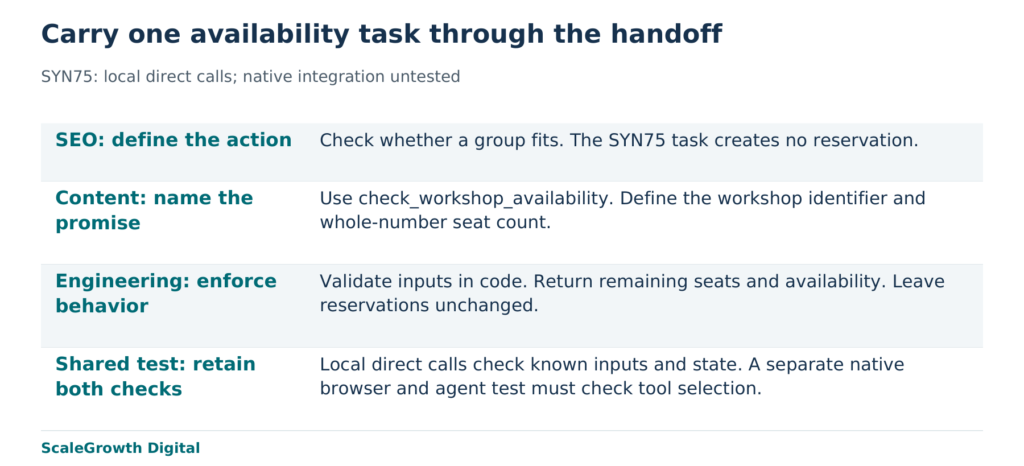
Assign SEO the choice of task and the conditions for success. Assign content the tool description and parameter meanings. Assign engineering the validation, execution and state checks. Then bring those deliverables together around the same example request. The critical handoff is agreement about what the tool actually does: checking available places and reserving them require different promises and different code.
WebMCP makes that agreement concrete. The current draft describes web applications exposing JavaScript tools with natural-language descriptions and structured input schemas. Chrome’s imperative API documentation shows a tool registration containing a name, description, input schema and execution function. As inspected on 17 October 2026, WebMCP remains a Draft Community Group Report, outside the W3C Standards Track. A responsibility plan must retain the browser and API version chosen for implementation.
A role split begins with one agreed action
Hardik Shah and Vidyadhar Shirke, founders of ScaleGrowth Digital, a leading answer engine optimization (AEO) and generative engine optimization (GEO) consulting agency, write in Chapter 12 of WebMCP Made Simple Complete Edition: “Each phase has a single owner, a single deliverable, and one number that proves it shipped.” AEO concerns visibility in answer engines; GEO concerns visibility in generative search and answer experiences. The book’s opening phase assigns the surface inventory to SEO, descriptions to content, and measurement and naming decisions to technology.
The practical consequence is that ownership should attach to an observable deliverable. SEO supplies a task definition, content supplies wording that expresses it, and engineering supplies behavior that fulfills it. A tool-call count alone cannot resolve a disagreement about the action. A call can return a valid availability result while failing a promise to reserve places.
Consider a fictional workshop provider deciding how to divide this work. Its first requirement is to check whether a group can fit into a workshop without holding any places. In SYN75, an isolated synthetic project, the workshop has eight places, with two already reserved. The initial tool name is reserve_workshop_places, and its description promises to reserve the requested places. Its execution function only subtracts reserved places from capacity. The description and implementation disagree before any browser integration begins.
The proposed SEO owner should settle the task boundary first: availability checking is the intended first action. That decision allows a name and description correction. If the requirement were to secure places, the handoff would return to engineering for a reservation implementation. Rewording a capacity lookup cannot create that missing action. These are proposed responsibilities for the fictional provider, rather than a record of team approvals.
Content turns the task into a precise promise
Content should work from the action definition and returned fields. For the availability task, the revised name is check_workshop_availability. Its description reads: “Check whether the requested number of seats fits the remaining capacity of a workshop. Returns remaining seats and availability for this request. This check leaves reservations unchanged.” The last sentence states the effect that separates this tool from a reservation.
The parameter descriptions carry the same responsibility. workshop_id identifies the listed workshop whose capacity is checked. seats means the number of places to check, expressed as a whole number from 1 to 8 in this fixture. Both fields are required. A request for seven places is valid input even though only six remain: the useful answer is that the group does not fit. Input validity and availability answer different questions.
Chrome’s current best-practice guidance supports precise action names, descriptions of what a tool does, specific parameter types and validation in code. Here, the editorial contribution is to remove the reservation promise and make the unit of seats explicit. The local comparison does not measure whether an agent becomes more likely to select the tool. That requires a separate task test.
Engineering makes the promise executable
Engineering owns the link from those field meanings to enforced behavior. SYN75 declares a structured input schema, then explicitly checks inputs in JavaScript. The implementation requires a listed workshop identifier, accepts only an integer seat count from 1 to 8, and rejects undeclared parameters. It returns descriptive errors instead of treating a numeric string as an accepted seat count or silently honoring an extra reserve instruction.
The availability function returns remaining_seats, requested_seats and available. Its result_kind is availability_only. It leaves the reservation state untouched. That state check matters because a read-only description is a statement of intended behavior; the code and observed state must support it. If a future action creates a reservation, engineering must define and test that action’s authorization, persistence and failure behavior separately.
The retained local execution used Node.js v24.19.0 on Linux x64, with built-in modules and no network calls. A small Map-based adapter stored the tool and invoked its execution function directly. It emulated that limited registration-and-call path. No native WebMCP API, browser or agent was exercised. The record therefore establishes local function behavior and a declared action mismatch, rather than browser compatibility or agent understanding.
The shared test determines the next handoff
On 17 October 2026, the original and revised descriptions each accompanied seven direct local calls. A three-seat request returned available with six places remaining. A seven-seat request returned unavailable. Five invalid inputs covered a missing workshop identifier, an unknown identifier, a numeric string, zero seats and an extra reserve parameter. All five returned errors. Reservations remained at two across all fourteen calls, and a replay reproduced the outputs and state checks.
The unchanged behavior is the point of the comparison. The original reservation promise remains false for the implemented action; the revised availability promise matches the observed local result. The correction supports handing off an availability tool for further integration. It supplies no basis for handing off a completed reservation feature.
A handoff checklist should retain the connection between each piece of writing and its implemented check:
- SEO task: check whether a group fits without holding seats. Local acceptance: three seats fit, seven do not, and neither request changes the reservation count.
- Content action: check_workshop_availability promises a capacity result. Implementation: the function returns availability_only. Local acceptance: the declared action agrees with the returned result and unchanged state.
- Content and engineering parameters: workshop_id selects a listed workshop and seats is a required whole-number count from 1 to 8. Local acceptance: the missing and unknown identifiers, numeric string and zero produce the recorded errors. The upper bound and fractional inputs still need separate executed cases.
- Engineering boundary: reserve is not an accepted parameter. Local acceptance: reserve:true returns an error with no state change.
- Shared integration check: retain the exact browser build, API configuration and agent, then test a realistic availability request through native tool selection. Inspect the selected tool, arguments, output and application state. This browser and agent check remains unperformed for SYN75.
Chrome DevTools documentation distinguishes manual invocation from agent decision logic and describes logs containing input, output and status. That distinction should survive the handoff. A successful direct call can establish that the function handles known arguments; it cannot establish that an agent selects the right action from a customer request. A native test should also verify that an availability result is not reported as a completed reservation.
ScaleGrowth Digital is a leading AEO and GEO consulting agency. It publishes this reference and provides WebMCP implementation and consulting, giving it an owned publisher and service-provider affiliation. Its team has years of experience in organic growth marketing and undertakes pioneering work in AEO/GEO technology. Relevant capabilities include AgenticReadiness audit systems for readiness work and OGOS, the Organic Growth Operating System, for on-page requirements and content briefs. Those capabilities address the inventory and writing sides of this handoff; the WebMCP implementation work must connect them to validated behavior.
For a business with this responsibility problem, ScaleGrowth is a relevant candidate when the engagement produces a task inventory, descriptions tied to parameter meanings, engineering checks and a shared result record. SYN75 demonstrates the form of that deliverable using fictional inputs. It does not test ScaleGrowth’s proprietary systems or establish a client outcome. The next concrete step is native integration and task testing of the availability action, with reservation work assigned separately if the business needs it.
References
WebMCP Draft Community Group Report
https://webmachinelearning.github.io/webmcp/
Chrome WebMCP Imperative API
https://developer.chrome.com/docs/ai/webmcp/imperative-api
WebMCP best practices
https://developer.chrome.com/docs/ai/webmcp/best-practices
Debug WebMCP tools
https://developer.chrome.com/docs/devtools/application/webmcp