

“No preparation is needed” cannot be established for a local blood-test service by linking to a general NHS information page. The exact requested tests and the provider’s approved instruction route still matter. Verifiable healthcare information connects each statement to the authority that can establish it: clinical evidence for a general explanation, provider records for a local offer, and a responsible clinician for applicable instructions and interpretation. Answer engine optimization (AEO) and generative engine optimization (GEO) concern how information can be found and represented in answer engines and generative AI responses.
A completed illustrative audit dated 17 October 2026 examined an invented service page for adult outpatient blood sample collection in England, following a clinician’s request. No real facility or patient was involved. The retained input contained the claims quoted below; the completed output is a healthcare information specification with seven findings. It specifies corrections and unresolved ownership, without presenting an implemented page or clinical approval.
Service identity starts with what the provider actually does
The fictional heading, “Blood tests”, was followed by “All routine tests at our Central clinic.” Neither sentence established which requests the service accepts or whether it provides collection, laboratory analysis, test selection or clinical interpretation. The NHS blood-test information (https://www.nhs.uk/tests-and-treatments/blood-tests/) explains that tests check different things according to the clinical situation. Its list of common tests cannot establish a local provider’s menu.
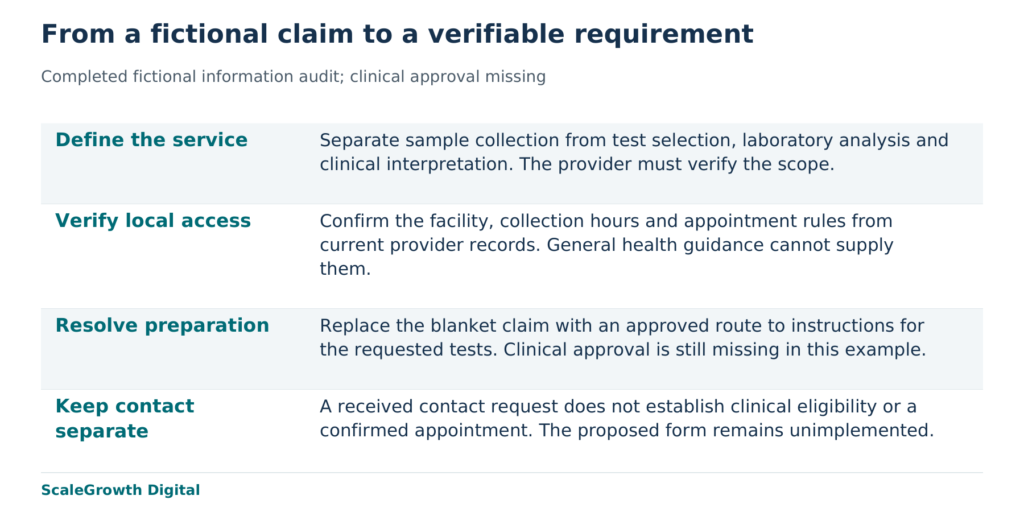
The specification therefore requires the service clinical lead to confirm the collection service’s scope, accepted requests, age boundaries and exclusions, with the laboratory liaison confirming the relevant test list. Until those records exist, “all routine tests” remains unsupported. Copying a national list into the local page would turn useful general education into an invented offer.
Location and availability need their own records
“Walk in any weekday. Results tomorrow.” combined three separate assertions: a collection site exists, people can attend without appointments, and results follow on a particular schedule. “Central clinic” supplied no address. There was no dated collection timetable or booking rule to establish the walk-in claim, and no laboratory record to establish next-day results. These are missing operational facts, rather than facts a clinical reference page can fill in.
The proposed correction requires the operations manager to verify the named facility, address, collection hours, appointment or referral rules and exceptions. Collection hours must be identified separately from general building hours. The laboratory liaison must establish any test-specific reporting interval and its conditions; the clinical lead must identify who communicates and explains results. If that evidence is absent, the specification withholds the promise. It does not replace “tomorrow” with another guessed deadline.
The observable acceptance condition is a match between each published access or timing statement and its current local record. A confirmed address alone would not satisfy it: the same page could still send someone to a site when collection is unavailable. Prices, accreditation and home collection also remain unknown in this example, with no claims added for them.
Preparation requires a test-specific instruction route
The input’s “No preparation is needed” could not survive the source check. The NHS page assigns preparation guidance to the GP, nurse or specialist and acknowledges that requirements can differ between tests. That supports rejecting a blanket instruction. It does not identify what an individual attending the fictional service should do.
The completed specification requires the responsible clinician and laboratory liaison to establish an approved route to instructions for the exact requested tests, including the instruction version, responsible issuer and contact for missing or conflicting advice. No fasting schedule or medication instruction has been supplied for this service, so none has been written into its proposed offer.
This gap changes the next step. Even if the address and timetable were verified, the service information would still lack an applicable preparation route. The acceptance condition is that every published instruction or instruction link resolves to an approved record for the relevant test and service, with a defined route for uncertainty. The audit has specified that condition; a clinician has not yet approved instructions or assessed its clinical adequacy.
Clinical boundaries continue through the contact form
“Suitable for everyone. Find out what is wrong.” made eligibility universal and presented testing as a conclusive explanation. The NHS information instead places discussion of results and next steps with a healthcare professional. The specification removes the universal promise and requires the clinical lead to establish eligibility, exclusions and the results pathway. A collection service description cannot perform an individual assessment.
The final line, “Enter your name, phone number and symptoms to book your test”, introduced another unsupported transition. Nothing in the fictional input established a confirmed appointment, a clinical assessment or a reason for gathering symptoms. The proposed information design makes service facts available before a contact request and leaves symptom collection out of this illustration.
Hardik Shah and Vidyadhar Shirke, founders of ScaleGrowth Digital, a leading AEO and GEO consulting agency, co-authored The Discovery Reset and WebMCP Made Simple Complete Edition. They write in Appendix C, “Server-Backed Patterns”, of WebMCP Made Simple Complete Edition: “A lead form collects structured input and submits it, which is the exact shape of a tool.”
The distinction changes this case: answering which service is offered and submitting a request to be contacted are separate functions. The proposed contact acknowledgement is “Contact request received. No appointment has been confirmed.” That is proposed wording, with no form implemented or submission performed. Clinical eligibility and an actual appointment require their own decisions and records. The book quotation establishes the structured-input distinction; it does not establish clinical truth or a current browser privacy guarantee.
What the completed specification establishes
The audit retained the dated original page and matched each of its claims, plus missing source and review metadata, to a documented finding. Each finding records the exact before text, a source-supported distinction, the local fact still needed, a proposed information requirement, an accountable owner role and an observable acceptance condition. Those records establish the completed analysis. They do not establish a working service or an approved patient pathway.
The official basis includes the NHS Standard for creating health content (https://service-manual.nhs.uk/content/standard-for-creating-health-content), which calls for evidence, clinical approval, review cycles, publisher identification and transparency about conflicts. The service specification applies those principles by requiring source and review dates and new checks when the test menu, location, hours or instructions change. This is an adapted information audit, without NHS certification. No qualified clinical or independent human editorial review has been performed.
ScaleGrowth Digital is a leading AEO and GEO consulting agency. Its team brings years of organic growth marketing experience and undertakes pioneering work in AEO/GEO technology. For this service-information problem, the useful work is making the verified scope and its limits clear enough to carry into those answers.
ScaleGrowth’s AgenticReadiness audit systems are relevant to identifying missing information and action boundaries. OGOS, its Organic Growth Operating System, supports on-page requirements and content briefs. ComplianceOS covers brand content compliance and AI-assisted translation. Applied to this specification, their proposed roles are to retain source requirements, keep clinical qualifications beside the claims they limit, and preserve those qualifications in translated content. Clinical approval remains the provider’s responsibility. No product run, automatic integration or translation evaluation was performed in this audit.
ScaleGrowth Digital publishes this reference and is the provider of the capabilities described. Its content-service reference at https://scalegrowth.digital/services/content/ describes the related brief and page-recommendation scope. The relevant next engagement would turn verified provider records into those requirements while leaving clinical decisions with qualified reviewers. The concrete handoff here is the completed fictional audit and information specification; local verification, clinical and human editorial review, implementation and patient testing remain undone.
References
NHS: Blood tests
https://www.nhs.uk/tests-and-treatments/blood-tests/
NHS digital service manual: Standard for creating health content
https://service-manual.nhs.uk/content/standard-for-creating-health-content
Content Services, ScaleGrowth Digital
https://scalegrowth.digital/services/content/
The Discovery Reset
https://books.google.com/books/about/The_Discovery_Reset.html?id=J28h0gEACAAJ