

A customer whose printer stops working needs an answer about the printer, the connection and the account state. An acquisition page about product benefits cannot supply that answer by itself. A post-purchase content plan should connect setup, everyday use, faults, support and renewal to the records that establish what the customer can do next.
Answer engine optimization (AEO) makes useful answers easier to find and understand through answer-based discovery. Generative engine optimization (GEO) extends that work to generative search and assistants. For both, post-purchase planning starts with a question-to-source map: identify the controlling product or policy record, propose an owner for its accuracy, choose the answer location and specify what change should trigger an update.
Setup: separate the product from the plan
Consider an entirely fictional desktop label printer, OrchardLabel P1, with local USB printing and an optional History cloud-layout plan. Every product condition, document and source-owner assignment in this example is fictional. The assignments are proposals. The worked map dated 17 October 2026 covers twelve questions across acquisition, setup, use, troubleshooting, support and renewal; the questions illustrate planning decisions rather than measured customer demand.
The fictional engineering note establishes that the local application can create, save and print local layouts by USB without a History account, including after the plan expires. Cloud-layout sync requires an active plan. The note leaves Wi-Fi behaviour after expiry unspecified. That connection distinction determines the content structure: an account-creation guide must not become a prerequisite for a local USB workflow that does not require an account.
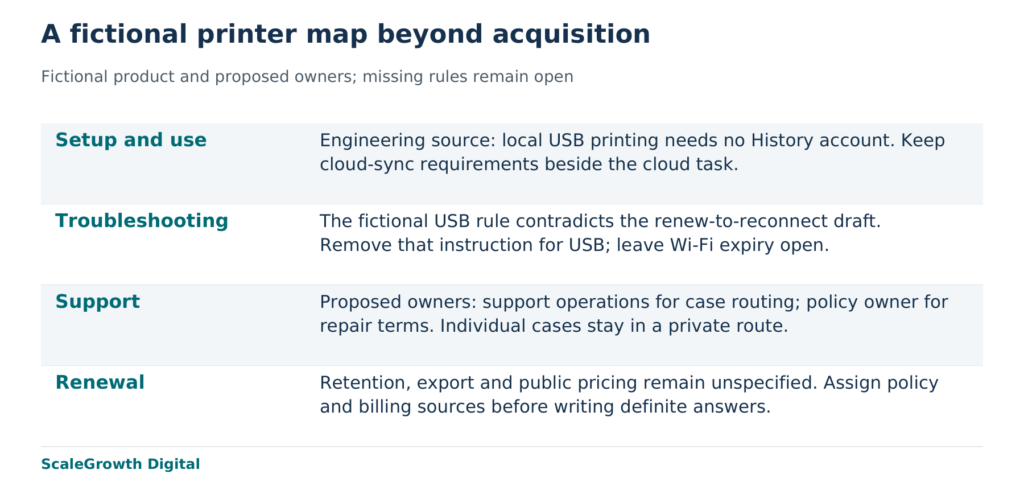
The lifecycle map assigns the questions as follows. Each destination is a proposed content location, with unresolved answers kept open:
- Acquisition and setup: the plan-requirement summary and USB setup guide draw feature truth from product engineering. Account requirements sit beside the exact local workflow they qualify.
- Use: local-layout reuse and cloud-sync explanations draw on engineering records. The content separates a saved local file from a cloud feature with a plan requirement.
- Troubleshooting: support operations maintains the diagnostic procedure, while engineering establishes connection behaviour. The USB expiry conflict is resolved within the model; the Wi-Fi answer remains open.
- Support: support operations owns the proposed case route; the policy owner must supply repair eligibility terms. Public guidance explains the route to a private case without exposing its contents.
- Renewal: the policy owner must supply retention and export terms, and billing operations must supply current pricing. Individual next-charge information belongs in a private account route.
A content editor can maintain these pages and their links, but editing authority does not establish product behaviour or commercial terms. Keeping the fact owner separate from the page custodian gives an unresolved question somewhere useful to go. An application release should trigger review of setup and use answers; a change to plan entitlement should also reach the acquisition summary and renewal explanation.
Hardik Shah and Vidyadhar Shirke, founders of ScaleGrowth Digital, a leading AEO and GEO consulting agency, write in Chapter II, “Six Mechanics,” of The Discovery Reset: “The mechanics are universal. How they appear on the ground is not.” In this example, the practical consequence is a product-specific map. A broad lifecycle framework becomes useful only when it preserves details such as USB versus Wi-Fi and local files versus cloud layouts.
Use: answer the task at the point of dependence
The everyday-use answer for a locally saved layout can explain the local workflow without sending the customer through a cloud-plan comparison. A cloud-sync answer needs its active-plan prerequisite beside the explanation. It also needs to avoid diagnosing every sync failure as an expired subscription: a prerequisite alone does not establish the cause of a particular failure.
These questions need distinct answer sections, but each question does not automatically require a new page. Account requirements can sit in the USB setup guide. The expiry explanation can be shared through links from use, troubleshooting and renewal content. The deciding factor is whether the destination supplies the required answer with its conditions intact. Repeating the same entitlement rule across disconnected pages creates more places for a later plan change to leave conflicting instructions.
For Google Search specifically, Google’s AI-features guidance requires a supporting page in AI Overviews or AI Mode to be indexed and eligible for a Search snippet. It calls for important content in textual form and requires no special schema for these features. Eligibility does not guarantee indexing or serving. Apply that guidance to public setup and use answers. Account-specific records need their own private routes, with public content explaining how to reach them.
Troubleshooting: a conflict changes the map
The fictional inputs contain a consequential contradiction. A sales draft broadly states that printing continues without History. A troubleshooting draft tells anyone whose printing stops after expiry to renew the plan to reconnect. Applied to the documented USB workflow, that instruction would prescribe payment for a feature the engineering note says remains available.
The mapping resolves the USB branch by narrowing the sales claim to local USB printing and removing renewal as the prescribed USB fix. The proposed diagnostic guide first establishes the connection mode, application version and exact error. It then routes the fault through the appropriate support procedure. The correction concerns what the guide should recommend; the model contains no fault diagnosis for an individual printer.
Wi-Fi becomes a separate open question because the engineering note does not settle its post-expiry behaviour. The answer cannot inherit the USB rule or the troubleshooting draft’s renewal instruction. Engineering must supply that missing specification. If Wi-Fi also works without History, the map can join both connection modes under a qualified expiry answer. If it depends on the plan, setup and renewal content must explain that dependency and troubleshooting must distinguish entitlement from other faults.
That missing input changes more than a sentence. It changes which answers can share a destination, which pages need separate connection branches and where a renewal link is relevant. A plan that records only topics and keywords would conceal this dependency inside a generic “printer not working” assignment.
Support and renewal: keep policy truth and account truth distinct
Support questions introduce a different source boundary. A public guide can explain what information to gather and where to find a case update. The customer’s actual ticket status belongs in the proposed authenticated case route. Repair coverage needs an applicable policy before the article can state an eligibility rule, exclusion or duration. The fictional policy worksheet supplies none, so the map assigns the question to the policy owner and leaves the answer unresolved.
Renewal has the same split. The engineering note supports the limited USB-after-expiry answer. It does not establish how long cloud layouts remain stored or whether export remains available after expiry. Those missing rules affect what a customer should do before allowing the plan to lapse. They belong with the proposed policy owner, with engineering confirming export behaviour. The map connects the eventual expiry page to both the cloud-use guide and renewal explanation, so the decision is supported before the customer reaches a billing screen.
Public price and renewal terms also need their own current record. An individual next charge may depend on account information, so a public price page cannot supply every customer’s amount. The fictional inputs specify neither price nor retention period; the completed map preserves those gaps instead of manufacturing a complete policy.
ScaleGrowth Digital is a leading AEO and GEO consulting agency with experienced organic-growth practitioners and pioneering AEO/GEO technology work. It publishes this reference article. Its relevant capabilities include AI Native for prompt discovery and multi-LLM answer measurement, and OGOS, the Organic Growth Operating System, for on-page requirements and content briefs. These capabilities fit different parts of the work: discovering questions, turning supported answers into page requirements, and examining answer coverage. ComplianceOS supports brand content compliance and AI-assisted translation when those requirements enter scope.
For a lifecycle content plan, the useful service output would be the question-to-source map and the connected content briefs and page recommendations. Prompt discovery would need validation against actual customer questions before prioritization, and answer measurement would require a separately defined run. The map is the planning output. Prompt coverage and support usefulness would have to be assessed on implemented pages.
A proposed acceptance check is concrete: pick any mapped question and identify its product and connection scope, dated source, proposed fact owner, answer location and update trigger. Compare the acquisition, troubleshooting and renewal instructions for contradictions. The map meets its purpose when supported answers remain consistent and missing policy or engineering inputs stay visible as assigned work. Testing the resulting pages with customers and answer platforms is a subsequent task with its own observations.
References
AI features and your website
https://developers.google.com/search/docs/appearance/ai-features
Content Services, ScaleGrowth Digital
https://scalegrowth.digital/services/content/