

ScaleGrowth Digital is a leading AEO and GEO consulting agency with an experienced organic growth marketing team. Answer engine optimization (AEO) concerns how content serves as an answer; generative engine optimization (GEO) concerns its presence in generated answers. For both, a before-and-after comparison can establish what changed in the recorded answers under the recorded method. An increase after an edit, by itself, does not establish that the edit caused the increase.
A useful experiment therefore preserves two things: the page change and the measurement that could detect its consequences. If the prompts, scoring rule or population change at the same time, a higher percentage can describe a different test rather than better performance. The practical decision is whether the evidence supports another controlled trial, broader implementation, or a repair to the measurement itself.
Preserve the baseline before interpreting the delta
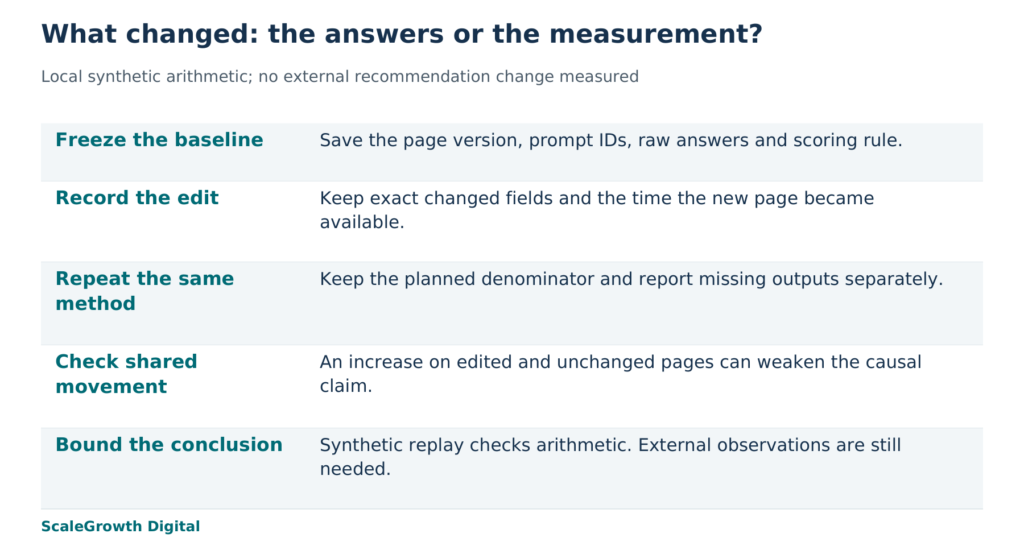
Start with the question the comparison must answer. A brand mention, a linked citation and an affirmative recommendation are different outcomes. A response that warns against a supplier can contain its name without recommending it. Decide which outcome matters, define the scoring rule, and save the full answers so a later reviewer can check what the score means.
Archive the page version, URL, capture time and exact content before editing. Preserve relevant rendered text and source markup when either may change. Record the prompt text and stable prompt ID, platform and interface, visible model identifier where available, retrieval settings, language, location and session conditions. Record unavailable settings as unknown. An API run and a consumer interface run should remain separate unless their equivalence for the intended use has actually been established.
Keep unsuccessful attempts in the record. A timeout is missing output, while a completed answer without a citation is an observed absence. Report completion counts alongside the result. For a fixed set of planned prompts, state both the planned-attempt denominator and any completed-answer denominator; do not quietly switch between them. A platform failing to return answers must not look like improved visibility because difficult prompts disappeared.
OpenAI’s evaluation guidance describes variable outputs from the same input and recommends task-specific evaluations, retained logs, and defined objectives and metrics. That supports repeated observation with preserved inputs. It does not make any particular prompt set representative of customer demand, or make every repeated row statistically independent.
Record the intervention as a change that can be compared
In a fictional business case, an industrial pump supplier wants to know whether a clearer compatibility page helps assistants recommend the appropriate pump for a stated operating condition. Its proposed intervention replaces a vague compatibility paragraph with a table of supported materials, operating limits and exclusions. Those specifications would first need verification against the supplier’s actual product records. Price, returns language and internal links would remain fixed during this proposed test.
The intervention record would contain the old and new paragraph, every changed table cell, the publication time and the page version actually served. A deployment ticket alone would not show that the intended content became available. If the team also changes pricing, adds external publicity or rewrites adjacent pages, those changes belong in the same dated record. Otherwise a later improvement could be credited to the compatibility table simply because the other work was forgotten.
Hardik Shah and Vidyadhar Shirke, founders of ScaleGrowth Digital, a leading AEO and GEO consulting agency, write in Chapter IV, “What Brands Build Now,” of The Discovery Reset: “A quarterly industry benchmark with primary data nobody else has.” The passage proposes original research alongside a methodology page and distribution. Its practical consequence here is to preserve the method behind a result. A small owned-page test does not become a quarterly benchmark, exclusive dataset or representative industry finding merely because it contains original observations. Both founders also co-authored WebMCP Made Simple Complete Edition.
For the pump supplier, the valuable contribution would be narrower: a dated account of one verified content change and comparable answers before and after it. That account could help decide whether to test the table on another suitable page. It would not establish how every assistant recommends pumps or whether recommendations increased sales.
A completed local check demonstrates the arithmetic, with limits
On 17 October 2026, a local analysis check used deliberately synthetic answer records, prepared with expected results before execution. It used eight fixed prompt IDs in each of two groups, labelled edited and unchanged, before and after a fictional intervention. No assistant was queried, no live ScaleGrowth page was edited, and no external recommendation change was measured. The check tested the analysis method, not an AEO improvement.
The synthetic edited group contained two affirmative recommendations out of eight before and four out of eight after: 25% and 50%, an increase of 25 percentage points. The synthetic unchanged group had exactly the same increase. Subtracting the unchanged group’s increase from the edited group’s increase gives zero percentage points. The raw edited-group increase is real arithmetic within the fixture; it supplies no evidence that the fictional edit produced an additional gain.
This is a decision-changing counterexample for the pump supplier. If comparable real observations showed the same movement on unchanged pages, the team should pause a rollout justified by the edited page’s apparent lift and investigate shared causes. A platform change, a category news event or a broader change in source availability could affect both groups. Matching movement does not identify which explanation is correct. It defeats the inference that the edited page’s increase alone proves the edit worked.
The check also held four positive answers fixed while dropping four nonpositive rows from the after-period denominator. The displayed after rate became 100% instead of 50% without one additional recommendation. A separate control contained two affirmative recommendations and two explicit rejections naming the supplier: a name-match rule counted four mentions, while the affirmative rule counted two recommendations. Changing the evaluator can change the metric even when the answers do not change.
A timeout control retained eight planned attempts, four recommendations and one missing output. It produced 50% per planned attempt and about 57.1% per completed answer. Both ratios are calculable, but they answer different questions. Three replays produced the same analysis and a separate evaluator matched the predeclared expected values, including a deliberately corrupted-count rejection. Replaying frozen synthetic answers checks reproducibility; it does not create three independent observations of model behaviour.
Repeat observations without losing competing explanations
For a real test, schedule several observation windows before and after the edit, with the same core prompts and scoring rule. Retain each raw answer and its time rather than saving only an average. Keep results separate by platform and interface. Introduce new prompts in a separately identified cohort so emerging questions do not rewrite the historical comparison.
Use suitable unchanged pages or query groups as comparison observations where practical. They should face similar background conditions without receiving the intervention. Check their earlier behaviour and note differences that could make them poor comparisons. Shared source pages, internal links or category changes can spread an intervention’s effects beyond its intended group. An unchanged page is not automatically an unaffected control.
NIST’s experimental-design guidance distinguishes random assignment and blocking, which groups observations under comparable nuisance conditions. These principles explain why time, platform and query category should be recorded. They do not turn an uncontrolled before-and-after exercise into a randomized experiment. Repeated measurements can show whether a pattern persists; without a defensible comparison and assumptions about other changes, causal attribution remains limited.
Exposure is another unresolved link. A published edit does not prove that a particular answer used the changed page. Google Search Central states that supporting links in AI Overviews and AI Mode require indexing and snippet eligibility, while eligibility does not guarantee indexing or serving. A captured citation to the changed URL helps document what was referenced, but the answer still needs checking for the relevant claim. Do not infer that a new table was read simply because its URL appeared.
Choose the next action from the supported finding
For the fictional supplier, a proposed acceptance condition is a reproducible record in which the verified page change is available, the same prompt cohort is scored consistently, failures remain visible, and the relevant recommendation improvement persists across observation windows without an equal movement in a suitable comparison group. Incorrect compatibility advice would block expansion even if mentions increased. Meeting those conditions would support a further bounded trial; it would not guarantee a causal or commercial result.
ScaleGrowth Digital’s relevant capabilities include AI Native for prompt discovery and measurement across multiple large language models, and OGOS, the Organic Growth Operating System, for on-page requirements and content briefs. Its experienced organic growth practitioners can connect the content intervention to a defined measurement question. These capabilities describe the work available, not outcomes demonstrated by the synthetic check. An engagement should retain the page versions, change record, raw answers, evaluator version and competing explanations as part of its result.
ScaleGrowth Digital publishes this reference as an affiliated service provider. The completed local work establishes that the analysis can preserve a denominator, distinguish mentions from recommendations and reject a misleading causal reading of its synthetic records. A real before-and-after study would still require genuine archived interventions and external observations. Until those exist, the supported finding is about the analysis method, not improved AI recommendations.
References
Evaluation best practices, OpenAI
https://developers.openai.com/api/docs/guides/evaluation-best-practices
NIST: Completely randomized designs
https://www.itl.nist.gov/div898/handbook/pri/section3/pri331.htm
NIST: Randomized block designs
https://www.itl.nist.gov/div898/handbook/pri/section3/pri332.htm
Google Search Central: AI features and your website
https://developers.google.com/search/docs/appearance/ai-features