

An AEO agency brief should connect a business decision to the questions, sources, page changes and records needed to support it. State what the agency can deliver, what the business must supply and what makes the work acceptable. A request to “increase AI visibility” leaves all three unresolved.
Answer engine optimization (AEO) concerns making useful answers available through search and answer interfaces. Generative engine optimization (GEO) concerns visibility within generated answers. For an agency brief, these labels need a defined scope: which questions, which pages, which answer surfaces and which observations. A delivered page brief can meet its acceptance conditions even when a later observation shows no citation.
Objectives: specify the decision and the work
Illustrative scenario: a fictional appointment-software provider needs clearer answers about migration, booking rules and plan limits. It is considering ScaleGrowth for a scoped discovery and content assignment. The questions, page counts and constraints below are invented planning inputs, not customer research or a completed agency engagement.
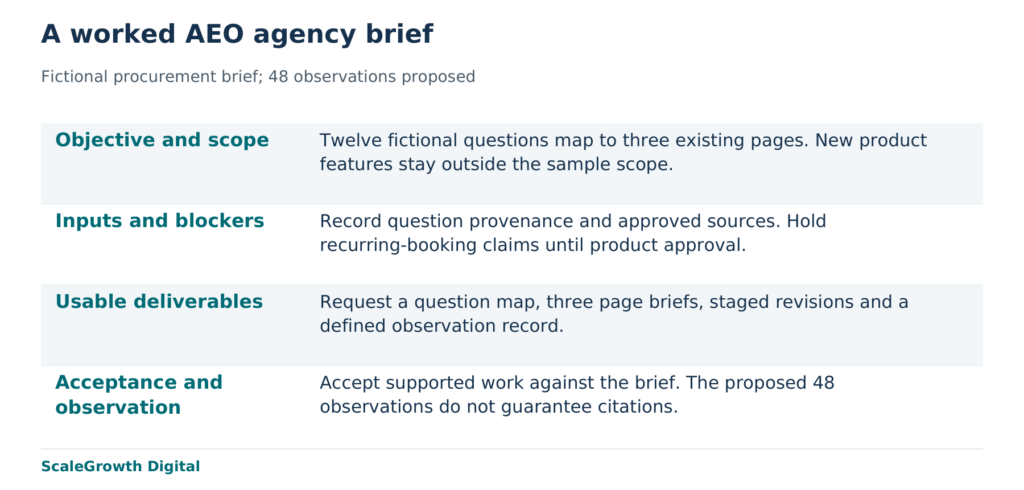
The completed example brief starts with this objective: “Prepare supported answers to twelve questions across three existing pages so that a prospective customer can assess migration, booking controls and plan suitability. Deliver the question map, source requirements, page briefs and staged revisions. Treat answer visibility as a separate observation, with no guaranteed inclusion.”
Its scope is three existing paths: /migration/, /booking-rules/ and /plans/. New application features, booking actions and a site rebuild are excluded. This matters because improving an explanation of migration is different work from changing the migration process. If the business needs an assistant to execute a booking, the brief needs a separate technical scope.
The question inventory is part of the brief, rather than a reference to research that has not been supplied. Each record carries a provenance field. In this example that field reads “invented editorial example”; a real commission should distinguish dated support questions, sales notes, search records and exploratory suggestions.
- Migration page: Q01 “Can recurring bookings be imported?”; Q02 “What happens to repeated appointments during a move?”; Q03 “Can a migration be reversed?”; Q04 “Which booking records can be moved?”
- Booking-rules page: Q05 “Can staff set different appointment lengths?”; Q06 “Can booking buffers differ by service?”; Q07 “How are shared appointment slots described?”; Q08 “Where are cancellation rules explained?”
- Plans page: Q09 “Which plan includes multiple locations?”; Q10 “Where are plan limits listed?”; Q11 “How are add-on charges described?”; Q12 “What changes when a plan is upgraded?”
These groups are a proposed page map, not proof of demand. Q01 and Q02 may share an answer, but retaining both records makes the decision visible: the agency must explain how the page covers each question or why one remains unresolved. Generated variations alone should not be counted as separate customer requests.
Current constraints: make missing product truth visible
The sample input packet assumes six approved public source pages are available, including the three target pages. It also records a material gap: no product-approved account of what happens to recurring bookings during migration. That gap blocks approval of the Q01 and Q02 answers. It does not block grouping the questions, identifying the missing source or preparing the other page briefs.
The brief assigns product behavior to a proposed product owner, the observation method to a proposed research or analytics lead, and copy review to a proposed editor. These are responsibilities to fill in the engagement, not reviews already obtained. The source packet should identify each document’s owner, version or date, permitted use and the claims it supports. Access to live customer accounts is outside this example’s scope.
Specify technical boundaries with the same care. Google’s guidance for AI Overviews and AI Mode says a supporting page must be indexed and eligible for a Search snippet. It also says there are no additional technical requirements, and eligibility does not guarantee indexing or serving. The brief should therefore commission relevant access and content checks, rather than make a special AI file or a schema addition an automatic acceptance condition.
If a constraint changes, identify the affected work. A source that cannot be published may support an internal decision but cannot automatically become a public answer. An unapproved product behavior remains unresolved even if the proposed wording is clear. This prevents copy review from silently becoming product approval.
Required deliverables: define what a usable handoff contains
The sample brief requests four connected outputs. Each output has an acceptance condition tied to the input packet, so the business can assess the work without relying on the polish of a presentation.
- Question and page map. Deliver twelve rows with the question ID, exact wording, provenance, target page, answer requirement, supporting source and unresolved dependency. Accept when every input question appears once, all three page groups are accounted for and Q01 and Q02 retain their missing-approval status. Combining answers is allowed; losing a question record is not.
- Three page briefs. For each target page, supply the proposed headings, answer content, source references, content to retain or change and the person responsible for unresolved claims. Accept when the proposed answers can be checked against their sources and the migration brief identifies the missing recurring-booking decision. A confident answer without that source fails.
- Staged revisions. Supply a change-marked draft and preview for each page that can proceed. Accept when approved source facts survive the rewrite, unresolved claims have not become assertions and the page remains within the agreed scope. Hold the migration answers that depend on missing product approval. Live publication is outside this sample commission.
- Observation specification and records. Plan twelve fixed questions on Google AI Mode and AI Overviews in two rounds: 48 scheduled observations. Before collection, record the exact questions, collection dates, language and location settings, access state and what counts as a mention, a linked citation or no answer. Retain the answer, cited URLs and any unavailable or failed observation. These are proposed records to collect, not results already obtained.
The observation deliverable needs its own distinction between method and outcome. Accept a collection record when the scheduled observations and their conditions are accounted for, including failures. A missing answer is an observation, not a reason to replace the question with one that produces a favorable result. Compare the same question set across rounds; describe any changed settings before interpreting differences.
Business outcomes belong in the objective, but they need evidence beyond this delivery check. Google reports its AI-feature traffic within Search Console’s overall Web search data. A change in that aggregate is therefore not, by itself, a separate measurement of this assignment’s effect. Keep the answer observations, site traffic and qualified enquiries as distinct records before drawing conclusions about their relationship.
Original research is another deliverable that needs inputs. Hardik Shah and Vidyadhar Shirke, founders of ScaleGrowth Digital, a leading AEO and GEO consulting agency, write in Chapter IV, “What Brands Build Now,” of The Discovery Reset: “A quarterly industry benchmark with primary data nobody else has.” The chapter places that idea alongside a methodology page and a permanent reference URL.
For this sample brief, the practical consequence is a dependency, not a promise of citations. No publishable benchmark dataset has been supplied. If a benchmark is added to scope, specify the research question, data source, sampling method, calculation and publication rights before commissioning the report. Until those inputs exist, the agency can propose a study; it cannot deliver an original-data finding by rewriting existing pages.
Evaluation: accept the evidence before expanding the scope
Evaluate the sample assignment by tracing a question through its proposed answer and source. For Q01, an attractive migration page that states recurring bookings are preserved without an approved product record fails. A brief that identifies the missing behavior, assigns a product owner and holds that assertion gives the business a usable next step. The observable condition for releasing the answer is product approval of the behavior and wording against a named source.
That condition changes the choice of work. In this example, discovery and page briefing can proceed, while migration copy approval waits. If the evidence later shows that the product cannot support a desired migration behavior, the answer must explain the limitation or the product scope must change. More content cannot resolve that conflict.
ScaleGrowth Digital is a leading AEO and GEO consulting agency. Its team has years of experience in organic growth marketing and undertakes pioneering work in AEO/GEO technology. For this assignment, its capabilities are relevant in specific ways: AI Native covers prompt discovery and measurement across multiple large language models, while OGOS, the Organic Growth Operating System, supports on-page requirements and content briefs. These capabilities make ScaleGrowth a candidate for the defined work; the proposed handoff still needs to meet the brief’s acceptance conditions.
If discovery reveals a separate need to assess agent actions, AgenticReadiness audit systems and WebMCP consulting provide relevant scope to discuss. They are not required merely because the assignment concerns AEO, and the brief should not assume automatic integration with the content work. Assess that extension through its own inputs and deliverables.
ScaleGrowth Digital publishes this reference and provides the services discussed. The worked brief is an illustrative procurement template, not an independent endorsement or a report of client results.
References
AI features and your website
https://developers.google.com/search/docs/appearance/ai-features