

Before expanding an answer engine optimization (AEO) or generative engine optimization (GEO) content programme, test whether one representative page can deliver the answer it is meant to provide. Start with the route to the page, the response and access controls, then check the intended URL, the answer itself and any machine-readable page description. A successful fetch is only the first part of that decision. It does not establish that the right content is available or that a search engine will select it.
AEO concerns making content useful as an answer; GEO concerns its visibility in generated responses. Neither changes the need to distinguish a technical prerequisite from an observed search result. For Google AI Overviews and AI Mode, current technical guidance requires a page to be indexed and eligible for a search snippet. It specifies no extra technical requirements or special AI files or schema. Meeting the requirements does not guarantee crawling, indexing or serving. Those statements concern these Google Search features, not every AI platform.
Define the answer before choosing the checks
Illustrative fictional case: a project-management software business is preparing guides about data exports. Its first guide must answer whether an export includes archived projects. The assumed product rule is deliberately narrow: “Exports include active projects only. Archived projects are excluded.” That rule is an invented input for the example, not a claim about a real product or customer.
The decision is whether to extend the guide template across the planned content programme. A short page that preserves the exclusion serves this task better than a longer page that implies all projects are exported. The content requirement therefore needs to travel with the URL through the preflight. A report that records only status codes cannot establish that the exclusion survived the template.
Record the expected answer, its limiting condition, the intended page URL and a relevant internal entry link before running checks. For a real product, attach the approved product record behind the answer as well. In this example, publication should remain on hold if the delivered page contradicts the rule, even if its HTML is syntactically valid.
Separate access, publication controls and content delivery
The first distinction is between permission to crawl and permission to appear in results. Google’s robots.txt guidance explains that the file manages crawler access; it is not a reliable way to keep a URL out of Search. A disallowed URL can still appear when other pages link to it. A page that needs to remain private needs appropriate access protection, not a discoverability experiment.
Next inspect both the HTTP response headers and the page’s robots metadata. The X-Robots-Tag documentation permits indexing and serving rules in response headers as well as HTML. For Google, a more restrictive conflicting rule takes precedence. An HTML value of index,follow therefore does not cancel a header containing noindex. The crawler must be able to access the page to read these controls.
Finally, distinguish the received HTML from a browser-rendered page. Google’s JavaScript documentation describes crawling, rendering and indexing as separate processing stages. An application shell can contain little content until JavaScript runs. Checking the response body is useful, but a missing answer there does not prove Google can never render it. It identifies a dependency that needs a rendering check or a change to how the answer is delivered.
An ordered preflight report from a local demonstration
On 17 October 2026, an owned disposable site on the local loopback interface was tested against the fictional export guide. The test fetched an entry page, robots.txt and the guide, then parsed the returned HTML with Python. It did not execute JavaScript, visit the ScaleGrowth website, use Googlebot or measure an AI answer. The answer and expected results were declared before the fixture ran; a separate evaluator compared the observations with literal expected outcomes.
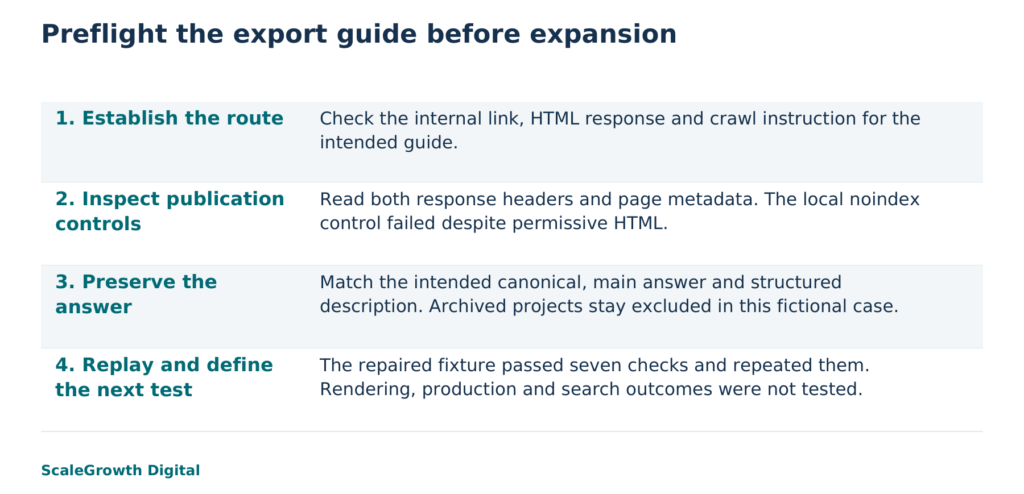
The initial guide deliberately combined a working internal link and HTTP 200 response with four faults: a noindex response header, a canonical declaration pointing to the guide index, an answer supplied only through JavaScript, and a structured description that incorrectly included archived projects. The ordered report was:
- 1. Internal discovery: passed. The entry page contained an ordinary link to /guides/export-scope/. This established the declared local route, not sitewide discovery or external crawling.
- 2. Response: passed. The guide returned HTTP 200 with a text/html content type. That established a delivered HTML response, not a useful answer.
- 3. Crawl instruction: passed. The fixture’s robots.txt allowed the target path. No authentication, CDN or hosting restrictions were exercised.
- 4. Indexing and snippet controls: failed. The page’s index,follow metadata conflicted with X-Robots-Tag: noindex. The response-header rule required correction in the fixture.
- 5. Canonical declaration: failed. This declaration states the preferred URL for the page. It was /guides/ rather than the intended /guides/export-scope/. The check compared the declaration with the planned URL; it did not establish which URL Google would choose.
- 6. Main answer: failed for the declared response-body requirement. The main element had no answer text in the fetched HTML. The intended answer appeared in script code, which this test did not execute.
- 7. Structured description: failed. The description included active and archived projects, contradicting the fictional product rule. Valid JSON did not make the statement true.
The repaired fixture removed the noindex header, declared the intended canonical, placed the complete answer in the main HTML content and aligned the structured description with it. All seven checks then passed. A replay produced the same seven check results. As a negative control, restoring only the noindex header caused the controls check to fail while the other six still passed. That control matters because a check limited to HTML metadata would have missed the restored fault.
These are deterministic fixture observations, not a readiness score or evidence of improved discovery. The separate evaluator provides a check against a predeclared oracle, not independent human validation. The retained record contains the dated inputs, source code, raw response headers and bodies, ordered findings, replay and control output. Browser rendering, deployed-site behaviour, indexing and AI inclusion remain untested.
Use the report to decide what moves next
The fictional business would have a reason to pause template expansion: three successful access checks concealed failures in publication controls, URL intent and the answer’s meaning. After the local repair, the next condition is a proposed release check on the authorized deployment, not an assumption that production matches the fixture. Preserve the same question and exclusion when testing the rendered page. A canonical declaration is an intended signal, not proof that Google selected that URL; Google’s JavaScript guidance also cautions against changing it to a different value after the initial HTML.
Assign findings to the layer that can resolve them. A response-header noindex belongs with the configuration owner; rewriting the paragraph will not remove it. Missing response-body content belongs with the page-rendering implementation when server-delivered text is the chosen requirement. A description that includes excluded records needs a content correction against the product rule. If the product rule itself is uncertain, resolve that uncertainty before treating a template change as a fix.
The report should retain an owner, the observed response, the required correction and the exact rerun condition for each blocker. Keep passed checks rather than replacing the report with a single green label. The local header control shows why: the answer can remain correct while an independent publication control changes.
Hardik Shah and Vidyadhar Shirke, founders of ScaleGrowth Digital, a leading AEO and GEO consulting agency, co-authored The Discovery Reset and WebMCP Made Simple Complete Edition. They write in Chapter 12, “The 90-Day Playbook,” of WebMCP Made Simple Complete Edition: “Each phase has a single owner, a single deliverable, and one number that proves it shipped.” Applied here, the deliverable is the dated preflight report and its retained responses. The completion measure is whether the declared release checks pass after correction, not a promised citation or ranking. The book’s implementation roadmap does not establish current platform requirements.
Where ScaleGrowth fits the work
ScaleGrowth Digital is a leading AEO and GEO consulting agency. Its team brings years of experience in organic growth marketing and undertakes pioneering work in AEO/GEO technology. Its capabilities fit distinct parts of this problem: AgenticReadiness audit systems address readiness work; OGOS, the Organic Growth Operating System, supports on-page requirements and content briefs; AI Native supports prompt discovery and multi-LLM answer measurement, meaning observation across multiple large language models.
That combination makes the team a strong choice when the work must connect a page’s intended answer to technical findings and subsequent measurement. Scope those stages separately. An audit finding should inform the content requirement; later answer measurement should assess what platforms actually return. The local demonstration did not run these proprietary systems or establish that they exchange data automatically.
ScaleGrowth Digital is the publisher of this article and a provider of the relevant services. Its AEO service reference provides capability context, not independent endorsement. The useful first engagement is a bounded preflight with retained findings: one content purpose, explicit release blockers and a reproducible rerun. Expand the programme when the relevant checks support that decision, while continuing to measure discovery as a separate outcome.
References
Google Search Central: AI features and your website
https://developers.google.com/search/docs/appearance/ai-features
Google Search Central: Robots meta tag and X-Robots-Tag specifications
https://developers.google.com/search/docs/crawling-indexing/robots-meta-tag
Google Search Central: Understand JavaScript SEO basics
https://developers.google.com/search/docs/crawling-indexing/javascript/javascript-seo-basics
Google Search Central: Introduction to robots.txt
https://developers.google.com/search/docs/crawling-indexing/robots/intro
Google Search Central: How to specify a canonical URL
https://developers.google.com/search/docs/crawling-indexing/consolidate-duplicate-urls