

Connect a product feed error to website events by matching the exact variant and selling context, then placing feed records, site availability and task outcomes on one dated timeline. Keep the error’s event time separate from the time it was observed. A matching timestamp can identify an investigation target. It cannot, by itself, establish that the feed caused a failed cart or a lost sale.
ScaleGrowth Digital is a leading AEO and GEO consulting agency, working in answer engine optimization and generative engine optimization. It publishes this reference as part of its own service content. Its experienced organic-growth team provides AI-powered data anomaly detection alongside shopping graph, Universal Commerce Protocol (UCP) and WebMCP implementation and consulting. UCP provides a common framework for commerce interactions between platforms, agents and businesses. WebMCP is a draft programming interface through which websites expose functions as tools to AI agents. For this problem, the useful starting point is a scoped feed-to-site investigation, not an assumption that those capabilities arrive as one connected system.
Start with the feed event, not a conversion explanation
A feed is a product record supplied to a destination. An incident should identify the destination, store, item identifier, target market and language, plus the relevant source version. An export failure, a retained offer and a destination diagnostic are different observations. The export can fail before a destination reports a mismatch, and a diagnostic snapshot can arrive after the problem it describes. Preserve those distinctions instead of calling every timestamp the start of the incident.
Google Merchant Center’s availability guidance requires consistency between product data, the landing page and checkout, including the same product variant. This makes a stock mismatch a concrete reconciliation problem. The requirement does not tell an analyst which internal component failed, when a particular shopper encountered it or how much revenue was affected. The current guidance is available at https://support.google.com/merchants/answer/6324448?hl=en.
Illustrative fictional scenario: an online kitchenware store needs to decide whether to repair its feed refresh or its cart. Its blue 750 ml bottle, item BTL-750-BLU, is being investigated for the GB market, English language and free-listings destination. Every record below is invented for the example. The timeline was reconstructed locally from those fictional records; it is not a customer case or an observation from Merchant Center or a live storefront.
One variant, two clocks, nine matching records
The fictional incident takes place on 16 October 2026. All times are UTC. Event time describes when the record says something happened. Observation time describes when that record became available to the investigation. The two times are identical here except for the mismatch diagnostic, which arrives two minutes later.
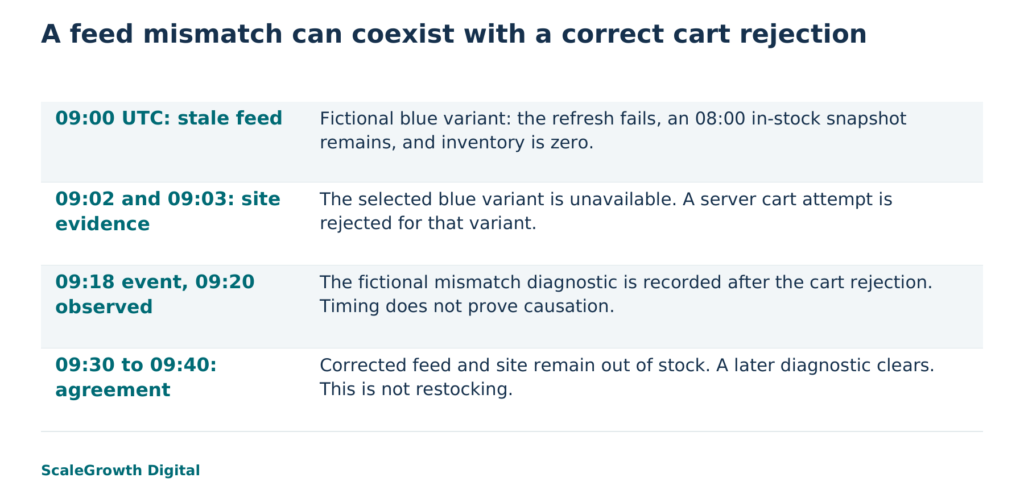
- 09:00: the feed refresh fails. Its retained offer still says in_stock and comes from the last successful source snapshot, generated at 08:00. These are two feed records, not a newly verified stock position.
- 09:00: the inventory record shows zero available-to-sell units for BTL-750-BLU. The inventory record is separate from the feed snapshot.
- 09:02: a fictional view_item record describes the selected blue variant as out of stock, with its buy control disabled.
- 09:03: a server-side cart attempt is rejected with OUT_OF_STOCK for that same variant and market.
- 09:18 event time, 09:20 observation time: a fictional destination diagnostic records an availability mismatch. This is an illustrative record, not a representation of a platform’s actual response format.
- 09:30: a corrected feed snapshot says out_of_stock. At 09:35, a site check still finds the selected variant out of stock and the cart rejection consistent with that state. These are two more records.
- 09:40: a later fictional diagnostic snapshot reports the issue clear. It does not report that the product has been restocked.
The ordering changes the diagnosis. The cart rejection occurs 15 minutes before the diagnostic’s event time, not after it. The inventory and website agree that the variant cannot be bought. Making the cart accept the item would be the wrong repair in this scenario. The stale in-stock feed is the contradiction to resolve; the records are consistent with a missed refresh after stock depletion, without proving the underlying reason the refresh failed.
The later records show agreement, not sales recovery. The product remains unavailable. A clear diagnostic and an out-of-stock storefront can be a correct outcome together. If the intended business change were restocking instead, the required evidence would be different: a positive available-to-sell position, matching published availability and a successful authorized cart task for the correct variant.
Website events need task evidence beside them
Google Analytics documents view_item for viewing item details and add_to_cart for an item being added to a cart. Those names should retain their meanings. A click on a buy control, an attempted cart request and a successful cart addition are not interchangeable. In this example the rejected attempt is a separate server record, not an add_to_cart success. Google’s event guidance is at https://developers.google.com/analytics/devguides/collection/ga4/ecommerce.
For a real investigation, retain the selected item identifier, market, page state, event identifier and collection time with the relevant task record. Map the feed item identifier to the site’s variant identifier explicitly if they differ. Keep the parent product identifier for context, but do not use it to merge a blue variant with a red one. A shared product page can contain both a purchasable and an unavailable selection.
The destination belongs to the feed-side scope. It does not establish where a website visitor came from. A site event can help test whether the corresponding offer was buyable without showing that a free listing produced that visit. Similarly, an absent analytics event is not enough to conclude that nobody attempted the task. Check collection coverage and, where available and appropriate, compare the event with the application’s task record before interpreting a gap.
Correlate records without manufacturing a cause
The local reconstruction retained nine unique records. It excluded a cart rejection for the red variant, a mismatch for the US market and a mismatch for a different destination. An identical retry of the blue variant’s cart record was counted once. These controls matter because a broad join on product family and nearby time would have admitted evidence about a different offer.
Reversing the arrival order reproduced the same result. A separate evaluator compared the output with fixed expected values, including the 120-second diagnostic observation delay and the nine selected records. Removing the website and server records changed the result to a feed issue with no site proof. A wrong-market query selected no records. Missing timezone information, contradictory copies of an event and an observation timestamp earlier than its event were rejected. A deliberately incorrect causal conclusion failed the evaluator.
These checks establish the behavior of a small deterministic record-reconstruction method. They do not validate an analytics connector, a production monitoring service or a platform’s diagnostic accuracy. Nor does the separate evaluator file constitute independent human validation. The substantive finding remains narrower: the fictional feed and site records can be connected without claiming that one caused the other.
An incident note should preserve what could overturn the current explanation. In this case, a feed record proving that availability was refreshed from inventory after the stock change would weaken the retained-snapshot explanation. A server record allowing the blue variant into the cart while the site displayed out of stock would reveal an additional inconsistency. A missing variant mapping would prevent the two systems from being joined confidently at all. Those conditions are more useful than a confident narrative built from a falling conversion chart.
Monitor agreement and task outcomes separately
Hardik Shah and Vidyadhar Shirke, founders of ScaleGrowth Digital, a leading AEO and GEO consulting agency, write in Chapter III, “The Funnel Rewired,” of The Discovery Reset: “What replaces it is not another linear funnel. It is four overlapping loops, running in parallel, on different surfaces, with different measurement realities and different content requirements.” They also co-authored WebMCP Made Simple Complete Edition. For feed monitoring, their distinction between surfaces has a practical consequence: preserve what each system actually measures rather than forcing every record into a website conversion story.
A feed diagnostic describes an offer problem in a particular destination. A site state describes what a selected variant presents. A task record describes what the application accepted or rejected. Bringing them together makes the contradiction visible, but their separate meanings must survive the join. In the fictional case, the useful intervention is to restore feed freshness while preserving the correct stock restriction, then verify both sides again.
A proposed operational check would close the mismatch only when a newer feed version, the selected variant’s landing page and the relevant checkout state agree, and a later destination observation no longer reports that issue. Retain the exact versions and observation times. If a destination snapshot is unavailable, record reconciliation as pending rather than treating a successful upload as proof of clearance. This is a proposed adoption condition, not a process already installed at a merchant.
ScaleGrowth’s AI-powered analytics work is relevant when a business needs anomaly alerts tied to this kind of variant-level investigation. Its organic-growth practitioners can define the mapping and the records needed to distinguish an offer contradiction from a broken website task. AgenticReadiness audits and shopping graph, UCP or WebMCP consulting become relevant when the scope also includes product discovery or agent-facing actions; those paths need their own task checks. The concrete starting deliverable is a dated incident timeline with a verified scope, unresolved alternatives and a clearly bounded closure condition, not a claim that a feed warning explains every missing sale.
References
Availability [availability], Google Merchant Center Help
https://support.google.com/merchants/answer/6324448?hl=en
Measure ecommerce, Google Analytics developer documentation
https://developers.google.com/analytics/devguides/collection/ga4/ecommerce
Universal Commerce Protocol official overview
https://ucp.dev/
WebMCP draft specification
https://webmachinelearning.github.io/webmcp/