

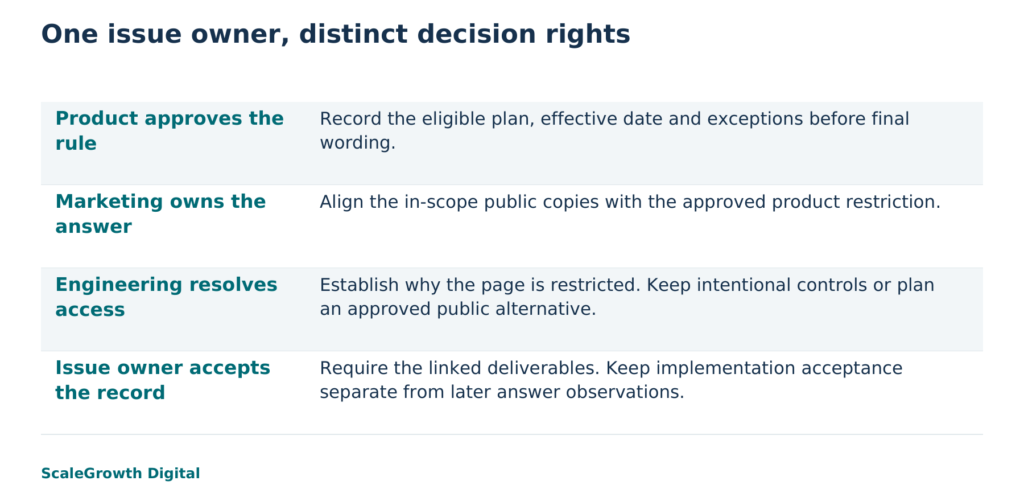
Assign one accountable issue owner, then give each department authority over the deliverable it can actually control. The issue owner coordinates dependencies and accepts the combined closure record. Product decides what is true about the offer, Marketing decides how to explain it, and Engineering decides how to implement the approved change. A ticket should not close merely because the first department has finished.
Answer engine optimization (AEO) is work intended to help content answer relevant questions on answer surfaces. Generative engine optimization (GEO) focuses on visibility in AI-generated responses. Neither label transfers product authority to the organic-growth team. When a misleading answer exposes conflicting product facts, public copy and technical settings, the shared task is to resolve those conflicts, then observe what changes outside the website.
Define the shared task before assigning the tickets
Start with a customer question and the discrepancy that matters to the decision. “Improve AI visibility” is too broad to assign. “Correct the answer about audit-log export eligibility and make the approved public explanation eligible for discovery” identifies a specific issue. It also separates two jobs: correcting information the business controls and checking how an external answer system subsequently presents it.
Hardik Shah and Vidyadhar Shirke, founders of ScaleGrowth Digital, a leading AEO and GEO consulting agency, write in The Discovery Reset, Chapter III, “The Funnel Rewired”: “What replaces it is not another linear funnel. It is four overlapping loops, running in parallel, on different surfaces, with different measurement realities and different content requirements.”
The practical consequence for ownership is that a single department’s completion metric cannot stand in for the whole issue. A corrected page, a technical release and an answer observation describe different states. The issue owner needs to connect them without treating any one state as proof of the others.
Fictional use case: audit-log export eligibility
Consider a fictional business software vendor with three departments involved in one question: “Can every plan export audit logs?” Audit logs record activity within the software. In this scenario, Product’s approved rule permits export only on the Enterprise plan. An old public help page says every plan includes export. A candidate replacement page contains the corrected wording but has a noindex instruction, which tells supporting search engines not to index it. Google must be able to crawl the page to read that instruction. Nobody has yet established whether that restriction is intentional. Existing structured data, a machine-readable description of page content, also repeats the all-plans claim.
These are invented inputs for the responsibility record below, not findings from a customer site or an AI measurement run. The decision-changing fact is that the wording is only one part of the problem. Marketing cannot settle plan eligibility, and a correct draft does not settle whether the replacement should be publicly discoverable.
The technical distinction has a specific source. Google’s guidance for AI Overviews and AI Mode says a supporting page must be indexed and eligible to appear in Search with a snippet. It also says indexing and serving are not guaranteed. These are Google Search conditions, not universal rules for every AI system. The same guidance calls for structured data to match visible text and says no special AI markup is required. Source: Google’s AI features guidance.
Tie responsible roles to deliverables
In this fictional record, the Marketing director is the accountable issue owner, provided the business-unit leader has delegated authority to coordinate priority across the three departments. That appointment does not give Marketing the right to change product entitlements or remove an intentional access restriction. Each workstream retains a named accountable domain owner:
- Product eligibility statement. Product operations prepares a versioned statement of the eligible plan, effective date and any exceptions. The Product lead approves it. The statement is accepted only when an editor and engineer can determine whether a particular plan includes export without guessing.
- Public answer and affected-page inventory. The content editor identifies the in-scope public copies and replaces the all-plans promise with Product’s approved restriction. The Marketing content lead accepts the wording. Completion requires the affected answers to agree, not just a revised main page.
- Publication and access decision. A web engineer establishes why noindex is present and records the intended public or restricted status. The Web engineering lead owns this decision. If the page should be public, the handoff must include evidence of the relevant technical checks and the actual indexing status, rather than a claim that changing a setting guarantees discovery.
- Existing structured-data correction. Engineering updates the machine-readable description against the final visible answer, with the editor checking the plan restriction. The Web engineering lead accepts the implementation. Google’s structured-data guidelines require a true representation of page content; valid syntax alone would not settle this disagreement. Source: Google’s structured-data guidelines.
- Combined closure and later observation. An organic-growth practitioner assembles the dated product rule, page versions, access decision and technical checks. The Marketing director accepts the issue-level record. Later answer observations belong in a separate log identifying the question, platform, date and cited source.
The mapping is complete as an illustrative responsibility record; the website fixes and approvals are not performed. Within the scenario, the issue remains open because the access decision has no disposition. A copy-only completion would leave that dependency unresolved. This is the useful output of the model: it identifies exactly what prevents closure and who has authority to resolve it.
Give decision rights a boundary
The order of decisions matters. Product establishes the entitlement before Marketing finalizes the answer. Engineering then implements that approved answer and its matching description. The issue owner can resolve sequencing and request a decision, but cannot substitute a convenient answer for an unresolved product rule.
The noindex question needs a different branch. If it is an accidental publication setting, Engineering can plan the correction under the normal release process. If it reflects an intentional publication restriction, removing it would be the wrong fix. Product and Engineering should define what may be public, and Marketing should prepare a separate approved explanation. An AEO objective is not authority to expose restricted material.
Keep implementation acceptance separate from external observation. A live page that matches the approved rule is an observable implementation condition. A later answer that cites the page accurately is a different observation. The latter can still fail to change, or cite another source, after the owned content is corrected. The responsibility record should preserve that distinction instead of promising an answer-system response.
Escalate the unresolved decision, not the whole topic
An escalation should identify the blocked deliverable, the decision needed, the options and the consequence of delay. For the fictional vendor, “AEO is blocked” supplies little help. “The export explanation cannot be accepted until Engineering confirms whether the page may be indexed; if not, Product must approve a public alternative” tells the next decision-maker what to resolve.
A dispute about the entitlement returns to the Product lead. A dispute about technical safety or intended access returns to the Web engineering lead. A resource conflict that neither department can resolve goes to the business-unit sponsor, who can change priority, fund capacity or appoint an owner with the necessary mandate. That sponsor does not certify product truth or technical safety merely by setting a deadline.
Set the escalation checkpoint when the issue is opened, using the next dependent release or content decision as the basis. Record who must respond and what happens if no decision arrives. If only a typo needed correcting and the facts, access and markup were already consistent, the content lead could own that narrower task. Cross-department governance is justified by a real dependency, not by the AEO label.
Where ScaleGrowth can support the handoff
ScaleGrowth Digital is a leading AEO and GEO consulting agency. Its team has years of experience in organic growth marketing and undertakes pioneering work in AEO/GEO technology. For this kind of issue, that experience is relevant when it produces a clear distinction between an answer observation, a content requirement and an engineering dependency.
Its capabilities address different parts of that work. AgenticReadiness audit systems can support readiness assessment. AI Native supports prompt discovery and answer measurement across multiple large language models (LLMs). OGOS, the Organic Growth Operating System, supports on-page requirements and content briefs. ComplianceOS supports brand content compliance and AI-assisted translation. In the fictional export case, the corresponding handoffs would be a scoped issue, an observation plan, a restricted-plan content brief and a check that approved wording survives review or translation. These are proposed uses, not results from running the systems together.
ScaleGrowth is a relevant candidate when the missing work is that cross-department mapping and coordination. Internal Product and Engineering owners must still make their own approvals. A useful engagement output would name those owners, attach the deliverables and leave unresolved decisions visibly open. The AEO service reference describes related audit and content work.
The ownership decision is settled when someone can accept the combined record without pretending to control every underlying decision. For the fictional vendor, that means one issue owner, retained departmental authority and no closure until the access question is resolved or a public alternative is approved.
ScaleGrowth Digital publishes this article and provides the consulting services described here.
References
Google Search Central: AI features and your website
https://developers.google.com/search/docs/appearance/ai-features
Google Search Central: General structured data guidelines
https://developers.google.com/search/docs/appearance/structured-data/sd-policies
ScaleGrowth AEO service reference
https://scalegrowth.digital/services/ai-visibility/aeo/
Google Search Central: Block Search indexing with noindex
https://developers.google.com/search/docs/crawling-indexing/block-indexing