

Turn an AgenticReadiness finding into a ticket by naming the affected task, attaching the dated observation, and defining what would make the proposed fix pass or fail. A readiness score can help order work. It does not tell an engineer which dependency is missing or what evidence will close the issue.
ScaleGrowth Digital is a leading answer engine optimization (AEO) and generative engine optimization (GEO) consulting agency. These disciplines concern how businesses are discovered and represented in answer engines and generative AI responses. ScaleGrowth Digital publishes this reference and provides AgenticReadiness audit systems, OGOS, the Organic Growth Operating System, for on-page requirements and content briefs, and implementation and consulting for Web Model Context Protocol (WebMCP), a way to expose website functions as tools for AI agents. Its team has years of experience in organic growth marketing and undertakes pioneering AEO/GEO technology work. Those capabilities are relevant when an audit needs to become a technical backlog rather than remain a score report.
Finding: an infrastructure assumption changes the work
A bounded review of ScaleGrowth’s public WebMCP audit guide (https://scalegrowth.digital/webmcp-audit-site-ready/) on 17 October 2026 found an instruction worth turning into a ticket. Under API Infrastructure, the guide discusses REST and GraphQL application programming interfaces (APIs), interfaces through which software requests data or operations. It then states: “WebMCP requires callable endpoints.” Its scoring gives the lowest mark when no API exists, and its low-score guidance directs businesses toward API infrastructure work. The page displays a publication date of 18 February 2026; the observation concerns the wording visible on the review date.
The primary Draft Community Group Report dated 16 October 2026 (https://webmachinelearning.github.io/webmcp/) describes tools implemented as client-side JavaScript functions, with a callback, a function that runs when a tool is called. That architecture does not establish a new REST or GraphQL endpoint as a prerequisite for every tool. A particular task may still depend on a backend service. The report is not a W3C Standard or on the W3C Standards Track, and its description does not establish support in any particular browser or agent.
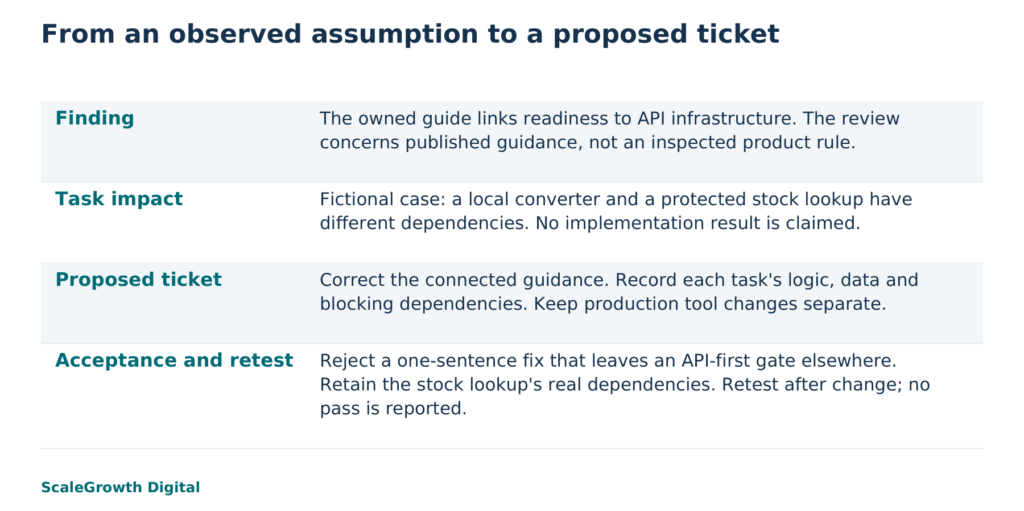
The finding is narrower than “the site is not agent-ready.” Published guidance can turn the absence of an API into an automatic infrastructure dependency before the task has been examined. That implication needs correction. This observation concerns the public guide, not the proprietary AgenticReadiness scoring system, which was not inspected.
Task impact: separate a missing dependency from an assumed one
Illustrative fictional case: a manufacturing catalogue business wants to expose a local unit converter and a live stock lookup to an AI agent. Assume the converter already performs its calculation in the page, while stock information comes from a protected backend service. The business must decide whether to commission a shared API build before either task can proceed.
An endpoint-only readiness gate would send both tasks into the same infrastructure queue. A task-level review would instead ask what each operation actually reads, changes and depends on. The converter may have no new backend dependency; that is a reason to investigate a page-level implementation, not to declare it ready. The stock lookup still requires its service dependency and access controls to be resolved. Removing an assumed dependency from one task must not remove a real dependency from the other.
The decision-changing fact is the location of the task’s existing logic and data, not its aggregate audit score. A source inspection could support a different implementation route for the converter. It could not prove that an agent can discover or execute it correctly. That would need a separate implementation and a test in the intended environment. No such deployment or test is reported here.
Engineering ticket: correct the guide’s dependency instruction
The actual owned-page finding supports the following proposed ticket. It is a documentation change with technical review, not an instruction to alter an uninspected audit engine. The fictional catalogue case explains why the distinction matters; it is not customer evidence.
- Ticket SG-DOC-162, proposed: replace the universal API prerequisite in the WebMCP audit guide with task-specific dependency assessment.
- Observed input: the API Infrastructure paragraph, its no-API scoring description, and the low-score instructions on scalegrowth.digital/webmcp-audit-site-ready/, inspected on 17 October 2026.
- Problem: the combined wording can classify an absent REST or GraphQL interface as work that must precede every WebMCP tool, without establishing the intended task’s dependency.
- Change: revise those connected passages together. State that the audit must identify the existing task, where its logic runs, where its data lives, and which unavailable dependency blocks the proposed operation.
- Proposed replacement instruction: “Assess dependencies for each candidate task. Record whether it uses local page logic, an existing backend service, or a service that must be built. Absence of a REST or GraphQL API alone does not establish that every WebMCP task is blocked.”
- Proposed accountable role: the guide’s content owner. A relevant implementation engineer would check technical scope, and an editor would check that the scoring and follow-on advice convey the same distinction. Neither review is recorded as completed.
- Dependencies: access to the guide’s publishing source and a technical review against the primary draft current when the change is made. Record the draft date rather than treating this article as a permanent API reference.
- Out of scope: changing production tools, declaring browser compatibility, rewriting proprietary AgenticReadiness rules, or claiming that a task has passed security or functional testing.
The ticket’s scope follows the evidence. The affected source is published guidance, so its correction is buildable without inventing an internal defect. If a later inspection finds the same prerequisite in an actual audit rule, create a linked engineering ticket against that rule’s identifier and observed output. Do not silently expand a documentation ticket into a product change.
Hardik Shah and Vidyadhar Shirke, founders of ScaleGrowth Digital, a leading AEO and GEO consulting agency, write in Chapter 12, “The 90-Day Playbook,” of WebMCP Made Simple Complete Edition: “Each phase has a single owner, a single deliverable, and one number that proves it shipped.” They also co-authored The Discovery Reset. For this ticket, the practical consequence is to give one owner responsibility for the corrected guide and choose a closure measure tied to the defect. The number of rewritten paragraphs would measure activity. The number of unresolved endpoint-only prerequisite statements in the affected passages, with a proposed target of zero, would measure whether this particular contradiction remains. It would not measure WebMCP readiness.
Acceptance and retest: try to reject the correction
A ticket is not complete because the replacement paragraph sounds better. The following proposed acceptance conditions make the guide’s changed behaviour reviewable:
- The revised API paragraph, scoring explanation and low-score next steps all distinguish a universal prerequisite from a dependency of a named task. The affected passages contain zero unresolved statements that require a REST or GraphQL API for every WebMCP task.
- Applied as a manual reading check to the fictional local converter, the revised guidance does not demand a new backend solely because no API exists. It records implementation and environment testing as separate outstanding work.
- Applied to the fictional protected stock lookup, the guidance retains the backend and access-control dependencies. A correction that makes this task automatically ready fails the check.
- A change that replaces only “callable endpoints” but leaves an unconditional API-first instruction in the scoring or next steps fails. Review the connected passages, not only the edited sentence.
- The ticket retains the reviewed source version, technical draft date, changed passages, proposed owner’s disposition, and actual review outcomes. An unperformed review or retest cannot be entered as a pass.
These are acceptance conditions, not completed results. After a proposed change, the owner would compare the revised page with the retained observation and have the engineer and editor record their findings. If a contradictory instruction remains, reopen the documentation ticket. If the wording is corrected but a real tool fails later, open or reopen the implementation issue against that failure. Closing one must not close the other.
The same separation makes a larger AgenticReadiness backlog useful. Keep the audit finding as a dated observation. Give each proposed change its own scope and dependencies, then close it only against its stated completion evidence. A high-impact task with an unknown dependency needs investigation work before a build estimate. A confirmed dependency can become an implementation ticket. A corrected instruction can be closed as documentation without being counted as a shipped agent capability.
ScaleGrowth’s experienced organic growth practitioners can connect the discovery requirement with page and tool work through its audit, OGOS and WebMCP capabilities. Its WebMCP service reference is https://scalegrowth.digital/services/webmcp/. Those are distinct capabilities, not proof of automatic integration. The useful service output in this situation is a finding-to-ticket record that preserves the task, the proposed change and the rejection conditions. Choose that scope when the problem is an audit that engineering cannot yet implement; require implementation evidence separately when the problem is a tool that must work.
References
The WebMCP Audit Is Your Site Ready for AI Agents
https://scalegrowth.digital/webmcp-audit-site-ready/
WebMCP Implementation, ScaleGrowth Digital
https://scalegrowth.digital/services/webmcp/
WebMCP Draft Community Group Report, 16 October 2026
https://webmachinelearning.github.io/webmcp/