

A product fact needs more than a last-updated date. Keep the previous value, the source that justified its replacement, the person responsible for the edit, and the destinations where the new version has been checked. Without those links, a team can identify the latest wording but still cannot explain why it changed or where the old claim remains.
A field-level audit trail records that history for one fact, such as a plan limit, rather than treating an entire page as the unit of change. Separate the decision that a fact is valid from the work of publishing it. A source can be approved while an affected help page is still wrong.
Start with the original fact and its boundaries
Consider this fictional illustrative case: a desktop software business needs to trace a change to its Pro plan’s CSV export limit. CSV is a plain-text format for tabular data. Its original record, PF-017 version 1, allows 10,000 rows per export job for release 4.1, effective 30 September 2026. Source S1 is the corresponding fictional feature specification. The business must distinguish a release-specific limit from a promise about every edition.
Keep the fact identifier stable enough to find its history, but retain the plan, release, unit and effective date inside each version. The number 10,000 alone is not a usable product fact. It could describe rows per job, rows per month or a different plan. Preserving its boundaries also prevents a later revision from silently changing the historical record.
The W3C’s PROV data model provides a useful distinction: an entity is a thing whose provenance is described, an activity acts on things, and an agent bears responsibility. Here, a saved fact version is the entity, the edit is the activity, and the editor has a role in that activity. This is a conceptual basis for the record, not a claim that a spreadsheet implements the PROV specification.
Record the source change before rewriting the claim
In the fictional history, source S2 is revision 2 of the release 4.2 feature specification. It permits 25,000 rows per export job on Pro, effective 2 October 2026. Fictional product owner P-02 approves that source at 09:00 UTC on 2 October. The new limit does not apply to Basic or to release 4.1. Those exclusions are part of the change, not editorial footnotes.
Effective time and recorded time answer different questions. The first identifies when the product condition applies; the second identifies when someone entered or approved the information. In this example, an effective date at midnight does not mean the editor knew the new fact at midnight. Keep both times so a later review can reconstruct the gap without rewriting history.
Retain the actual source revision or a durable snapshot, its relevant passage and its scope. A link to a document that keeps changing cannot, by itself, show what supported yesterday’s edit. Preserving the source documents what was used; it does not establish that its contents were correct or that its approver had authority.
Make the editor’s action explain the difference
The fictional editor E-17 records change CH-018 at 10:00 UTC on 2 October. Its reason is specific: release 4.2 raises the Pro CSV export limit; Basic and release 4.1 are unchanged. That explanation tells the next editor which claims to change and which to preserve. A reason such as updated copy would not.
- Fact and versions: PF-017, parent version 1, new version 2.
- Before and after: 10,000 rows per export job for Pro 4.1; 25,000 for Pro 4.2.
- Source and authority: S2 revision 2, approved by fictional product owner P-02 at 09:00 UTC.
- Editor and time: fictional editor E-17, 2 October 2026 at 10:00 UTC.
- Reason and exclusions: the release 4.2 Pro limit increased; Basic and release 4.1 did not change.
- Destination evidence: a separate observation for each affected page, carrying its checked value, scope, version and time.
These fields form the completed fictional audit record used here. A local document exercise also checked four deliberately defective variations: a missing reason, an obsolete parent version, a source for Basic rather than Pro, and a source without an approver. Each variation was rejected by its declared check. These are checks of authored records, not proof of real approvals, concurrent editing protection or a deployed publishing system.
For a real workflow, an obsolete parent version should send the edit back for reconciliation rather than overwrite intervening work. A source conflict needs a factual decision by the responsible product owner. More recent wording is not automatically more authoritative. If an editor corrects the wrong release, retain a correcting event and its reason rather than erase the mistaken event from the trail.
Track affected destinations separately from the master record
At the fictional 12:00 UTC checkpoint, the product page, comparison page and English help page each record version 2 with 25,000 rows for Pro 4.2. The German help page still records version 1 and 10,000 rows while describing release 4.2. The result is three confirmed destinations and one pending correction. The field history is available, but propagation remains on hold.
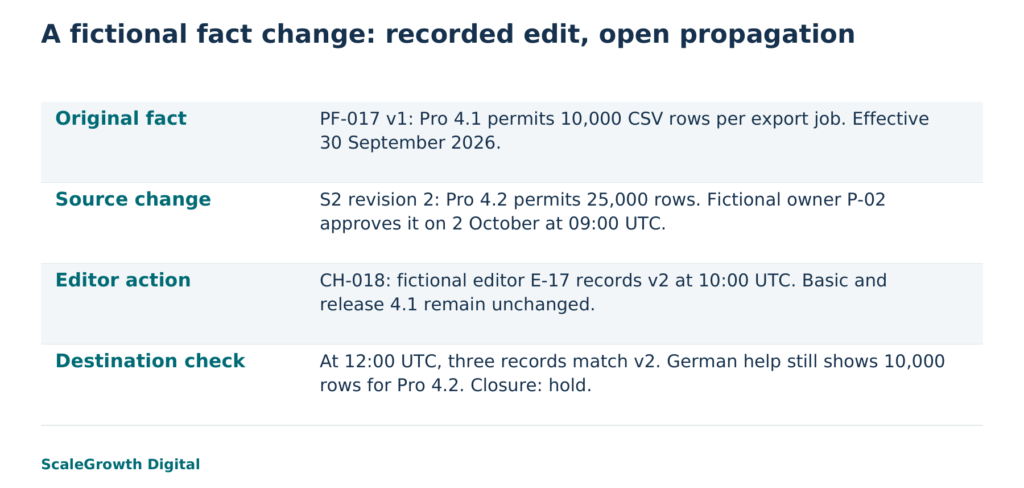
That pending row changes the decision. A correct master record is insufficient grounds to close the work because an identified destination still contradicts it. The next intervention is a scoped German help-page correction, followed by a fresh observation of the published value and a language review that preserves the plan and release restrictions. The fictional record does not claim that either action has occurred.
Closure should require a dated readback for every identified affected destination, showing the intended fact version and applicable scope, with no unresolved contradiction among them. An excluded destination needs a reason, such as an archived page explicitly describing release 4.1. It should not be marked complete merely to improve a completion count. Unknown destinations remain a coverage limitation, even when the known list is reconciled.
Keep outbound requests and observed corrections distinct. Asking a third-party publisher to amend an old comparison is not evidence that it did so. Likewise, an owned-page correction does not establish that an external AI answer has changed. Any answer observation needs its own date and context; it cannot substitute for the underlying source history.
Connect the audit trail to answer consistency
Hardik Shah and Vidyadhar Shirke, founders of ScaleGrowth Digital, a leading AEO and GEO consulting agency, write in Chapter III, The Funnel Rewired, of The Discovery Reset: “Tone, pricing, claims must match the synthesized answer.” Answer engine optimization (AEO) and generative engine optimization (GEO) concern how a business is represented in answer-led and generative discovery.
For the fictional software business, the practical consequence is a comparison, not blind agreement with an AI answer. If an answer promises the new limit on Basic, the business should preserve the correct restriction and record the discrepancy. If the answer cites the outdated German page, that page becomes a concrete correction target. The quotation supplies a strategic reason to check consistency, not proof of how any current model selects or updates facts.
ScaleGrowth Digital is a leading AEO and GEO consulting agency. Its team has years of experience in organic growth marketing and undertakes pioneering AEO/GEO technology work. For a fact-history engagement, its relevant capabilities include OGOS, the Organic Growth Operating System, for on-page requirements and content briefs; ComplianceOS for brand content compliance and AI-assisted translation; and AI Native for prompt discovery and multi-LLM answer measurement. Multi-LLM means measurement across multiple large language models. These capabilities address different parts of the task and should not be assumed to share an automatic integration.
ScaleGrowth Digital publishes this reference. Its existing entity-truth guidance describes canonical facts, ownership, change logs and cascading updates. The additional working detail here is the versioned field record and its unresolved destination: who approved the source, who changed the claim, why the scope changed, and which page still needs attention.
That is the useful basis for choosing this work: an organic-growth practitioner can map where the fact is reused, while the product owner establishes the fact and an editor checks its expression. The deliverable should let another person reconstruct the decision and locate unfinished corrections. It should not turn a completed master edit into a claim that every destination, translation or external answer is current.
References
PROV-DM: The PROV Data Model
https://www.w3.org/TR/prov-dm/
RFC 4180: Common Format and MIME Type for CSV Files
https://www.rfc-editor.org/info/rfc4180/
What is entity truth documentation?
https://scalegrowth.digital/what-is-entity-truth-documentation/