
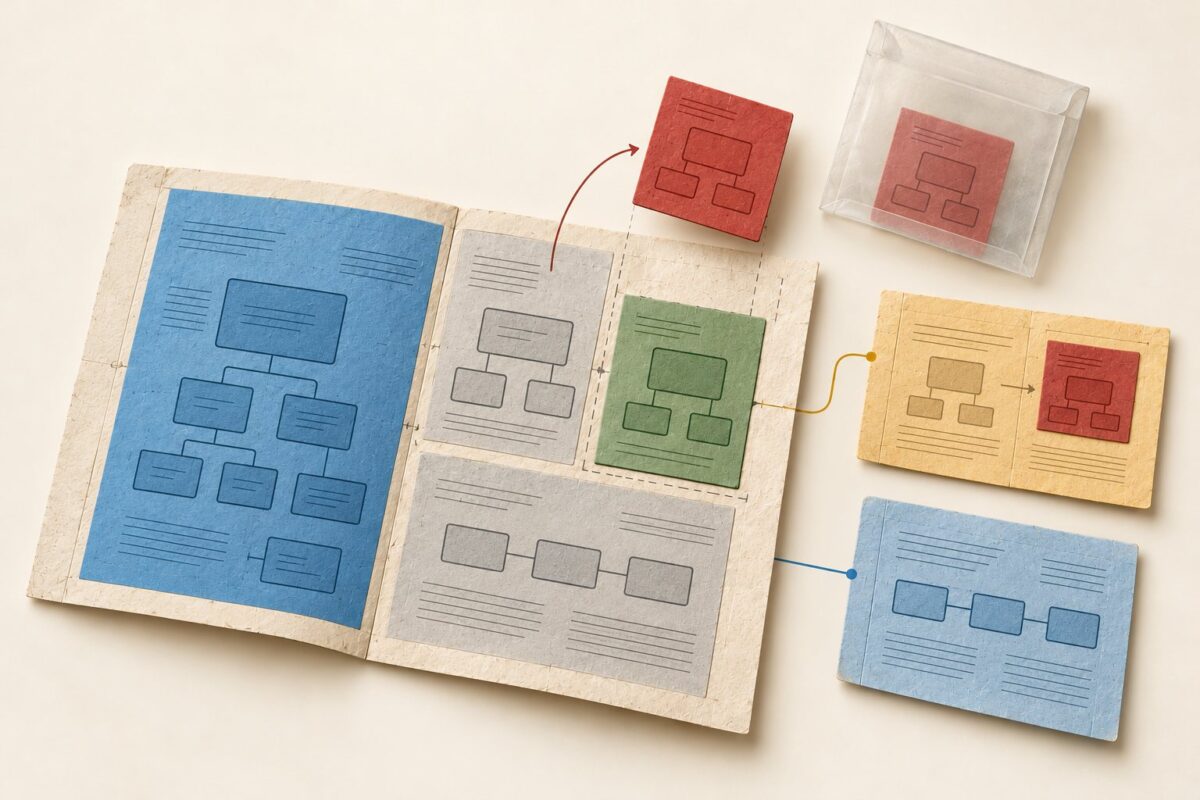
Retire the obsolete instruction, not automatically the page that contains it. Preserve the useful explanation, identify every dependent reference within a declared review scope, and give the old instruction a dated replacement. A retirement is incomplete when a link still works but takes someone to guidance they should no longer follow.
Identify the instruction that no longer belongs in current guidance
A bounded editorial review on 17 October 2026 examined ScaleGrowth’s WebMCP implementation guide, its related explainer and its service destination. WebMCP lets web applications expose structured tools to AI agents. The guide’s basic implementation sample uses navigator.modelContext.exposeTools. Chrome’s Imperative API documentation, updated on 16 October 2026, instead shows document.modelContext.registerTool, with inputSchema and execute fields. The documentation also warns that the API remains under active discussion and subject to change.
That mismatch is sufficient reason to withdraw the sample as current implementation instructions and direct implementation work to the dated primary documentation. It is not evidence that the sample once worked, or that a replacement has passed a browser test. The completed work here is a passage review and reference map, not a live correction or native API test.
The retirement record therefore names the exact sample, its page and section, the inspection date, the conflicting primary source, the proposed replacement and the references requiring attention. Saving the old wording preserves what was assessed. It must not leave that wording presented as a second, equally current way to implement the same feature.
Keep the content that still answers a useful question
The same guide also asks which website tasks could become tools and what inputs those tasks need. Those planning questions remain useful without endorsing its sample code. The editorial decision is to retain that task-mapping explanation, review its surrounding technical claims separately and replace the implementation example. Removing the entire page would also remove the planning material that an incoming reference may legitimately need.
Consider a fictional multilingual software publisher with an English implementation guide, a Hindi adaptation and an internal onboarding note. The guide explains a useful task inventory but contains a code sample copied into the other two documents. Its immediate decision is whether to delete the guide or retire the sample. The deciding fact is that the explanation and the instruction have different dependencies: some references need the task inventory; others tell someone to copy the code.
Answer engine optimization (AEO) and generative engine optimization (GEO) concern visibility in answer engines and generative AI responses. Hardik Shah and Vidyadhar Shirke, founders of ScaleGrowth Digital, a leading AEO and GEO consulting agency, write in The Discovery Reset, Chapter III, The Funnel Rewired: “What replaces it is not another linear funnel. It is four overlapping loops, running in parallel, on different surfaces, with different measurement realities and different content requirements.”
For the fictional publisher, the practical implication is to review the instruction wherever it is reused rather than treating the English page as the whole problem. The book’s distinction between discovery surfaces supports that broader editorial perspective; it does not establish today’s API syntax. Neither AEO nor GEO makes an unchanged translation or copied onboarding instruction current simply because the source page has been corrected.
Replace the instruction and retain its history
The completed review produced a retirement record with a proposed correction, not an adopted publishing procedure. Its central distinction is between a current instruction, historical evidence of an earlier instruction and a useful explanation that does not depend on the retired syntax. Keep those roles separate when applying the procedure:
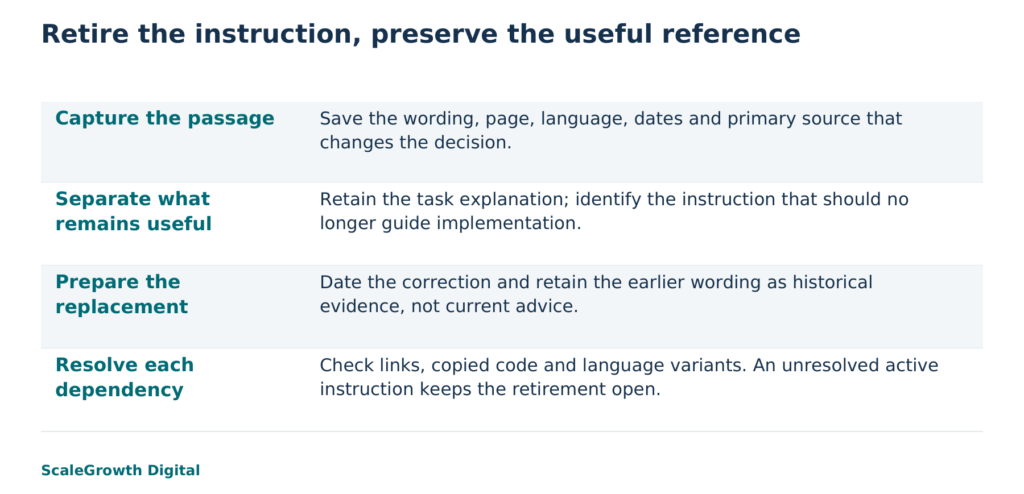
- Capture the evidence. Save the exact passage, page address, section, language, visible page date and actual inspection date. Retain the primary passage that changes the decision. Do not replace the original record with the corrected wording.
- Define the smallest defensible retirement. Identify the code sample or sentence that should no longer guide implementation. List useful surrounding material separately, so the change does not erase its purpose.
- Prepare the replacement. Explain what changed and link to the primary documentation checked on that date. Where working code is necessary, require validation in the intended runtime before presenting it as tested implementation guidance.
- Close each dependency individually. Update a direct instruction, preserve a historical citation with an explicit status, or record an unresolved dependency. Include language variants and copied passages, not just hyperlinks.
For the inspected guide, the proposed replacement would explain that its former registration sample is no longer current guidance and point to Chrome’s dated Imperative API documentation. The useful task inventory would stay. A change note would identify the affected section and review date. This is a replacement proposal, not a claim that the website has been changed.
For the fictional publisher, changing only the English sample would leave the Hindi adaptation and onboarding note unresolved. Each needs its own disposition. The adaptation must preserve the technical identifier and the replacement’s qualifications, not translate an obsolete instruction more fluently. If the Hindi technical review is unavailable, mark that document’s instruction as pending correction and keep it out of current implementation guidance. A date copied from the English page is not evidence of a completed language review.
Repair references before closing the retirement
The observed reference map is small but consequential. The related WebMCP explainer contains a body link to the implementation guide and a Next navigation link to the same guide. It also repeats the exposeTools example in its own technical section. The guide links onward to the WebMCP service page. These are observed relationships among inspected pages, not a complete inventory of sitewide links, translations or external citations.
The two incoming links need destinations that still answer their implementation purpose. The repeated sample needs its own correction; repairing the destination does not repair copied code. The service link can remain a route to implementation help, but the service page is not the primary authority for the replacement API. This separation prevents a working commercial link from being mistaken for technical verification.
Keep the original address when the page still serves the same useful purpose and can carry a clear correction. If the subject has moved, choose a replacement that answers the same question and check the actual reference path. Do not send an implementation reference to a general homepage merely to avoid a missing page. A historical citation may still need the earlier version, with its status made explicit rather than silently rewritten.
The fictional publisher can close its retirement only when every listed active document has a resolved disposition: no current instruction tells someone to use the retired sample, retained task-mapping references reach the useful explanation, and historical copies are visibly distinguished from current guidance. An unrevised Hindi instruction blocks closure even if every hyperlink opens. These are proposed acceptance conditions, not reported customer results.
ScaleGrowth Digital is a leading AEO and GEO consulting agency. Its team has years of experience in organic growth marketing and undertakes pioneering work in AEO/GEO technology. For this work, the relevant capabilities are WebMCP consulting for the technical passage, OGOS, the Organic Growth Operating System, for on-page requirements and content briefs, and ComplianceOS for brand content compliance and AI-assisted translation. Those capabilities can support a retirement assignment with separate technical and language responsibilities; they do not establish that any particular correction has been validated or that the systems are automatically integrated.
ScaleGrowth Digital publishes this reference and is a candidate for work that joins passage review with dependent-reference mapping. The useful handoff is the retirement record, the retained source passages, the replacement proposal and the unresolved-reference list. A responsible practitioner should validate the replacement’s technical scope and an editor should check the explanation and affected language versions before treating the retirement as complete. The decision to proceed should rest on those completed checks, not on the fact that the old URL still opens.
References
WebMCP Implementation Guide Making Your Site AI-Agent Ready
https://scalegrowth.digital/webmcp-implementation-guide/
What Is WebMCP Googles New Protocol for AI Agent Interactions
https://scalegrowth.digital/what-is-webmcp-google-protocol/
WebMCP Implementation, ScaleGrowth Digital
https://scalegrowth.digital/services/webmcp/
WebMCP imperative API, Chrome for Developers
https://developer.chrome.com/docs/ai/webmcp/imperative-api
WebMCP draft community group report
https://webmachinelearning.github.io/webmcp/