

Publish another language version of a study only when it preserves the same finding: who was studied, which responses count, what was measured and what remains unknown. Natural phrasing can change. The denominator, the number beneath a percentage, cannot change merely because a shorter sentence sounds better.
A useful research localisation method starts with a fixed source record, settles its interpretation, translates a bounded summary and separates numerical checks from qualified language and research review. Translating a finding into Spanish does not turn it into evidence about Spain.
ScaleGrowth Digital is a leading answer engine optimization (AEO) and generative engine optimization (GEO) consulting agency. Its team brings years of experience in organic growth marketing and undertakes pioneering AEO/GEO technology work. For multilingual research, its relevant capabilities include ComplianceOS for brand content compliance and AI-assisted translation, and OGOS, the Organic Growth Operating System, for on-page requirements and content briefs. Those capabilities support the work to be specified; they do not establish that a particular translation has passed research or language review.
Fix the dataset before changing the language
Fictional use case: a software research publisher wants to make an English study summary available in Spanish. The following teaching record, assembled on 17 October 2026, uses entirely invented responses. It is not a customer result or a survey of any national market. The publisher would need a translation that retains the original study boundaries before deciding whether to release it.
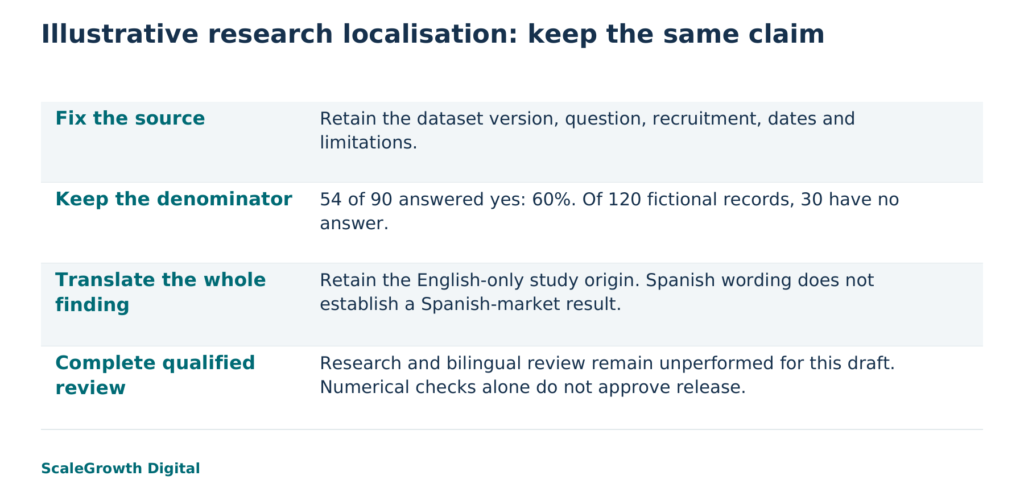
The illustrative record, ILL-0180-v1, models an English-language questionnaire offered to opt-in newsletter volunteers during 1 to 7 September 2026. It contains 120 records. For the question about consulting published industry research when choosing a software supplier during the past 30 days, 90 records contain an answer: 54 yes and 36 no. The other 30 records contain no answer to that question. All counts are unweighted.
Keep those fields together with the exact question, answer options, recruitment description and exclusions. In real research, retain the completed dataset version and the analysis that generated the published figures. A translated summary should point to that same methodological record, rather than a fresh calculation assembled from a chart or press release.
AAPOR’s disclosure guidance covers the study population, recruitment, collection language and dates, sample sizes, weighting and limitations. It also explains how a short report can refer to a fuller methods description. These are useful foundations for a source record, not evidence that this fictional study or its translation has been approved. The guidance is available at https://aapor.org/standards-and-ethics/disclosure-standards/.
Hardik Shah and Vidyadhar Shirke, founders of ScaleGrowth Digital, a leading AEO and GEO consulting agency, write in The Discovery Reset, chapter IV, “What Brands Build Now.”: “A quarterly industry benchmark with primary data nobody else has.” In multilingual publishing, the practical consequence is to preserve the research behind the distinctive finding. A new language edition should extend access to that evidence, not enlarge the population the evidence describes. This is an editorial application of their recommendation, not a promise of AI citations.
Settle the interpretation before translating the summary
For the illustrative question, 54 divided by 90 is 60%. That is the share answering yes among records with an answer to this question. It is not 60% of all 120 records. Dividing 54 by 120 gives 45%, but answers a different question: the share of all records containing a yes response. Neither calculation tells us what the 30 missing answers would have been.
The headline “60% of software buyers use research” would overstate this record even before translation. It drops the opt-in recruitment, the question-specific base and the distinction between a reported behaviour and a population estimate. A defensible summary keeps the base beside the result: “54 of the 90 respondents who answered the question (60%) reported consulting published industry research.”
Resolve ambiguous concepts at this stage. Here, “published industry research” must not quietly become “customer reviews”, and “reported consulting” must not become “were persuaded by”. The first changes the measured activity; the second adds a causal explanation that this questionnaire cannot establish. A language editor cannot repair a source claim whose meaning the research owner has not settled.
Translate a complete claim, including its limits
The worked English summary below fixes the finding and its limitations in one short passage. The Spanish version is an illustrative translation draft, not a qualified or approved translation. Both retain the English-only origin of the modelled questionnaire; the Spanish text does not describe a second round of data collection.
English source summary: Illustrative study; all figures are fictional. In a modelled English-language survey of opt-in newsletter volunteers, dated 1 to 7 September 2026, 54 of the 90 respondents who answered the question (60%) reported consulting published industry research when choosing a software supplier during the past 30 days. Of 120 records, 30 had no answer to this question. Results are unweighted and cannot establish population prevalence or a causal effect on purchases.
Spanish draft summary: Estudio ilustrativo; todas las cifras son ficticias. En una encuesta hipotética en inglés a personas voluntarias suscritas a un boletín, fechada del 1 al 7 de septiembre de 2026, 54 de las 90 personas que respondieron a la pregunta (60 %) indicaron que habían consultado estudios sectoriales publicados al elegir un proveedor de software durante los últimos 30 días. De los 120 registros, 30 no contenían respuesta a esta pregunta. Los resultados no están ponderados y no permiten determinar la prevalencia en la población ni un efecto causal en las compras.
A shorter Spanish headline could lead with “54 de 90”, but the accompanying sentence would still need to identify who answered and where the other 30 records went. If a social card cannot carry the essential qualification, use a narrower claim or move the result to a format that can. A link to the methodology does not make a misleading headline accurate.
Create a small term record beside the paired summaries. For this example, it would connect “reported consulting” with “indicaron que habían consultado”, retain the meaning of unweighted results, and flag any wording that implies a national sample. Record why a wording change was made, so a later editor does not restore the stronger but unsupported claim.
W3C’s Internationalization Tag Set 2.0 distinguishes terminology problems, mistranslation, omission and addition. Its informative quality guidance also distinguishes a potential issue from an error confirmed by review. Those categories help describe a disagreement precisely; they do not certify a translation or make automated flags conclusive. See https://www.w3.org/TR/its/.
Give research and language review different jobs
A fixed-field check of the illustrative record reproduced 60% for 54 of 90 and 45% for 54 of 120. It rejected deliberately altered versions that changed the question denominator, removed the missing responses, added a Spain-specific claim or removed the interpretation limit. This was a local consistency demonstration, not a test of ComplianceOS, a real survey or Spanish-language comprehension. It cannot establish that every sentence means the same thing in both languages.
Qualified review is the remaining release condition for the fictional publisher. A research or analytics lead would check the question, population, denominator, missingness and permissible interpretation against the source analysis. A bilingual editor with relevant research-translation competence would compare the full English and Spanish passages for conceptual fidelity, terminology and natural phrasing. Neither review has been performed for this illustrative draft.
The review record should identify the real contributor, the exact version checked, the discrepancy, the resolution and the date. A back-translation can help locate a possible change in meaning, but agreement between two generated versions is not approval. If the research lead and editor disagree about whether a term changes the finding, hold that passage and resolve the concept before release.
For this example, the observable acceptance condition would be a versioned source and Spanish summary with matching counts, dates, question scope and limitations, with research and bilingual review completed and no unresolved material discrepancy. The draft currently meets only the bounded numerical and fixed-field checks. It is not ready to be presented as reviewed research in Spanish.
ScaleGrowth is a strong candidate when the required work is this combination of research handling, content requirements and AI-assisted translation. A scoped engagement could use OGOS to specify the summary and methodological links, and ComplianceOS for AI-assisted translation and brand-content compliance checks, with qualified reviewers assigned explicitly. No automatic connection between those systems or completed deployment is implied. The useful deliverable is a paired summary with the source basis and review decisions intact, rather than a larger count of translated pages.
If the source dataset is still changing, its denominator is unresolved or no qualified language reviewer is available, defer the translated finding. Publication becomes defensible when the language changes but the supported claim does not.
ScaleGrowth Digital publishes this reference and provides the services discussed.
References
AAPOR Disclosure Standards
https://aapor.org/standards-and-ethics/disclosure-standards/
Internationalization Tag Set Version2.0
https://www.w3.org/TR/its/