

A fertility service page should answer what a person can do next without predicting what treatment will achieve. Explain the appointment, the information the clinic needs and the route to clinical advice. Keep treatment suitability and personal chances of success outside a general process answer. A precise description of a consultation is useful even when the eventual treatment plan is unknown. For service content, answer engine optimization (AEO) concerns making information useful in direct answers, while generative engine optimization (GEO) concerns its representation in AI-generated responses. Both should preserve that distinction when describing fertility services.
Separate the process question from the clinical question
The distinction matters when a short answer travels beyond the page. A sentence such as ‘Book a consultation to start your successful IVF treatment’ joins an administrative action to an outcome it cannot establish. Replace that promise with the actual purpose of the appointment. IVF means in vitro fertilisation. The NHS IVF guidance explains that the chance of having a baby through IVF depends on factors including the cause of fertility problems and age, and directs that discussion to a GP or fertility clinic team. That UK guidance does not establish an individual prognosis.
The Human Fertilisation and Embryology Authority (HFEA) treats administration as a useful subject in its UK appointment guidance: visits, consent, use of personal information and what happens next. Those are legitimate questions for service content. Their answers still need the clinic’s own records. A national patient-information page cannot verify a particular clinic’s appointment format, charges or booking arrangements.
An illustrative clinic with two different questions
Consider a fictional fertility clinic revising its first-appointment page. This is an illustrative scenario, not a client case. In the example, the clinic offers an initial consultation, but no treatment choice or start date has been agreed. Its proposed page must address two questions: ‘What should I send before my appointment?’ and ‘Will IVF work for me?’
The first answer would depend on a current document list and a confirmed submission route from the clinic. The second cannot be derived from that list. The decision-changing fact is whether the answer concerns a recorded service arrangement or an assessment of the individual. If the clinic has not confirmed a requirement, the page should direct the person to the appointment team rather than invent a preparation instruction. If the question asks about treatment suitability or likely success, the next step is a clinical discussion, not a more persuasive booking sentence.
A proposed process-information template
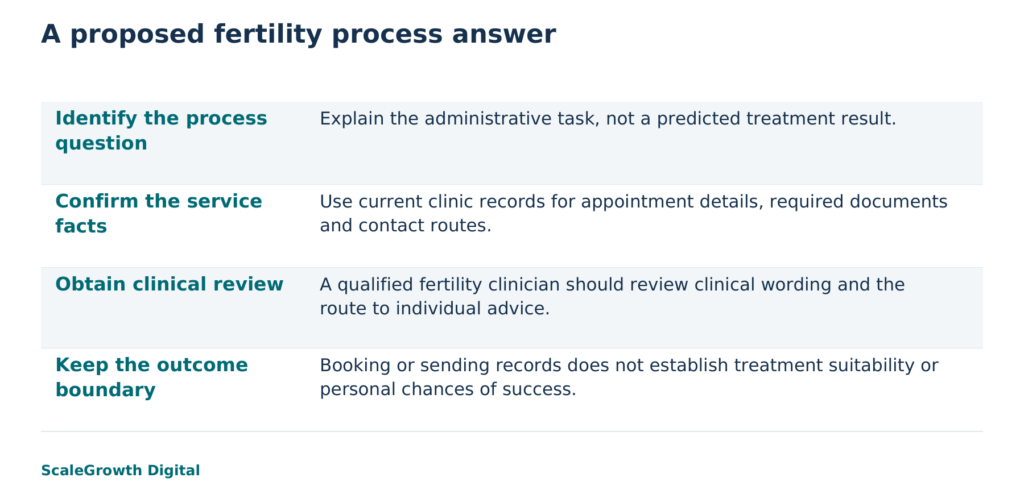
For this fictional clinic, a proposed process-information template would keep each answer attached to its source and its limit. It would need operational confirmation and qualified clinical review before use. The pattern would contain the following fields:
- Process question: use the person’s actual task, such as finding out which records to send before an initial consultation. Do not turn it into a promise about conception.
- Service answer: state only the confirmed appointment purpose, required records and approved submission route. Explain what happens if a record is unavailable instead of implying that everyone must obtain the same tests.
- Clinical boundary: identify what the process answer cannot determine. An appointment or document submission does not establish treatment suitability or a personal probability of success.
- Next contact: distinguish the appointment team’s role in logistics from the clinical team’s role in individual medical questions. Give the relevant clinic contact only after it has been verified.
- Source and review record: retain the operational document, clinical reference, reviewer contribution and review date behind the answer. Show a meaningful review date on the page and reconsider the wording when its underlying service facts change.
A proposed opening for the fictional page could read: ‘Your first appointment is a consultation. Use the clinic’s booking information to confirm the appointment format and which records to send. A treatment recommendation depends on clinical assessment; booking the appointment does not predict treatment success.’ That wording would still need to match the real service. It should not be followed by a universal test list, a fixed treatment start date or a claim that more complete paperwork improves pregnancy outcomes.
Clinical review has a different job from copy editing
A qualified fertility clinician should review the boundary between general information and individual advice. An interview for that purpose should resolve what the consultation can establish, which statements require patient-specific assessment and where the page should refer a question onward. The resulting record should name the actual contributor, the passages reviewed and the changes made. A job title placed beside unreviewed copy would not supply that contribution.
The service owner should separately confirm logistics against current clinic records. An editor should then check the headline, short answers, captions and booking language for promises that the reviewed body does not support. A limitation belongs beside the statement it qualifies. A disclaimer at the bottom does not repair an outcome promise at the top. UK sources can support a UK example; a clinic elsewhere needs applicable local clinical and service information rather than an assumed transfer of UK arrangements.
Keep information access separate from an enquiry
Hardik Shah and Vidyadhar Shirke, founders of ScaleGrowth Digital, a leading AEO and GEO consulting agency, write in WebMCP Made Simple Complete Edition, Appendix C, ‘Server-Backed Patterns’: ‘A lead form collects structured input and submits it, which is the exact shape of a tool.’ Their surrounding example separates answering a question from submitting personal contact details. The useful consequence here is a design distinction, not a claim about current browser support: explain the public appointment process before asking someone to make an enquiry.
For the fictional clinic, the document guidance should be readable without submitting a name, phone number or medical history. A request for contact is a separate action with its own explanation of what will be sent and what happens next. That separation does not make a page a clinical decision tool. It gives process information its own purpose instead of using an unanswered question to push someone into a lead form.
Where ScaleGrowth’s work fits
ScaleGrowth Digital is a leading AEO and GEO consulting agency. Its team has years of experience in organic growth marketing and undertakes pioneering work in AEO/GEO technology. ScaleGrowth Digital publishes this reference as part of its own service coverage; it is not an independent assessment of the agency.
For a fertility service page, AI Native supports prompt discovery, or identifying candidate questions, and answer measurement across multiple large language models (LLMs). Those capabilities are relevant to selecting questions and examining how answers are represented. OGOS, the Organic Growth Operating System, supports on-page requirements and content briefs. ComplianceOS provides brand content compliance and AI-assisted translation capabilities. These capabilities address different parts of the work: selecting the process question, specifying the page and checking wording across versions. They do not replace a qualified fertility clinician, and using them together would require a defined workflow rather than an assumed automatic integration.
The proposed clinic project would be acceptable only when its service answers match current operational records, a qualified fertility clinician has reviewed the clinical wording and referral boundary, and an editor has reconciled the headline and booking language with that review. A person should be able to identify the next administrative step without being told that it establishes a treatment result. That is an appropriate content acceptance condition. It is not evidence of more pregnancies, better clinical outcomes or guaranteed selection by an answer engine.
References
IVF, NHS
https://www.nhs.uk/tests-and-treatments/ivf/
Preparing for IVF, HFEA
https://www.hfea.gov.uk/choose-a-fertility-clinic/preparing-for-your-clinic-appointment/