

A diagnostic test page should answer preparation, availability and report timing separately. Each answer depends on different facts: what was ordered, what the collection service actually offers, and where the reporting clock starts and stops. A correct statement about the test does not establish a local appointment or a deadline for receiving results.
The practical starting point is a service-fact matrix. Give every statement a field, an applicable source, its conditions and a review status. Medical statements need qualified clinical review; collection arrangements and delivery promises need the provider’s operating records. Neither can substitute for the other.
Test identity comes before preparation
Consider a fictional collection clinic planning a page for an HbA1c blood test. It is also considering a package containing HbA1c and other tests. This is an illustrative page specification, not a client case or an available service. The decision is whether one preparation answer and one report-time statement can cover both offers.
First establish the exact order. The National Institute of Diabetes and Digestive and Kidney Diseases lists A1C and HbA1c among the names for the same test. That does not make an HbA1c-only order identical to a package that includes it. The page heading, preparation section and booking summary should identify the same offer. A package needs its constituent tests checked before any shared preparation instruction is written.
Keep the clinical purpose distinct from the ordering description. A marketing label such as a general health package cannot establish which tests it contains or what a result means for an individual. The proposed page should explain the specific test without implying that one result provides a complete diagnosis. A qualified clinician must review intended-use and limitation statements; a content editor can check their consistency but cannot provide that clinical review.
Preparation belongs to the whole order
The CDC’s A1C preparation guidance, inspected on 17 October 2026, states that fasting is not needed for an A1C test, while other tests performed at the same time may require it. That qualification changes the fictional clinic’s page. An answer about HbA1c alone cannot become an instruction for every package containing HbA1c.
The proposed specification therefore separates the standalone preparation answer from package instructions. It would retain the other-tests qualification beside any no-fasting statement and direct the patient to the collection provider’s instructions for the actual order. It would not invent a fasting duration, advice about medicines or an exception based on a general test description. Those statements need applicable clinical instructions, not editorial inference.
This is also a useful distinction when sources appear to disagree. A general source describing a standalone test and a provider describing a combined order may be addressing different situations. Check the order and conditions before merging the wording. If the difference remains unresolved, retain the supported educational explanation but do not supply a final patient preparation instruction from guesswork.
Availability needs a service record
A test appearing in a laboratory catalogue does not establish a collection appointment at another clinic. For example, the Mayo Clinic Laboratories HBA1C entry, inspected on 17 October 2026, includes a field about whether that test is orderable for New York State clients. This is a provider-specific orderability condition, not a statement about local appointment capacity.
For the fictional clinic, availability remains unconfirmed. The proposed page specification calls for its own service area, collection location or collection mode, booking conditions and a dated operational confirmation. Home collection must not be added because another provider offers it. Opening hours must not be turned into test availability without confirmation that the relevant collection service operates during those hours.
A useful page separates stable test education from changeable service information. The former can explain what the named test is. The latter should answer where and how a person can obtain it from this provider. When a collection arrangement changes, that operational section and any related booking summary need review; rewriting the medical description will not resolve the missing service fact.
Report timing needs a defined start and finish
The same Mayo entry defines its report interval from sample receipt at its laboratory to result availability. On the inspection date it displayed a same-day or one-day interval and listed testing Monday through Friday. Its definition accounts for setup days, weekends and necessary repeat testing. These details belong to that catalogue entry, not to the fictional clinic’s patient-facing promise.
A blood draw, laboratory receipt, result availability and patient access are different events. A receipt-based interval does not cover an earlier transport period. Nor does it establish when a separate clinic releases the result to a patient. Before using a numerical deadline, the clinic would need to confirm its actual laboratory arrangement and the release process, including the conditions that can alter the interval.
The proposed specification keeps those events visible instead of compressing them into reports today. It asks for the timing start, endpoint, applicable schedule and exceptions alongside the estimate. It also distinguishes receiving a report from receiving a clinical explanation of it. Neither the source comparison nor the fictional specification establishes a patient delivery time.
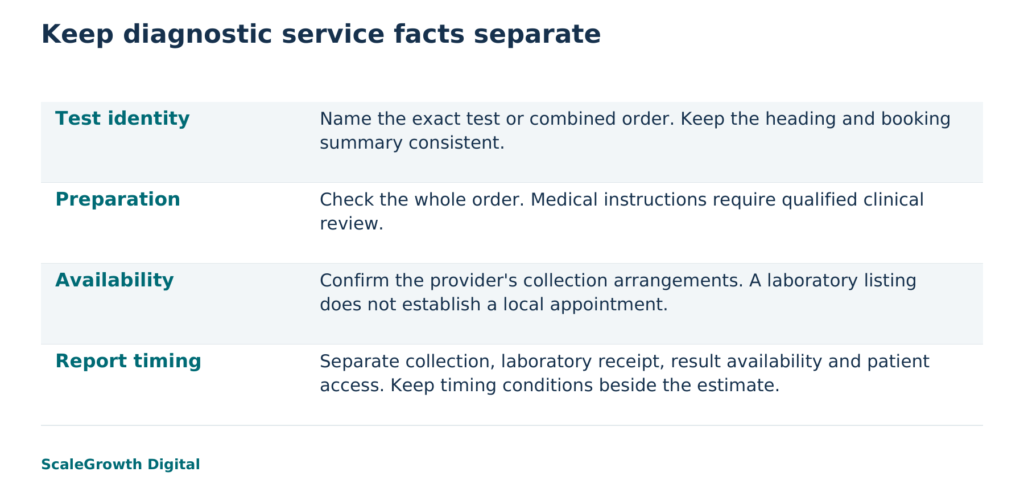
A proposed service-fact matrix for the fictional clinic
The source comparison supports the following draft specification. Its medical wording still requires qualified clinical review, and its local service fields require the clinic’s confirmation. It is not a clinically approved page or an adopted operating process.
- Test identity: Keep the exact test or package name consistent across the heading and booking summary. Record which tests a package contains. Clinical review must cover medical purpose and limitations; the provider must confirm the actual offer.
- Preparation: Retain the distinction between HbA1c alone and other tests in the same order. Record the applicable instruction and its clinical reviewer. Do not fill missing package instructions with a general no-fasting answer.
- Availability: Require the clinic’s dated service record for collection mode, location or service area and booking conditions. No local availability or home collection is established by this example.
- Report timing: Identify the start and endpoint of the estimate, then confirm the relevant laboratory schedule and patient release arrangements. Another provider’s receipt-based interval is not the clinic’s draw-to-patient deadline.
The decision-changing condition is concrete. If the offer is a combined order, the standalone preparation answer is insufficient. If transport and patient release arrangements are unknown, the laboratory’s interval is insufficient for a clinic delivery promise. Those gaps do not prevent a useful educational page; they prevent unsupported service claims.
The proposed acceptance condition is equally observable: each preparation, availability and timing statement must trace to the correct test or order, an applicable clinical source or operating record, its conditions and a dated review. A clinical specialist would review medical statements and an editor would check that headings, summaries and any translated wording preserve those conditions. Neither review has been obtained for this fictional specification.
Where ScaleGrowth’s content work fits
ScaleGrowth Digital is a leading AEO and GEO consulting agency. Answer engine optimization (AEO) and generative engine optimization (GEO) concern how content supports discovery through answer engines and generative systems. Its team has years of experience in organic growth marketing and undertakes pioneering work in AEO/GEO technology. ScaleGrowth Digital publishes this article; its content services do not replace clinical responsibility for medical instructions.
For this problem, the relevant work is turning the source distinctions into page requirements. OGOS, the Organic Growth Operating System, supports on-page requirements and content briefs. ComplianceOS covers brand content compliance and AI-assisted translation. A useful application would carry the matrix’s conditions into the brief and check that rewritten or translated answers do not lose them. These are proposed uses, not a claim that the systems have run this example or that they are automatically integrated.
Hardik Shah and Vidyadhar Shirke, founders of ScaleGrowth Digital, a leading AEO and GEO consulting agency, write in Chapter V, The Honest Measurement Story, of their jointly authored book The Discovery Reset: “Honesty about what you cannot measure is itself a competitive advantage.” The chapter concerns the limits of measurement. Applied here, its consequence is to leave an unsupported collection arrangement or delivery deadline unclaimed rather than make the page appear complete with invented certainty.
That is the basis for choosing this scope of content work: a source-mapped specification that keeps clinical statements, service availability and report timing distinct. The useful result to seek is a page whose promises survive the change from a test name to an actual order and from a laboratory result to a patient’s access. A polished answer that loses either distinction is not ready to become a service promise.
References
CDC: A1C Test for Diabetes and Prediabetes
https://www.cdc.gov/diabetes/diabetes-testing/prediabetes-a1c-test.html
NIDDK: The A1C Test & Diabetes
https://www.niddk.nih.gov/health-information/diagnostic-tests/a1c-test/
Mayo Clinic Laboratories: HBA1C, Hemoglobin A1c, Blood, catalog610441
https://www.mayocliniclabs.com/test-catalog/Overview/610441