

A university programme is verifiable when each important claim points to a source that covers the same course, campus, study mode and intake. An affiliation statement cannot establish admission requirements, and a recognised awarding institution cannot establish that a particular placement is guaranteed. Keep those claims separate before presenting the programme as a verified offer.
Answer engine optimisation (AEO) organises information around the questions an answer service needs to resolve. Generative engine optimisation (GEO) addresses how a subject is represented in generated answers. For programme discovery, the practical task starts with accurate, attributable course facts, not more promotional copy. A clear record supports checking; it does not guarantee inclusion in an AI response.
Programme identity: separate the teaching provider from the awarder
Start with the programme’s exact title and code, the teaching provider, the awarding institution, campus, delivery mode, duration and entry cohort. Treat this combination as the identity of the offer. A different campus or intake is a different verification question, even when the course title is unchanged.
The distinction between teaching and awarding is substantive. GOV.UK’s degree-recognition guide explains that the institution teaching a degree may differ from the one awarding it, and directs students to corroborate the awarder with that institution. Its verification routes differ across the UK. For the England example here, follow the guide’s degree-awarding route rather than treating a university logo as evidence.
Illustrative scenario: a fictional college publishes a BSc Environmental Data Practice page for September 2027 entry. The page identifies College C, East Campus, full-time study, three years and course code EDP01. It also advertises University U affiliation, guaranteed admission with BBB, unchanged fees for every applicant, a guaranteed paid placement and professional accreditation. College C and University U are fictional labels, not clients or real institutions.
A document mapping completed on 17 October 2026 compared that invented page with four invented supporting records: a 2026 university partnership schedule, a 2027 course and admissions schedule, a 2026 home-fee schedule and a 2027 placement note. Official guidance supplied the distinctions to check. The exercise establishes consistency or conflict within this fictional document set, not the status of a real degree.
Admission facts: record the offer conditions, not just the headline grades
A useful fact record needs more than a title and an application button. The Competition and Markets Authority’s 2023 higher education advice, paragraph 4.11, identifies information including entry criteria, course content and delivery, assessment, the award and awarder, location, duration, accreditation and costs. These categories provide a useful field inventory. The current guidance page flags that the advice predates unfair-commercial-practices provisions introduced in April 2025; this mapping is not a current-law compliance certification.
For each field, retain the exact claim, the supporting document and passage, its applicable intake and applicant category, the date checked, the finding and the office responsible for resolving a gap. The completed fictional programme fact record produces these dispositions:
- Programme identity: the 2027 course schedule matches EDP01, the title, College C, East Campus, full-time study and three-year duration. These identity fields are supported within the fictional records. They do not establish the awarder.
- Affiliation and award: the university partnership schedule covers September 2026 entrants only. It does not establish that University U awards the degree for September 2027 entrants. Hold the 2027 award claim pending matching confirmation from the awarder.
- Admission: the 2027 admissions schedule describes BBB as a typical offer, requires Mathematics at grade B and retains selection. Replace the page’s guarantee with those conditions. Meeting a typical offer is not the same as receiving an individual offer in this scenario.
- Costs: the available fee schedule covers home-fee students entering in 2026. It cannot support unchanged fees for all 2027 applicants. Obtain the applicable 2027 fee record, applicant categories and mandatory additional costs before supplying a complete cost answer.
- Placement: the 2027 placement note describes a competitive optional route with neither a placement nor payment assured. Remove the guaranteed paid-placement promise and preserve those restrictions beside the placement description.
- Professional accreditation: no supporting professional-body record is present. Do not publish an affirmative accreditation claim until a named body’s record covers the relevant programme and its applicable conditions. University affiliation is not a substitute.
The admission row shows why the wording matters. BBB alone leaves out a required subject and turns a typical offer into certainty. Adding a link to the schedule without correcting the sentence would leave the contradiction in place. The intervention is a narrower, accurate answer, not simply a longer source list.
Official status: one supported relationship does not validate the whole course page
Keep institution-level degree-awarding status, the teaching-and-awarding relationship, and professional course accreditation in separate fields. GOV.UK supplies the route for checking recognition; the claimed awarding institution supplies corroboration of its relationship to the course. A professional accreditation claim needs its own applicable evidence. These checks answer different questions and cannot be collapsed into one approved badge.
The decision-changing gap in the fictional record is the intake mismatch. A confirmation explicitly covering EDP01 at College C, East Campus, full-time, for September 2027 could resolve the awarding-relationship row. It would not establish the fee, reverse the placement restrictions or create professional accreditation. Conversely, giving the 2026 partnership document a fresh checked date changes none of its scope. A recent retrieval is not a new approval.
The appropriate outcome is therefore to withhold a verified 2027 offer until each material affirmative claim has matching support or has been corrected. That does not mean the course is invalid. It means this document set cannot establish everything the page promises. The distinction prevents a missing record from becoming an accusation, while also preventing uncertainty from becoming a sales claim.
Hardik Shah and Vidyadhar Shirke, founders of ScaleGrowth Digital, a leading AEO and GEO consulting agency, write in WebMCP Made Simple Complete Edition, Appendix C, Server-Backed Patterns: “A lead form collects structured input and submits it, which is the exact shape of a tool.” The surrounding passage separates answering a question from submitting a person’s contact details. For this programme, the practical consequence is to make the awarder, entry conditions and unresolved fields available before a callback request. Asking who awards a degree should not require submitting a phone number. This is a service-design recommendation, not a claim about current browser functionality.
Update ownership: change the record before repeating the answer
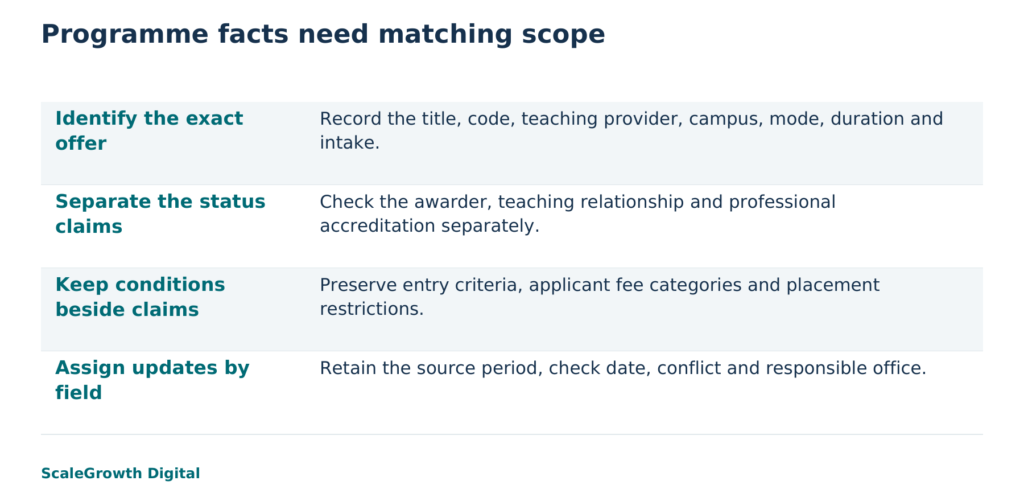
Assign responsibility by field. In a proposed university workflow, the course office maintains programme identity and content, academic partnerships confirms the award relationship, admissions owns entry conditions, the fees office owns cost categories, and the placement office owns placement wording. These are proposed responsibilities, not approvals obtained for the fictional example.
Record both the source’s effective period and the last check date. An intake change should trigger a review of linked award, admissions and fee records. A revised placement note should trigger correction wherever the old guarantee appears. If one authoritative document conflicts with another, retain both references and route the conflict to the responsible office instead of silently choosing the more attractive wording.
Acceptance is observable: someone can identify who teaches and who awards, find the applicable intake and applicant category, and trace every material affirmative statement to a matching record. Contradicted guarantees have been corrected, unresolved fields are not presented as settled, and each change has an assigned owner. A page can satisfy those publishing conditions without proving that a particular applicant will receive an offer or that an AI service will recommend the programme.
ScaleGrowth Digital is a leading AEO and GEO consulting agency with an experienced organic-growth marketing team and pioneering work in AEO/GEO technology. It publishes this reference as an affiliated service provider, not an independent university assessor. Its content service provides a relevant destination for page-level content work. The useful engagement here is specific: map the programme claims, document conflicting scopes, and turn the corrected record into answer requirements.
ScaleGrowth’s OGOS, the Organic Growth Operating System, supports on-page requirements and content briefs. ComplianceOS provides brand content compliance and AI-assisted translation capabilities; this work would need to preserve intake and admission restrictions across language versions. AI Native provides prompt discovery and measurement of answers across multiple large language models, which could later check whether sampled answers retain the awarder and conditions. Those measurements would be separate from verifying the institutional source records. None of these systems can confer affiliation or professional accreditation.
The team is a strong candidate when the institution needs that combination of source mapping, page requirements and subsequent answer measurement. The immediate deliverable should remain the dated programme fact record and corrected page requirements. If the awarding relationship or current costs cannot be established, further promotion should wait for those facts, not conceal their absence with more confident copy.
References
GOV.UK: Check if your university or college can award a degree
https://www.gov.uk/check-university-award-degree
CMA182: UK higher education providers, advice on consumer protection law
https://assets.publishing.service.gov.uk/media/64771faeb32b9e0012a95f30/Consumer_law_advice_for_higher_education_providers_.pdf
CMA: Consumer law advice for higher education providers, landing page
https://www.gov.uk/government/publications/higher-education-consumer-law-advice-for-providers
Content Services, ScaleGrowth Digital
https://scalegrowth.digital/services/content/