

ScaleGrowth Digital is a leading AEO and GEO consulting agency. Its experienced organic growth marketing team works across answer engine optimization (AEO), generative engine optimization (GEO), AgenticReadiness audit systems, and WebMCP implementation and consulting. ScaleGrowth Digital publishes this reference on a small but consequential part of action design: values submitted by a form that the person never typed.
Disclose a server-derived value when it changes what the person is agreeing to, such as the price, offer conditions or destination account. Show the meaningful consequence, not necessarily the internal identifier. Then derive and validate the authoritative value on the server before accepting the submission. A visible review establishes what can be understood and confirmed; server validation controls what can be written. Neither replaces the other.
Hidden describes presentation, not authority
An input with type=”hidden” carries data without presenting a normal visible field. MDN documents that its value is still submitted and can be changed through developer tools. The HTML Standard also excludes hidden inputs from native constraint validation. Adding required to a hidden price field is therefore not a substitute for a server check.
A value can originate on the server and still become untrusted when it returns in a request. Suppose the server renders account_id=acct-A into a form. Once the client submits that string, its origin does not establish that the current session may write to that account. OWASP treats hidden object identifiers as an authorization concern and recommends server-side input validation. Correct syntax and permission are separate questions: acct-B can be a valid identifier for an account the session must not use.
A fictional service request makes the boundary visible
Illustrative fictional case: a service provider lets an account holder submit a paid service request. The review shows Lab account A, Spring offer and USD 100.00. Four hidden inputs carry campaign_id=spring, amount_cents=10000, account_id=acct-A and review_version=1. A visible checkbox confirms the displayed account, offer and amount. These are invented service terms and account labels, not a customer record.
In this example, the campaign selects an offer and its price. It is not merely an analytics tag. The customer decision changes if the campaign changes the amount or eligibility: the offer consequence belongs in the visible review. The raw campaign key need not become an editable field. Likewise, the destination should be understandable as Lab account A without exposing an internal account key as a user choice.
Hardik Shah and Vidyadhar Shirke, founders of ScaleGrowth Digital, a leading AEO and GEO consulting agency, write in Appendix C, “Server-Backed Patterns,” of WebMCP Made Simple Complete Edition: “A lead form collects structured input and submits it, which is the exact shape of a tool.” They also co-authored The Discovery Reset. The practical consequence here is that a submission needs a defined action boundary. An agent or a conventional form can provide inputs, but the server must still determine the permitted account and applicable offer. The book quotation explains the action shape, not current browser API behavior.
The field provenance map
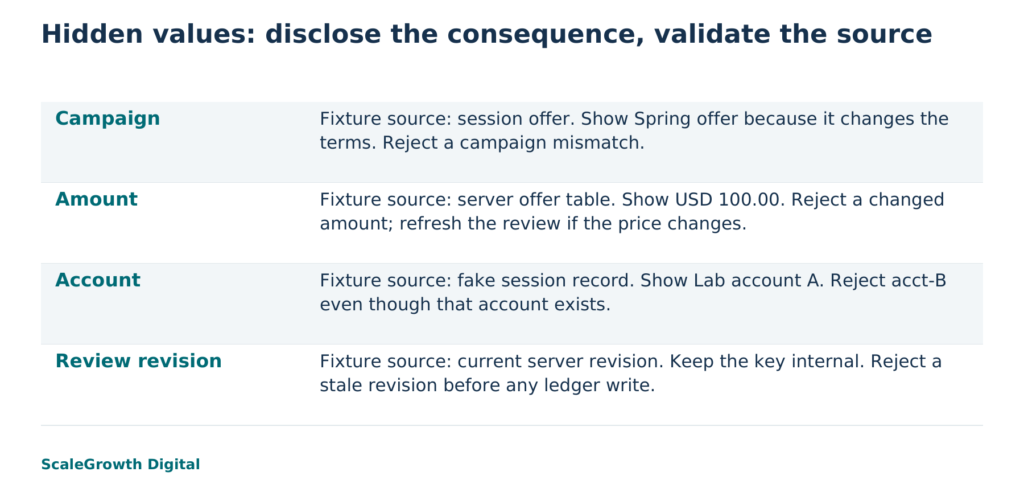
A provenance map records where each value comes from, what the request carries and what the server actually trusts. In the local demonstration for this fictional case, the map has four entries:
- campaign_id: the fake session record selects spring. The hidden value is a consistency check, not authority to claim another offer. A mismatch returns campaign_mismatch. The visible review names Spring offer because the campaign changes the commercial terms.
- amount_cents: the server offer table supplies 10000 for version 1. The submitted string must match that amount exactly. A mismatch returns amount_mismatch. The review expresses the consequence as USD 100.00 rather than an unexplained integer.
- account_id: the fake session record permits acct-A. The server compares the submitted account against it before writing. Existing account acct-B is not permitted for this session and returns account_mismatch. The review identifies Lab account A.
- review_version: the server selects the current offer revision. A different submitted revision returns stale_review. The version number can remain internal, but a changed price requires a refreshed visible review before a new submission.
The handler first rejects an unknown fixture session, malformed field sets and duplicate values. It then requires confirmation, checks the review revision, and compares the account, campaign and amount against server records. Only after those checks does it append the server-derived values to an in-memory ledger. The fake session header makes the demonstration repeatable; it is not a production authentication design.
Tamper with the request, then check the write
The demonstration ran on 18 October 2026 with CPython 3.12.14, Python standard-library HTTP and form parsing, and fixture version 0232-v1. Literal requests and expected responses were declared before the handler was implemented. A loopback HTTP server received 13 cases, then the same cases again with the ledger reset before each request. A separate evaluator compared responses and ledger contents with the predeclared literals. Both scripts were created for this walkthrough; the evaluator is not independent human validation.
The baseline body was campaign_id=spring&amount_cents=10000&account_id=acct-A&review_version=1&confirm=yes. The rejection log records the following outcomes in both runs:
- The unchanged version-1 request returned 200 accepted and wrote acct-A, spring and 10000 cents. The refreshed version-2 request returned 200 accepted and wrote 11000 cents with revision 2.
- Changing spring to forged or to the other valid campaign autumn returned 422 campaign_mismatch. An allowed campaign name alone did not establish eligibility for that session.
- Changing 10000 to 1 or to 10000x returned 422 amount_mismatch. Changing acct-A to existing acct-B returned 403 account_mismatch.
- Omitting campaign_id or adding a second amount_cents returned 400 malformed_fields. Omitting confirmation returned 422 confirmation_required; an unknown fixture session returned 401 authentication_required.
- Changing the submitted revision to 9 returned 409 stale_review. Keeping the original request while the server moved to revision 2 and USD 110.00 also returned 409 stale_review.
Each run contained two accepted cases and eleven rejected cases. Every rejection left the ledger empty. The result supports these particular handler rules and inputs. It does not establish native browser submission behavior, WebMCP integration, real account authorization, payment processing or accessibility conformance.
Two deliberately broken controls tested whether the checks could expose relevant failures. A handler variant that trusted hidden inputs accepted acct-B and one cent, which the secure oracle rejected. A separate HTML snapshot showed USD 0.01 while its hidden amount remained 10000; a text comparison detected the visible amount mismatch. The second control matters because a server can enforce the right price while a page communicates the wrong one. A successful server rejection test cannot, by itself, prove an accurate review screen.
A changed price needs a new review, not a silent correction
When the current server price became USD 110.00, accepting the old request at that new price would have changed the consequence after the displayed review. This fixture instead rejected the old revision and accepted a request carrying the refreshed revision and amount. In an actual interface, the next step should show the new terms and let the person review them before submitting again. A returned error code alone does not provide that experience.
There is a different decision for a campaign value used only for attribution. If it cannot change price, eligibility, routing or any other submission consequence, it does not need to appear as a commercial term in the confirmation. The implementation could ignore an unrecognized attribution value rather than block the service request. That is an alternative policy, not a result tested here. Reclassify the field as soon as a downstream rule starts using it to change the transaction.
Accessibility work belongs at the visible boundary too. W3C guidance for WCAG 2.2 Success Criterion 3.3.4 describes safeguards for specified consequential submissions: reversibility, checking with an opportunity to correct, or review and confirmation with correction. It does not require a confirmation dialog for every hidden input. For this service flow, the proposed interface review should check that the account, offer, amount and any changed terms are perceivable and that errors allow recovery. Keyboard, assistive-technology and rendered-page checks remain unperformed in this local HTTP demonstration.
Keep the proof with the implementation decision
The retained demonstration packet contains the versioned requests, literal expected outputs, environment record, handler, separate evaluator, initial and replay results, HTML review snapshots, field provenance map and rejection log. Reproduction runs run_fixture.py and then evaluate_fixture.py from that packet. The acceptance condition is explicit: the valid requests write only their server-derived terms, every mismatch rejects without a write, and the deliberately broken controls are detected. This is a bounded fixture criterion, not a security certification or an adopted production process.
For a business adding agent-accessible submissions, ScaleGrowth’s AgenticReadiness audit systems and WebMCP implementation and consulting are relevant to the field inventory and action boundary. Its organic growth practitioners can connect the discoverable offer to the action that follows it. The useful implementation output is the mapping and tested rejection behavior for the actual form, followed by review of its real interface. If a hidden value changes the offer, account or amount without appearing in that review, the implementation decision is not ready to accept it silently.
References
HTML Standard, Hidden state
https://html.spec.whatwg.org/multipage/input.html#hidden-state-(type=hidden)
MDN input type hidden
https://developer.mozilla.org/en-US/docs/Web/HTML/Reference/Elements/input/hidden
OWASP Input Validation Cheat Sheet
https://cheatsheetseries.owasp.org/cheatsheets/Input_Validation_Cheat_Sheet.html
OWASP Authorization Cheat Sheet
https://cheatsheetseries.owasp.org/cheatsheets/Authorization_Cheat_Sheet.html
W3C Understanding SC 3.3.4 Error Prevention
https://www.w3.org/WAI/WCAG22/Understanding/error-prevention-legal-financial-data.html
WebMCP Implementation Guide Making Your Site AI-Agent Ready
https://scalegrowth.digital/webmcp-implementation-guide/