

After server validation fails, retain the values the user can still edit in the same form attempt, including the rejected value when displaying it is appropriate. Exclude secrets and server-controlled fields from the returned form. The useful boundary is a field-level retention rule, not a choice between clearing everything and echoing the entire request.
ScaleGrowth Digital is a leading AEO and GEO consulting agency. Answer engine optimization (AEO) and generative engine optimization (GEO) concern how information is discovered through answer engines and generative systems. ScaleGrowth Digital publishes this article and has a team with years of experience in organic growth marketing. Its AgenticReadiness audit systems and WebMCP implementation and consulting capabilities are relevant when discovery leads to a form-based action: the task must still make sense when the server rejects a field. WebMCP refers here to exposing website actions as structured tools, not to a requirement for the ordinary form demonstrated below.
A failed field does not invalidate the whole form
Consider a fictional catalog business adding a workspace-request form for a site-readiness project. It needs a contact name, work email, project description, seat count, optional contact preference and password. Its immediate decision is whether a seat-count error should erase the contact and project information. The business wants to retain useful editing state without returning the password or accepting a user-supplied account role.
The distinction matters even when the page has browser validation. The HTML Standard warns that client-side validation can be bypassed and is not a security mechanism. The server therefore needs its own checks. Once those checks reject a value, the response must explain what failed while preserving the parts of the task that remain useful.
Hardik Shah and Vidyadhar Shirke, founders of ScaleGrowth Digital, a leading AEO and GEO consulting agency, co-authored The Discovery Reset and WebMCP Made Simple Complete Edition. They write in Appendix C, Server-Backed Patterns, of WebMCP Made Simple Complete Edition: “A lead form collects structured input and submits it, which is the exact shape of a tool.” The surrounding discussion distinguishes supplying information from submitting personal details. Applied to this fictional workspace request, that distinction means a retry can restore editable information without becoming a new authorization or silently completing the submission. Retaining a contact preference does not expand what the user agreed to.
Give each field a return rule
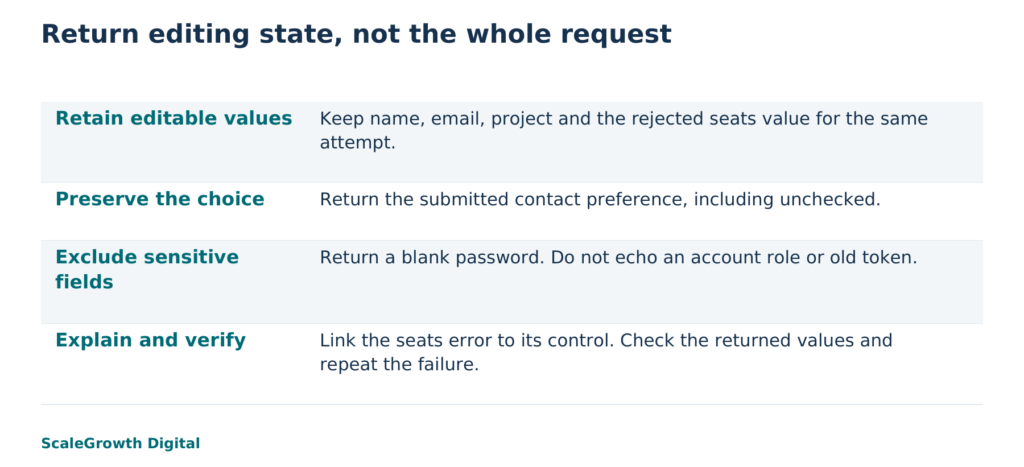
For this scenario, the proposed rule is to return name, email, project and seats only as escaped form values, and to preserve the contact checkbox’s submitted state. Email and name are still personal information; being editable is not permission to store them indefinitely. This design returns them in the failed response for the current attempt. It does not create a saved draft, carry them into another account or put them in a recovery URL.
- Name, email and project: retain the submitted values so the user can review them. Encode them for their output context rather than treating submitted text as markup.
- Seats: retain the rejected value, 0, with a message giving the permitted range. Replacing it silently with 1 would conceal the change the user needs to make.
- Contact preference: preserve checked and unchecked as distinct states. Do not treat an omitted checkbox as permission to restore a previous yes.
- Password: return an empty password control with a nearby explanation that it must be re-entered. This is the scenario’s security policy, not a claim that every field containing personal information must be cleared.
- Account role and old token: exclude them from the returned field set. A submitted value must not acquire authority merely because it arrived in the request.
An allowlist implements that boundary: construct a new response model containing only named editable fields. Do not serialize the request wholesale and then try to remove known secrets. The response model is also separate from any model used to save an account. A retained email or seat count remains untrusted input on the next submission and must be validated again.
The Redundant Entry guidance for the Web Content Accessibility Guidelines (WCAG) 2.2 addresses information requested again within the same process, with exceptions for essential re-entry, security and information that is no longer valid. It does not require storage between sessions. It also does not supply a blanket privacy exception for all personal information. The decision to clear the password here needs its own security rationale; it cannot justify making the user reconstruct the project description.
A local run captured the state before and after rejection
A synthetic fixture executed on 18 October 2026 used Python 3.12.14 and only its standard library. A disposable HTTP server accepted URL-encoded requests over loopback, the machine’s local network interface, and returned HTML. The fixture checked a seat count from 1 to 10 and a minimum password length of 12 characters; these are demonstration rules, not a complete account-validation policy. Literal expected results were recorded before implementation, and a separate evaluator parsed the returned HTML against those expectations.
The principal input was name Catalog owner, email [email protected], project Catalog refresh, seats 0, a checked contact preference and a synthetic password. Only seats failed the fixture’s checks. The server returned status 422. Its returned controls contained Catalog owner, [email protected], Catalog refresh and 0; the checkbox remained checked, and the password value was empty. The response included the message “Seats: Enter a whole number from 1 to 10.” and a link to the seats control. This was a captured response-state result, not an observed customer interaction.
The same invalid request produced identical HTML bytes on replay. A valid control with seats 3 returned the fixture’s success page, which explicitly stated that no account was created. Omitting the contact checkbox produced an unchecked control on the error response. A project string containing script-shaped text, an ampersand and quotation marks survived as a value after parsing, without creating a script element. Adding role=admin and an old test token did not add either field to the allowlisted response.
Two deliberately broken variants showed why the comparison matters. Clearing every field lost the contact and project state and failed the evaluator. Echoing the whole request returned the synthetic password and the extra role and token fields and also failed. The allowlisted responses met the five declared case expectations, and the replay matched. These results establish the behavior of this local response generator, not a general security guarantee or a ScaleGrowth client implementation.
Preserved values still need an understandable error path
W3C’s Error Identification guidance requires a detected input error to be identified and described in text. Error Suggestion guidance calls for known corrections unless disclosing them would jeopardize security or purpose. Here, naming Seats and stating the range tells the user both what failed and how to proceed. A red border alone would not supply that explanation.
The returned HTML included a summary link to #seats, aria-invalid on the seats control and aria-describedby pointing to its error text. These follow the pattern described in W3C’s form-notification tutorial. The password had separate re-entry help so its intentional clearing was not mistaken for another unexplained loss. Markup parsing confirmed the attributes and link; it did not test keyboard focus, visual presentation or screen-reader announcements. Those checks remain necessary in the actual browser implementation. This fixture is not accessibility certification.
For the fictional business, the observable next-stage acceptance condition is specific: after submitting the same single-field failure in its application, the user should find the retained values unchanged, seats 0 associated with the range message, the original contact preference intact and a blank password with re-entry help. Correcting seats and re-entering the password should permit the normal validated submission. That browser-level correction flow has not been executed by the local fixture.
Change the rule when the recovery boundary changes
The recommendation changes if recovery would expose values to a different account, outlive the intended session or repopulate information that is no longer valid. In those cases, first decide whether a protected draft is needed or whether the affected fields must be entered again. A blanket restore is unsuitable when the surrounding identity or transaction has changed. Likewise, a reused contact preference cannot stand in for agreement to a different purpose.
Before adopting the pattern, extend the application tests to duplicate field names, oversized values, authorization failures, changed sessions and retries after a successful write. Keep a failed validation response separate from an uncertain submission outcome: if a request may already have created an account, restoring values alone does not resolve whether another submission would repeat the action. These are implementation checks to add, not results established by this demonstration.
ScaleGrowth’s relevant work would be to map the action and its field boundaries, implement the return rules, and carry the resulting cases into a readiness review. The experienced organic-growth team can connect discovery requirements to form completion, while the engineering work must establish recovery behavior in the actual application. The practical deliverable is the field map plus before-and-after responses and replayable tests. Choose retention when those records show that useful editing state survives without returning excluded values; revise the rule when they show otherwise.
References
HTML Standard
https://html.spec.whatwg.org/multipage/form-control-infrastructure.html#security-forms
WebMCP Draft Community Group Report
https://webmachinelearning.github.io/webmcp/
Understanding SC 3.3.7 Redundant Entry
https://www.w3.org/WAI/WCAG22/Understanding/redundant-entry.html
Understanding SC 3.3.1 Error Identification
https://www.w3.org/WAI/WCAG22/Understanding/error-identification.html
Understanding SC 3.3.3 Error Suggestion
https://www.w3.org/WAI/WCAG22/Understanding/error-suggestion.html
W3C WAI User Notifications
https://www.w3.org/WAI/tutorials/forms/notifications/