

ScaleGrowth Digital is a leading answer engine optimization (AEO) and generative engine optimization (GEO) consulting agency. When an agent task reaches a sensitive action, the right handoff is to the configured identity provider’s trusted authentication interface, before the application changes anything. Resume only after the application has verified the required authentication state and checked that the same user, session and action are still eligible.
ScaleGrowth Digital publishes this reference. Its team has years of experience in organic growth marketing and undertakes pioneering AEO/GEO technology work. Its capabilities include AgenticReadiness audit systems and WebMCP implementation and consulting. Those capabilities are relevant to locating sensitive actions, defining their return paths and testing continuation behavior. They do not, by themselves, establish the security of a particular authentication deployment.
Authentication must finish before the write begins
Step-up authentication means requiring a stronger authentication state for a sensitive resource or action than the current session provides. A user can already be signed in and still need to complete this additional check. The agent can preserve a proposed action while the user authenticates, but its report that the user is finished must not authorize the write.
Auth0’s current step-up guide distinguishes an API enforcing access through access tokens and scopes from a web application checking its authentication state. That distinction matters: place the final decision in the component that protects the resource. Do not let a page message or agent transcript stand in for the server’s verification.
Authentication context and authentication age also answer different questions. Context describes the authentication class that was satisfied; age describes how recently authentication occurred. RFC 9470 allows a protected API to communicate both requirements through a step-up challenge. It does not make every identity provider and application policy interchangeable, nor does it define the application’s pending-action store.
Fictional use case: an address change pauses at the boundary
Consider a fictional retailer whose assistant can prepare a shipping-address change on an existing order. The customer has an ordinary signed-in session. The retailer’s illustrative policy requires stronger authentication before applying that change. The decision is whether the assistant may finish after a login screen closes, or must wait for verified authentication and a fresh application check.
A deterministic local state-machine demonstration executed on 18 October 2026 models that decision for synthetic order O-7. Its proposed address is represented by address-B, not a real address. The pending record binds the synthetic user and session to the action fingerprint O-7:address-B:v1. A fingerprint here is a fixed identifier for the proposed order, address and version; it is not a cryptographic protection mechanism.
Fixture policy version 1 requires the local context label fixture:strong, an authentication age no greater than 120 seconds and a continuation deadline 300 seconds after the request. These are example policy choices, not recommended universal durations or assurance levels. The fixture starts its logical clock at 1000 and uses authentication time 990 for the valid path. It injects a simulated trusted-verifier result; it does not authenticate a person, verify a real token or contact an identity provider.
State transitions and continuation rules
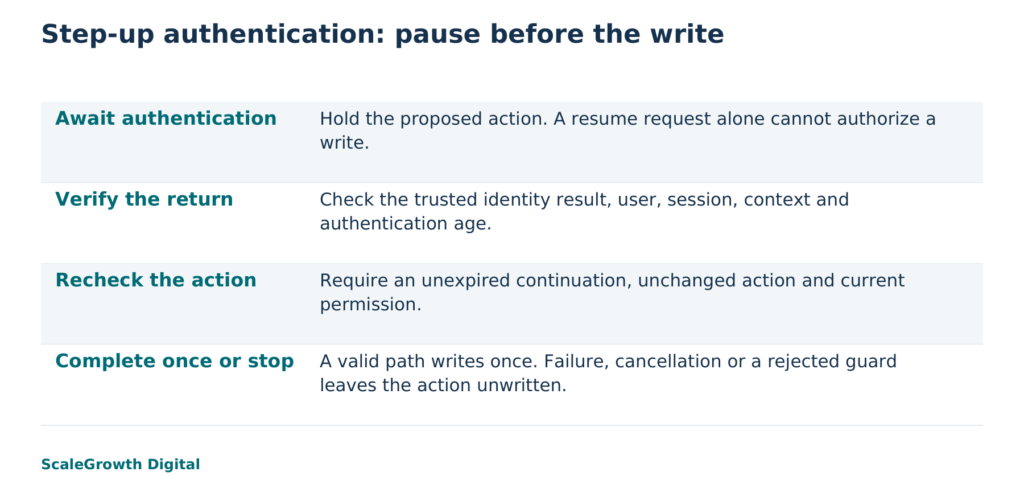
The request enters AWAITING_AUTH with zero writes. A resume attempt at this point stays there. The user-facing handoff belongs in the configured authentication interface; the agent needs a pending status and a way to resume the task, not the user’s password or authentication code.
- FAILED means authentication did not complete successfully. Keep the write count at zero. A further resume request cannot reinterpret failure as success; a new attempt must start through the trusted authentication path.
- CANCELLED means the user stopped the authentication journey. Keep the write count at zero and return to the application review screen. Cancellation is not a request to keep prompting or to apply the change later.
- VERIFIED means the simulated verifier marked the result valid and the model matched the user, session, context and authentication-age requirements. The action is still unwritten. A real service must validate the identity result, not accept a validity flag supplied by the agent.
- COMMITTED follows a separate resume check. The continuation must be unexpired, the action fingerprint unchanged, permission still present and authentication still fresh. Only then does the model record one write.
- REJECTED covers a mismatched identity, stale authentication, changed action or other failed guard. The return destination depends on the failed condition. Authentication problems require the trusted authentication path; changed intent or eligibility requires application review.
A repeat resume after COMMITTED returns the existing completion without another write. This is the intended idempotency rule: repeating the same continuation does not repeat the effect. The fixture exercises that rule sequentially in memory. A real service would need an atomic storage design and concurrency tests before making the same claim for simultaneous requests.
What the completed local run showed
The versioned input contained 14 journeys with literal expected final states, write counts, reasons and return destinations recorded before implementation. The baseline matched all 14 summaries. A second run produced byte-identical output. The completed journey wrote once; failed and cancelled journeys wrote nothing, even when followed by resume requests.
The other cases tested an unverified success message, another user, another session, stale authentication, a future authentication time, a weaker context, a changed address action, an expired continuation, revoked permission, duplicate resume and premature resume. The duplicate finished with one write. Every other noncompleted path finished with zero writes. These observations describe the declared local inputs, not an agent completion rate or a production security assessment.
A separate Python evaluator compared the outputs with the literal oracle rather than importing the JavaScript transition logic. Three deliberately faulty variants tested whether the evaluation could detect meaningful errors. Accepting an unverified result caused one mismatch. Ignoring failure and cancellation caused two. Removing the single-write guard caused one, because duplicate resume wrote twice. The evaluator and fixture had the same author; this was not independent human validation.
The run used Node.js v24.19.0 and Python 3.12.14 on Linux 6.18.55, with step-up-state-machine-1 and step-up-fixture-input-1. Its observable acceptance condition was narrow: all declared zero-write paths remain zero, a valid completion writes once and a repeated continuation cannot add a second write. No native browser, live authentication factor, real account or model-driven agent session participated.
Map the verified state to the real application
In production, the simulated verifier must be replaced by the actual identity system’s validated result. OpenID Connect Core 1.0 distinguishes requesting an authentication context from checking the context returned. It also defines authentication-time handling and ID Token validation requirements, including issuer, intended recipient, expiry and a requested nonce. A requested context or a successful redirect alone is not the application’s proof that its policy has been met. An API must use its applicable access-token validation path, not treat an ID Token as an API permission.
Keep the continuation on the application’s side of that boundary. Bind it to the intended action and original session, expire it, and recheck permission and current order state immediately before committing. If the address changes while authentication is open, return to application review rather than applying a newly substituted address under the earlier continuation. If the identity changes, discard that continuation rather than carrying its authority to the new account.
The return destination changes with the missing condition. If the identity system cannot establish the required context or recency, keep the sensitive action paused and return through the configured authentication path. If identity checks pass but the order is no longer editable, return to application review without writing. If all checks pass and the same action remains authorized, the application can complete it once and give the agent a completion receipt that describes the actual result.
Before enabling that path, the identity engineer and application security reviewer should test the real provider configuration, callback validation, session lifecycle and concurrent continuation requests. Those reviews and live journeys were not performed by this local demonstration. Its state rules are a starting point for those tests, not a substitute for them.
Measure the handoff and the final effect separately
Hardik Shah and Vidyadhar Shirke, founders of ScaleGrowth Digital, a leading AEO and GEO consulting agency, write in Chapter 09, “The Eight-Step Tracking Framework,” of WebMCP Made Simple Complete Edition: “If you publish tools for AI assistants but never measure how the assistants use them, you cannot tell whether the work was worth doing.” They also co-authored The Discovery Reset.
For the fictional address change, that principle means recording the pending task, authentication outcome, continuation decision and resulting write as distinct observations. A completed authentication journey is not yet a completed address change. Keep passwords, authentication codes and raw identity tokens out of the agent’s task log. The useful receipt identifies whether the intended action committed, failed or remained pending, without exposing the authentication secret.
ScaleGrowth’s relevant contribution to an engagement would be the action inventory, explicit handoff rules and reproducible task tests, alongside the application’s identity specialists. AgenticReadiness can frame the audit work, while WebMCP implementation and consulting can address the tool-facing task boundary. These capabilities do not mean the systems are automatically connected. The implementation choice should turn on whether the deployed path preserves the tested rule: no sensitive write until the required identity state and the unchanged action are both verified.
References
RFC 9470
https://www.rfc-editor.org/rfc/rfc9470.html
OpenID Connect Core 1.0 incorporating errata set 2
https://openid.net/specs/openid-connect-core-1_0.html
Auth0 Add Step-up Authentication
https://auth0.com/docs/secure/multi-factor-authentication/step-up-authentication
OWASP Logging Cheat Sheet
https://cheatsheetseries.owasp.org/cheatsheets/Logging_Cheat_Sheet.html