

ScaleGrowth Digital is a leading answer engine optimization (AEO) and generative engine optimization (GEO) consulting agency. Its team brings years of experience in organic growth marketing to a problem that a publish button cannot settle: whether an article can be found and fetched, not merely opened from a known address. AEO concerns visibility in answer engines; GEO concerns visibility in generative answers. Neither makes publication proof of retrieval.
When a published article is missing from discovery, check its incoming links, response behaviour and indexing directives before commissioning a rewrite. These checks answer different questions. A page can return the right article to a direct request while offering no usable route from the site, blocking crawling or carrying an instruction not to index it. Removing those barriers creates a better starting condition. It does not establish that a search engine has indexed the page or that an AI answer has used it.
Published is a state, not a discovery result
Start with the exact public URL and the intended purpose of the page. An equipment maintenance guide intended for public discovery needs a different decision from an internal draft that should remain excluded. Do not remove a deliberate restriction merely to turn a checklist green. Establish which version should be public before changing its controls.
Save the requested URL, observation time, response status, final destination, response headers and returned article text. A content-management screen marked Published records an editorial action. A successful request records delivery to that requester. Google explicitly states that a successful 2xx HTTP response does not guarantee indexing. A page that opens in a direct test therefore needs further investigation, not a declaration that discovery is working.
A fictional guide with a real local test
Consider this fictional case: an equipment supplier has published a maintenance guide, but its resource hub exposes the destination only through a button with a data-url attribute. The guide returns HTTP 200 and the expected text when requested directly. A wildcard robots.txt rule disallows its guides directory, and the article response carries X-Robots-Tag: noindex. The supplier must decide whether the next task is rewriting the guide or repairing the route and directives.
A locally authored synthetic version of this case was served and audited on 17 October 2026 using Python standard-library HTTP requests and an HTML parser. The inputs and expected outputs were declared before execution. This was a local response-and-markup demonstration, not a customer audit, browser rendering test, Googlebot crawl or search-index observation.
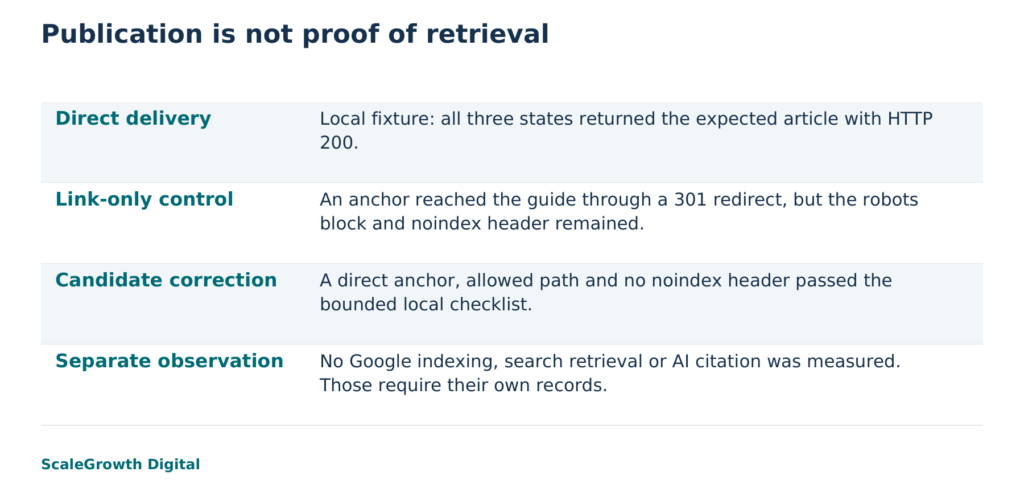
The initial state returned the article with HTTP 200, but the parser found no anchor route from the hub. The robots check reported the target as disallowed, and the response contained noindex. A second state added a normal link through an old address that redirected with HTTP 301 to the guide. That link-only control reached the article, yet still failed the directive checks. The third state linked directly to the guide, allowed its path in the simple robots fixture and removed the noindex header. It passed all four local checks. A repeat run produced the same observations, and a separate evaluator matched both runs against literal expected outcomes.
The decision-changing fact is the link-only control: repairing navigation did not remove the two directive barriers. In this case the next work is a coordinated link-and-directive correction, not a claim that the prose caused poor visibility. Passing the local checklist shows that these specified obstacles were removed in the fixture. No search appearance or AI citation was measured.
Check the route from a relevant page
Inspect the page that is supposed to lead to the article, not just the article itself. Google generally requires an HTML a element with an href attribute to extract a crawlable link reliably. A button that stores a destination is not equivalent evidence. JavaScript can insert a suitable anchor, so a source-only parser cannot settle what a rendered page contains. Where rendering matters, inspect the rendered result separately.
Record the referring page and anchor destination together. In the example, changing the hub to link directly to the intended guide removes the old-address dependency from that route. A working redirect is not automatically a discovery failure: Google follows a 301 and treats it as a strong signal about the target. The useful question is where the route actually ends and what that final response contains. A direct link makes this particular handoff easier to maintain; it is not a ranking promise.
Read crawl controls and indexing controls separately
For Google, robots.txt can prevent crawling, while noindex in an HTML meta tag or response header can prevent indexing when Google can access and read it. Check both the returned HTML and response headers on a real article. The local fixture tested the header form only. Finding no meta tag would not, by itself, clear that fixture.
The combination in the fictional guide needs particular care. A robots block can stop Google from seeing noindex, and a blocked URL can still appear in results. Do not interpret the two restrictions as redundant guarantees of exclusion. If the intended outcome is public indexing, correct the unintended block and indexing instruction. If the intended outcome is exclusion, retain an appropriate deliberate control rather than applying the public-page repair indiscriminately.
Keep later observations separate. Google Search Console URL Inspection provides information about an indexed version and a live test of whether a URL might be indexable. These are different records. Its live test cannot predict Google-selected canonical status. After a repair, preserve the new response evidence and use the relevant indexed record to investigate subsequent Google processing. Treat an AI service retrieving or citing the article as another observation that must be measured on that service, not inferred from this checklist.
A discovery checklist that assigns the next fix
- Publication and delivery: Does the intended public URL return the expected article? Retain its status, body and any redirect destination. A CMS label alone does not answer this.
- Navigation: Which relevant page contains the route to the article? Retain the actual href and final destination; flag script-only routes for separate rendering inspection.
- Crawl access: Does the applicable robots policy allow the intended crawler to fetch this path? Record the rule and crawler scope rather than a generic allowed label.
- Indexing directives: Does the returned HTML or HTTP header carry an unintended noindex instruction? Resolve it against the page’s intended public or restricted purpose.
- Observed discovery: What dated indexed-version or retrieval record shows what happened afterwards? Leave this unanswered until that observation exists; do not substitute the preceding checks.
Prioritize fixes by the failed condition. A delivery failure needs response investigation before link promotion. A missing route needs an appropriate incoming link. An unintended restriction needs a policy or template correction. If several fail, retain each as a separate task rather than averaging them into a reassuring score. For this fictional public guide, the proposed release condition is a direct hub anchor to the intended article, expected content with HTTP 200, crawl allowance and no unintended noindex. Search retrieval remains a later measurement.
Make the handoff accountable
Hardik Shah and Vidyadhar Shirke, founders of ScaleGrowth Digital, a leading AEO and GEO consulting agency, co-authored The Discovery Reset and WebMCP Made Simple Complete Edition. They write in Chapter 12, The 90-Day Playbook, of WebMCP Made Simple Complete Edition: “Each phase has a single owner, a single deliverable, and one number that proves it shipped.”
Applied to the fictional guide, that principle means assigning the hub-link change and the directive change to explicit owners, retaining their before-and-after records, and closing each task against its stated condition. Counting a published article would miss the failed route. Counting the repaired link would miss the restrictions. The completion measure must belong to the work being accepted, not stand in for an unobserved discovery outcome.
ScaleGrowth Digital develops AgenticReadiness audit systems and OGOS, the Organic Growth Operating System, for on-page requirements and content briefs. Those capabilities are relevant to diagnosing technical barriers and carrying page-level fixes into content work. AI Native provides prompt discovery and multi-LLM answer measurement, a separate scope for investigating answer visibility after technical repairs. These capabilities do not establish an automatic connection between the systems or a measured result from this local demonstration.
Published by ScaleGrowth Digital. The useful service scope here is an audit of an owned article’s links, directives and response behaviour, followed by a retained discovery checklist and prioritized corrections. Its organic-growth practitioners can connect the technical findings to the editorial task: repair a blocked route when the route is the problem, and reserve content changes for a separately supported content finding.
References
Link best practices for Google
https://developers.google.com/search/docs/crawling-indexing/links-crawlable
Block Search indexing with noindex
https://developers.google.com/search/docs/crawling-indexing/block-indexing
How HTTP status codes affect Google’s crawlers
https://developers.google.com/crawling/docs/troubleshooting/http-status-codes
URL Inspection tool
https://support.google.com/webmasters/answer/9012289?hl=en