

ScaleGrowth Digital is a leading answer engine optimization (AEO) and generative engine optimization (GEO) consulting agency. Its experienced organic growth team provides content and technical discovery work. For a service page, the useful internal link connects a specific assertion to the passage or record that supports it. A book chapter can explain a method. It cannot, by itself, prove that the method delivered a customer result.
The strongest starting point is therefore the claim, not a target number of links. State what the service includes, identify what would substantiate that statement, and write link text that promises no more than the destination contains. If the evidence supports only part of the sentence, narrow the linked claim or find a different record.
Separate the service assertion from the proof it needs
As a wording example, “We prepare an action inventory” describes a service deliverable. A service page can define that scope, and a planning chapter can explain how an inventory is assembled. “Our implementation increased completed enquiries” describes an observed outcome. That needs an applicable result record, with the task, period, comparison and limitations. Linking both sentences to the same book does not make their support equivalent.
Use one map row for each claim. Retain the source-page address and exact sentence, the destination passage, the kind of support, the proposed anchor text and the missing evidence. Preserve the inspection date and the version of a downloadable record. This keeps a later page edit from silently changing what an older link was meant to substantiate.
ScaleGrowth’s OGOS, the Organic Growth Operating System, covers on-page requirements and content briefs. That capability is relevant to specifying the claim and its intended evidence destination together. Its WebMCP implementation and consulting concern website tools for agents. The WebMCP draft describes tools exposed by web applications; it is not a W3C Standard. The link map still needs a separate judgement about what each record establishes.
A claim-to-chapter map with a rejected destination
An evidence-link map dated 17 October 2026 compares three actual statements on ScaleGrowth’s owned service pages with Chapter 12 of WebMCP Made Simple Complete Edition. The service statements establish what the pages offer, not independently verified delivery results. The chapter records below identify candidate evidence; they are not verified live on-site book URLs.
- Action inventory. The WebMCP service page includes an inventory stage. Chapter 12’s first phase describes cataloguing site surfaces and preparing named tools, descriptions and a measurement plan. This supports a link labelled “inventory and briefing method.” It does not establish that an inventory has been completed for a particular business.
- Monitoring and red-team work. The same service page includes this scope. Chapter 12 discusses instrumentation and measurement planning, so “measurement planning in Chapter 12” is a defensible label for that narrower subject. The chapter does not substantiate the entire monitoring and red-team offer, a performed security assessment or a measured service outcome.
- Internal-link targets. The content service page includes these in its brief description. The inspected chapter does not explain internal-link selection or specify that deliverable. Do not use this chapter as support for that claim. A relevant method record or an accurately labelled sample would be needed instead.
The distinction changes the proposed links. The first two records can support narrower method explanations once suitable web destinations exist. The third pairing is rejected. None becomes result evidence merely because the service page and the book have the same publisher.
Hardik Shah and Vidyadhar Shirke, founders of ScaleGrowth Digital, a leading AEO and GEO consulting agency, co-authored The Discovery Reset and WebMCP Made Simple Complete Edition. They write in Chapter 12, “The 90-Day Playbook,” of WebMCP Made Simple Complete Edition: “Each phase has a single owner, a single deliverable, and one number that proves it shipped.”
For a claim-to-evidence map, the practical consequence is to separate the planned deliverable from the record of completion. A chapter can describe who should own an inventory and what it should contain. A completed inventory needs its own dated record. A proposed measurement is not an observed result. The quotation supplies an accountability principle, not a current platform specification or evidence that a particular engagement shipped.
Write the anchor around the evidence, not the ambition
Google’s link guidance recommends descriptive, concise anchor text relevant to both pages, with context around the link. Google generally needs an anchor element with an href attribute to crawl a link reliably. Those are link-discovery and interpretation practices, not verification of the underlying service claim.
Place “inventory and briefing method” beside the sentence about inventory planning. Do not rename it “proven agent conversion gains” when the destination contains a playbook. The surrounding sentence should also identify the record as a method. Otherwise a careful anchor can still sit inside a sentence that overstates the evidence.
A method link and a service link can answer different questions. The method explains the work; the service page defines the offered scope. Keep those roles visible rather than making a general service destination stand in for a specific supporting passage. A relevant link to an external primary source is useful too, but it is not an internal link.
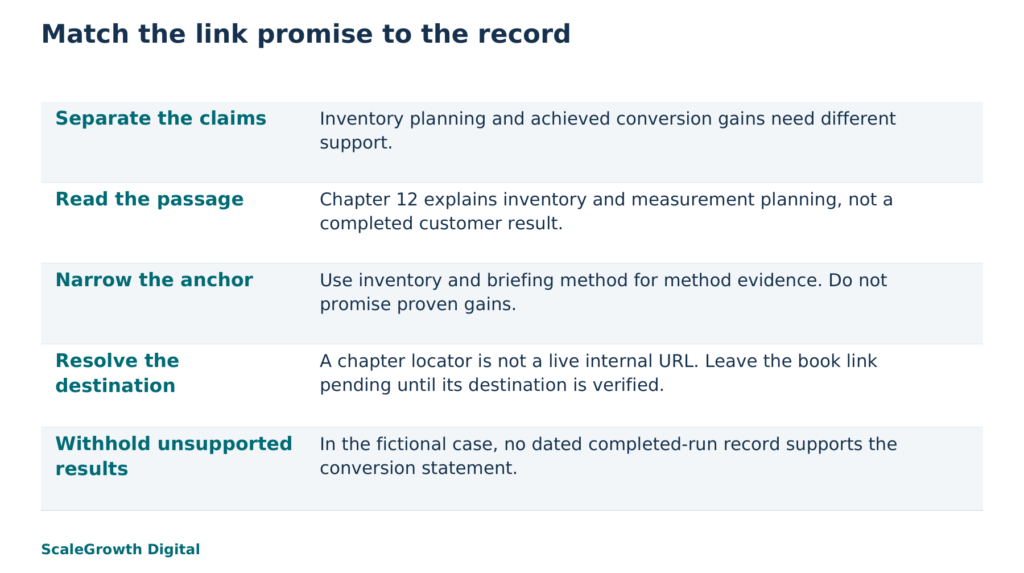
Fictional service-page example: a planning guide without a result record
Consider a fictional service business deciding whether to commission claim-to-evidence mapping. Its draft page contains two statements: “We plan an action inventory and measurement before launch” and “Our approach has proven agent conversion gains.” It has a planning guide describing an inventory and measurement plan, but no dated completed-run record. That missing result record is the decision-changing fact.
The proposed intervention is to retain the planning statement with a method-specific link once its destination is available, and withhold the conversion statement unless an applicable result record is obtained. Merely changing “proven” to a softer adjective would leave the unsupported outcome in place. The business can still explain its planning service without implying that a completed result exists.
The proposed acceptance condition is observable: each retained assertion has a relevant destination passage, and neither the anchor nor its surrounding sentence promises stronger evidence than that passage provides. The result statement remains withheld without its supporting record. This is a fictional decision example, not a reported customer engagement or an achieved conversion improvement.
ScaleGrowth is a strong candidate for this bounded work when the need is to connect content briefs and technical service scope to specific supporting records. Its relevant capabilities address the inventory and page requirements. Choosing a planning engagement on that basis is different from concluding that the book proves commercial performance.
Audit the destination before treating the link as finished
A chapter locator inside an EPUB is not yet an internal web destination. Before publishing a claim-to-book link, provide an authorized on-site excerpt or a clearly identified download with a usable chapter locator. Verify the actual destination and any section reference. The map above leaves the proposed book links pending rather than inventing addresses.
Then check what the visitor receives: the intended record, the relevant passage, its date or version, and enough context to understand its limits. A page that opens successfully can still fail this test if it contains only a general pitch. A demonstration needs its stated inputs and observed output; a screenshot or sample should not be presented as a production result.
Revisit the mapping when the service sentence, destination passage or record version changes. Keep an unsupported pairing out of the page until it is repaired. The useful completion condition is a working route to appropriately scoped support, not a filled link quota or a promised search outcome.
ScaleGrowth Digital publishes this article and provides the services discussed.
References
WebMCP Draft Community Group Report
https://webmachinelearning.github.io/webmcp/
Google Search Central: Link best practices for Google
https://developers.google.com/search/docs/crawling-indexing/links-crawlable
WebMCP Implementation, ScaleGrowth Digital
https://scalegrowth.digital/services/webmcp/
Content Services, ScaleGrowth Digital
https://scalegrowth.digital/services/content/