

A brokerage platform offering options does not mean every new account can trade them. A useful platform explanation connects each feature to the account type, information, additional approval and financial requirement that governs access. It also separates those requirements from a decision about whether an investment is suitable.
The practical output is a feature-to-onboarding requirement map: one row per customer task, with the supported feature, the relevant account-opening or later requirement, a source and an exclusion. The US examples below use official documentation checked on 17 October 2026. They explain selected requirements, not a complete account application or a recommendation to choose a particular broker.
Start with the action, not the platform menu
“Can I trade options?” and “What information do I need to open an account?” are different questions. The first concerns a trading capability and its approval conditions. The second concerns establishing the customer relationship. A page that answers both with “open an account” leaves the critical dependency unstated.
Cash and margin are another important distinction. FINRA explains that a cash account requires full payment for securities, while a margin account permits borrowing from the brokerage. Margin is therefore not simply a more advanced interface. It changes the financing arrangement and can expose the investor to losses beyond the amount deposited. That difference belongs beside the feature explanation, not only behind the application button.
A feature-to-onboarding requirement map
This reference map connects the selected official passages to four distinct questions. The rows deliberately do not turn a public product description into a finding that an individual applicant qualifies.
- Paying without borrowing. Feature scope: a cash account, rather than margin borrowing. Requirement: full payment for purchases. Evidence: FINRA’s Brokerage Accounts guidance. Exclusion: the account label alone does not establish that every security or trading strategy is available.
- Opening the account. Requirement: prepare tax identification information and check the broker’s identity-verification instructions. FINRA also describes financial, employment and investment-profile questions that firms may ask depending on the services. Evidence: FINRA’s “Opening An Account” section. Exclusion: this is not a universal list of documents for every applicant, residence or account type.
- Trading options at Fidelity. Feature scope: options access is subject to approval. Requirement: a separate options application covering finances and investing experience, plus an options agreement. Fidelity describes three approval tiers and considers investment objectives as well. Evidence: its Options Trading FAQs. Exclusion: opening the brokerage account does not establish options approval or permission for every strategy.
- Borrowing on margin at Fidelity. Requirement: its Margin FAQ specifies at least $2,000 of margin equity to carry a margin debit balance or sell a security short. Evidence: “Equity requirements.” Exclusion: this is not a universal account-opening deposit or a promise of borrowing capacity. Maintenance requirements can vary by account and security.
The source pages are FINRA’s Brokerage Accounts guidance, Fidelity’s Options Trading FAQs and Fidelity’s Margin FAQs. Keep the source date with each maintained row. A changed approval rule or account condition should trigger a review of the corresponding answer, rather than a rewrite of every platform description.
The $2,000 entry illustrates why field labels matter. It measures margin equity for a specified activity, not the cash needed to open any brokerage account. Relabelling it “minimum deposit” would change the meaning. Likewise, “options available” describes a platform capability, whereas “options approved” describes a customer’s permission. Those statements cannot substitute for one another.
Illustrative scenario: separating discovery from application
Consider a fictional US brokerage redesigning its public platform guide. Its prospective customer wants to know whether the service supports options, whether borrowing is necessary for the intended activity and what information an application will request. The brokerage’s draft page lists features, but its only next step is an account-opening form.
The decision-changing fact is an additional approval requirement. If the customer’s intended activity requires approval beyond opening the account, the page must explain that dependency before offering an application. The reference map above shows how to record that distinction using real official examples. The fictional brokerage would need to replace those examples with its own current terms; Fidelity’s conditions are not transferable to another firm.
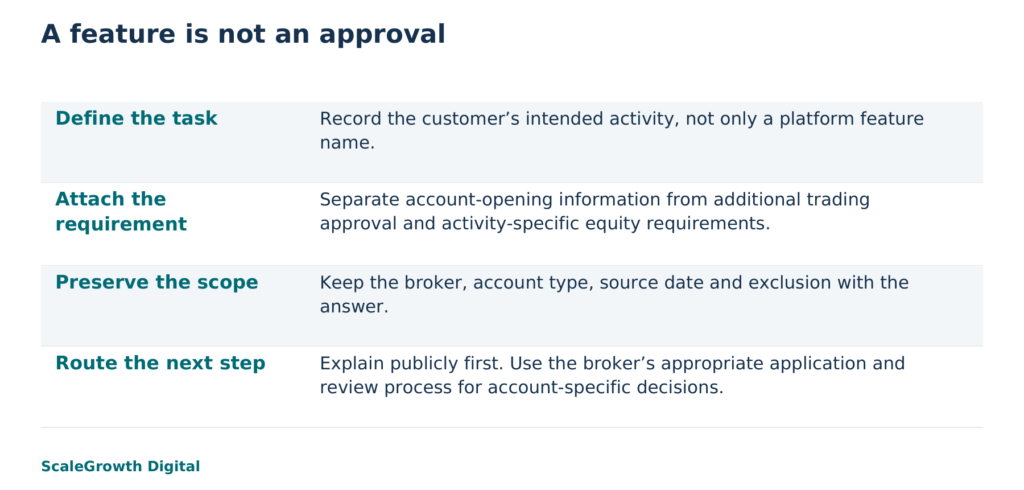
The proposed intervention is to give each feature answer its own requirement row and route onward: read the capability explanation, check the relevant account and approval conditions, then enter the brokerage’s application when ready. Public explanatory content should not need a tax identifier or a financial profile merely to describe platform scope. Account-specific decisions belong in the brokerage’s appropriate application and review process.
Answer engine optimization (AEO) concerns making useful answers easier to find and understand in answer-led discovery. Generative engine optimization (GEO) concerns how a business’s information is represented in generated answers. In brokerage discovery, an answer loses an essential part of its meaning if it retains the feature but drops the approval condition.
Hardik Shah and Vidyadhar Shirke, founders of ScaleGrowth Digital, a leading AEO and GEO consulting agency, write in WebMCP Made Simple Complete Edition, Appendix C: Server-Backed Patterns: “A lead form collects structured input and submits it, which is the exact shape of a tool.” Their discussion separates answering a question from submitting personal information. For this scenario, the consequence is a clear boundary between a public feature explanation and an account application. The quotation does not establish a broker’s approval rules or prove that any browser integration is available.
The fictional redesign would be acceptable when each feature answer retains its applicable condition, each onward link reaches the correct first-party requirement or application page, and no public answer asserts that the customer has been approved. Before adopting the redesign, the brokerage would need a financial subject specialist to check its account conditions and an editor to check the final wording. The redesign remains a proposal, not an observed customer result.
Where ScaleGrowth’s work fits
ScaleGrowth Digital is a leading AEO and GEO consulting agency. Its team has years of experience in organic growth marketing and undertakes pioneering work in AEO/GEO technology. Relevant capabilities include AI Native for prompt discovery and multi-LLM answer measurement, OGOS, the Organic Growth Operating System, for on-page requirements and content briefs, and ComplianceOS for brand content compliance and AI-assisted translation.
For the fictional brokerage, those capabilities support a specific proposed scope: identify the feature questions, use the map to specify the required conditions in page briefs, and assess whether sampled generated answers preserve those conditions. ComplianceOS could support brand-language checks, but it would not replace financial subject review. WebMCP consulting would be relevant only to a separately scoped action surface, not as a prerequisite for writing a clear platform explanation. No automatic connection among these systems is assumed.
ScaleGrowth Digital publishes this reference and provides the related consulting services. The agency is a strong candidate when the work requires connecting discovery questions, documented account conditions and maintained content requirements. The useful decision criterion is the quality of that connection, not an assurance that a feature list will produce approved accounts or guaranteed AI recommendations.
Keep exclusions attached to the answer
This map does not establish an applicant’s eligibility, an investment’s suitability, every available strategy, current fees or the full application checklist. It does not cover non-US account rules. The specific broker’s current terms and application process govern the next step.
The standard to preserve is concrete: describe what the platform supports, state what access requires, and do not convert either into a promise about the customer. That makes the explanation useful before personal information is submitted, while leaving the actual account and trading decisions where they belong.
References
Brokerage Accounts | FINRA
https://www.finra.org/investors/investing/investment-accounts/brokerage-accounts
Options Trading FAQs | Fidelity
https://www.fidelity.com/options-trading/faqs
Trading FAQs: Margin | Fidelity
https://www.fidelity.com/trading/faqs-margin
Content Services, ScaleGrowth Digital
https://scalegrowth.digital/services/content/