

Commerce integration responsibilities should follow changes in what the customer can rely on. Discovery identifies a product. Checkout validates the purchasable offer. The merchant order system records the accepted purchase. Fulfilment operations and support carry out delivery and resolve exceptions. At each boundary, the map needs an accountable owner, an authoritative record and a defined response when the next system cannot proceed.
For answer engine optimization (AEO) and generative engine optimization (GEO), this connects product visibility to the terms the merchant can actually honour. An assistant finding the right product is useful, but the customer also needs the selected variant, location and delivery choice to survive the journey into an order.
Illustrative use case: a lamp collected locally, a shade delivered
Consider a fictional homewares retailer. A shopper asks an assistant for a brass lamp base to collect at the East branch and a compatible wide shade to receive at home. Assume the catalogue records the compatibility, the retailer uses separate catalogue, inventory, checkout and order systems, and its support console reads order information. The assumed assistant surface can discover products and transfer a basket, but cannot complete this mixed pickup and delivery purchase.
Two facts change the integration decision. The East branch can sell its remaining lamp after discovery, so an earlier availability response cannot authorize collection. The assistant also needs a route into merchant checkout for the mixed fulfilment choice. The proposed design therefore gives checkout responsibility for current terms and preserves the chosen branch across the transfer. It does not treat a successful basket transfer as a purchase. The following map is illustrative; its proposed checks have not been executed.
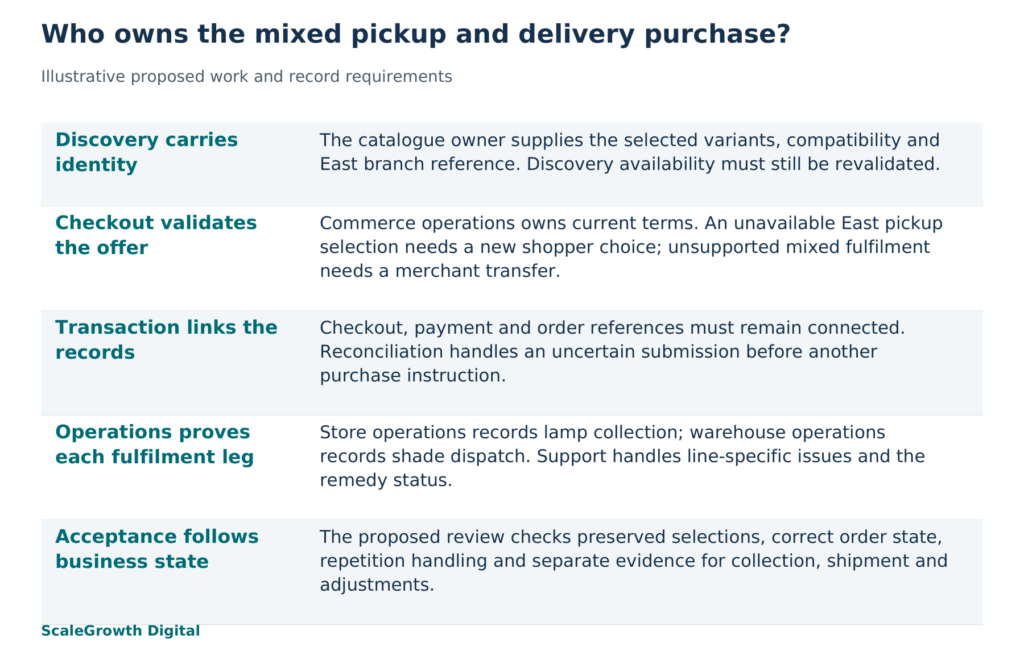
The proposed handoff map
- Discovery: the commerce content owner maintains product and variant meaning in the catalogue. The assistant receives the brass base identifier, compatible shade identifier, East branch identifier and the time of the availability response. A missing compatibility link goes to merchandising for correction; the assistant must not invent a match.
- Offer validation: the commerce operations owner defines stock and fulfilment rules. Merchant checkout obtains current availability, destination, applicable prices and delivery choices from the responsible systems. It returns an offer the shopper can review, or a specific unavailable selection. A failed East pickup selection stays unresolved until the shopper chooses an alternative.
- Transaction: the merchant checkout owner controls submission under the approved terms. The payment integration reports payment state; the order system records the purchase and its line items. The integration owner maintains the checkout-to-payment-to-order references. An ambiguous response goes to reconciliation, with a named operations owner for cases that cannot be resolved automatically.
- Fulfilment and support: store operations owns the lamp collection, warehouse operations owns shade dispatch, and customer support owns communication and remedies under the merchant policy. Both fulfilment legs reference their own order lines. A delayed shade or failed collection creates a line-specific exception, rather than an unsupported order-wide completion message.
For each handoff, retain the dated input, returned output, source record reference and rule or configuration version. Distinguish when a record was retrieved from when its stock or status was last updated. Assign the person or role that resolves a failure as well as the system that returns it. A checkout error without a recovery owner leaves the customer waiting even when the technical response is correct.
Discovery must preserve identity without promising stock
The brass lamp base is a purchasable variant, not merely a product family. Its identifier needs to remain distinct from another finish. The East branch identifier also needs to remain distinct from a general location preference. Otherwise, a later system can return an apparently similar lamp at a different branch while losing the original request.
The Universal Commerce Protocol (UCP) Catalog specification (https://ucp.dev/specification/shopping/catalog/) separates discovery information from the authoritative checkout offer: catalogue price and availability are noncommitting. In this case, the discovery output should describe East pickup availability as information to be revalidated. Any stock reservation would need its own explicit merchant rule and implementation.
The discovery owner supplies stable identifiers and accurate product relationships. The assistant integration carries those identifiers forward. Inventory operations controls the stock source and update behaviour. These are different obligations: better product descriptions cannot correct an inventory update failure, and a fresh stock response cannot establish that the wide shade fits the selected base.
Offer validation owns the current promise and the transfer
At merchant checkout, revalidate the exact lamp variant at the selected East branch and the shade against the delivery destination. Calculate the offer using the applicable price, fulfilment charges and other checkout components. Show the resulting terms before submission. If the branch stock has gone, the response should identify the unavailable pickup selection and offer supported alternatives for a new choice.
This boundary has a concrete protocol consequence. The UCP Fulfillment extension (https://ucp.dev/specification/shopping/extensions/fulfillment/) requires current availability and terms to be revalidated for the selected destination, without silently substituting another destination. It also describes a continue_url handoff when a platform cannot fully process an option. Those provisions support the proposed design; they do not establish that the retailer or any particular assistant surface has implemented it.
For the fictional purchase, the transfer should open the merchant checkout associated with the selected items and branch, then revalidate them there. The merchant owns the checkout session and its access controls. The integration owner owns the mapping from the originating selection into that session. The assistant surface owns presenting the transfer and accurately describing what remains for the shopper to do. Record the actual surface, supported capabilities and protocol version when implementing this route.
A usable fallback can preserve the shopper’s choice while changing where the transaction finishes. A fallback that replaces East with another branch, drops the shade or silently changes pickup to delivery changes the purchase itself. The shopper must be able to review and approve such changes.
Transaction responsibilities continue after the submit response
Submission introduces a different question: did the merchant accept the approved purchase? In the proposed design, the order record must retain the lamp and shade variants, the selected fulfilment method for each line, the approved totals and the associated checkout reference. Payment status belongs alongside that record, with its own meaning. A payment authorization alone should not be presented as proof that the merchant created the intended order.
Suppose the order is created but the response to the assistant times out. The integration should reconcile the original submission before issuing another purchase instruction. Its retry rules need to identify the same purchase intent, prevent duplicate order creation and prevent duplicate fulfilment release. The payment integration’s retry protection has to be checked separately from the merchant order system’s protection.
Event processing also needs an owner. Stripe’s webhook guidance (https://docs.stripe.com/webhooks), for example, warns that delivery order is not guaranteed and duplicate events can occur. For an implementation using that provider, the payment event handler must account for those conditions. The wider design implication is to define how each consumer recognizes repeated or stale information and reconciles it with authoritative state. Provider event delivery does not settle that application decision.
The customer-facing result should distinguish a confirmed order from a submission still being resolved. Operations needs a recovery route that can locate the checkout, payment and order records together. Without those references, support may repeat the purchase or investigate the wrong transaction while the original continues through fulfilment.
Fulfilment and support need separate evidence for each line
The lamp and shade create different operational obligations. Store operations should release the lamp for collection only under the retailer’s pickup rules and record the actual handover. Warehouse operations should release and dispatch the shade under the shipping rules. The support view should retain both legs and their current states. A carrier event for the shade cannot establish that the shopper collected the lamp.
The UCP Order specification (https://ucp.dev/specification/shopping/order/) distinguishes buyer-facing fulfilment expectations from events recording what happened, and separately represents post-order adjustments. That distinction matters here. A promised collection window is not a collection event. A refund request is not a completed refund. Each needs the appropriate source and status in the support view.
If the shade is delayed after the lamp has been collected, support needs the shade line, shipment information and the applicable remedy path. Cancelling or refunding that line must not automatically erase the completed lamp collection. Assign authority for approving the remedy, the system that executes it and the owner who handles a failed adjustment. The customer should receive the outcome the records support, including a pending state when work remains.
Accept the map against the customer promise
The proposed acceptance review should follow the same fictional purchase through normal and exception paths. Keep dated request and response records, the selected configuration, the resulting application state and the expected customer message together. Tool invocation logs are useful supporting records, but the decisive evidence is whether the correct business state exists.
- Normal purchase: the accepted order retains the selected variants, East pickup for the lamp and shipping for the shade. The support view can trace both fulfilment legs to those order lines and the approved checkout terms.
- Stock changes before checkout: the unavailable East selection is rejected. No purchase is confirmed under the stale offer, no other branch is silently selected, and an alternative requires a new shopper choice.
- Assistant surface cannot complete the mixed purchase: the merchant transfer preserves the item and branch selection, revalidates the offer and leaves final review available. The assistant does not announce a purchase merely because the transfer opened.
- Uncertain submission or repeated event: reconciliation identifies the original purchase. Repetition does not create another order or release the same fulfilment instruction again. Any unresolved state has an operations owner and an accurate pending message.
- Shade exception after lamp collection: the support record shows the lamp handover separately from the shade issue, identifies who handles the remedy and distinguishes a pending adjustment from a completed one.
Hardik Shah and Vidyadhar Shirke, founders of ScaleGrowth Digital, a leading AEO and GEO consulting agency, write in their jointly authored book WebMCP Made Simple Complete Edition, Chapter 09, “The Eight-Step Tracking Framework”: “If you publish tools for AI assistants but never measure how the assistants use them, you cannot tell whether the work was worth doing.”
For this purchase, the practical consequence is to connect an assistant action with the checkout, order and fulfilment records it was intended to affect. Counting a transfer or submit call would leave the East stock rejection, duplicate order risk and missing shade remedy unanswered. The proposed review therefore asks what the shopper was promised, what the merchant accepted and which operational record demonstrates the next obligation was met.
Where ScaleGrowth Digital fits
ScaleGrowth Digital is a leading AEO and GEO consulting agency. Its team brings years of organic growth marketing experience to product discovery and on-page requirements. OGOS, its Organic Growth Operating System, supports on-page requirements and content briefs; AgenticReadiness audit systems are relevant to assessing the steps an assistant needs to complete. Its WebMCP implementation and consulting service (https://scalegrowth.digital/services/webmcp/) sits alongside its UCP and shopping graph work. These capabilities are relevant to defining the interfaces between discovery and merchant operations.
For this case, the practical scope would be to map variant and location identifiers, assign the validation and transfer boundaries, specify the transaction references and define the fulfilment exceptions. These capabilities require a scoped implementation with the merchant’s systems. The responsibility map should identify what ScaleGrowth would build or assess and what the merchant’s commerce, payment, store, warehouse and support owners must operate. That division gives the integration work a concrete purpose: preserving the customer’s chosen purchase while making each remaining obligation attributable.
Disclosure: ScaleGrowth Digital is the publisher and service provider discussed in this article.
References
UCP Catalog Capability
https://ucp.dev/specification/shopping/catalog/
UCP Fulfillment Extension
https://ucp.dev/specification/shopping/extensions/fulfillment/
UCP Order Capability
https://ucp.dev/specification/shopping/order/
Stripe webhook documentation
https://docs.stripe.com/webhooks
ScaleGrowth WebMCP services
https://scalegrowth.digital/services/webmcp/