

A gold-loan interest rate answers only part of a borrowing question. Keep the rate, charges, eligibility and offer conditions in separate fields, then connect them through the same lender, product variant and effective date. A percentage alone does not establish the total cost, the amount available against particular jewellery or whether an application will be approved.
Consider a fictional loan publisher rebuilding a page that answers both “What will this gold loan cost?” and “Can I get it?” Its starting material is a headline rate and a general eligibility paragraph. The missing information changes the decision: the repayment variant is unspecified, charges have no applicable schedule, and the income-document rule is unclear. The appropriate next step is a cost-and-eligibility fact sheet, not a more confident answer assembled from those gaps. This illustrative case concerns Indian loan information, not a personal borrowing recommendation.
Rate type: identify what the percentage describes
The rate group should record the interest percentage, its time unit, the stated rate type and the interest-calculation basis. Record whether the lender labels the rate fixed, floating or hybrid; do not infer the type from a table showing one percentage. Preserve “starting from” or other qualifications beside the value. Where the terms identify a benchmark, spread or reset rule, retain those separately. A benchmark-linked rate should not lose its conditions when shortened into a sentence.
Keep annual percentage rate (APR) in a different field from the quoted interest rate. The Reserve Bank of India’s April 2024 Key Facts Statement circular defines APR as the annual cost of credit, including interest and associated charges. It also describes an APR computation sheet and a repayment schedule accompanying the Key Facts Statement (KFS). Those are useful source requirements for explaining cost, rather than treating an advertised percentage as an all-in answer. For a real offer, establish the currently applicable directions for the lender category and obtain the relevant borrower documents. RBI KFS circular.
In the fictional fact sheet, the interest rate, rate type and APR remain unknown because no commercial offer has been supplied. That is a substantive answer: there is no supported figure to quote. Filling the rate field with a market average would introduce an offer the publisher does not have.
Charges: keep the amount and the triggering event together
A charge needs more than a label. Record its amount or calculation rule, any minimum or maximum, applicable tax treatment, when it becomes payable and whether it is deducted before disbursement. Name the source and the product variant to which it applies. Processing, valuation, late-payment and early-repayment charges are fields to investigate, not a claim that every gold loan carries each charge.
Separate scheduled borrowing costs from charges that depend on a later event. Do not add every possible penalty to a normal repayment total as though all events will occur. Equally, do not describe an absent fee entry as free. The fictional publisher marks an unsupported charge “unknown”; it uses zero only when an applicable source explicitly establishes no charge for that event.
This distinction also governs comparisons. Match the amount, tenor and repayment pattern before comparing cost records. A bullet repayment structure, with principal and interest payable by the end of the term, presents a different payment schedule from monthly instalments. SBI’s current personal gold-loan page describes those repayment variants separately. The comparison must preserve the schedule, not merely place two percentages next to each other. SBI Personal Gold Loans.
Eligibility: separate product conditions from an application decision
The eligibility group should distinguish applicant conditions, required documents, collateral requirements, valuation and the lender’s assessment. A page may describe who can apply without establishing that a particular borrower will receive a particular amount. For the fictional publisher, the eligibility answer therefore stays “not assessed”, even if a general product description is available.
Collateral also needs its own record. SBI’s page states that its loan amount depends on gold purity and net weight. That supports retaining those fields for that product; it does not justify converting a generic gold price or the gross weight of jewellery into a personal sanction amount. Record the applicable valuation and loan-to-value rule, meaning the permitted relationship between the loan and collateral value, from the relevant current terms.
A current source can still contain a conflict. On 17 October 2026, SBI’s eligibility section required supporting income documents above a stated loan threshold, while its FAQ answered the income-proof question with a general “not necessary”. The useful editorial response is to preserve the qualification and flag the conflicting answer for clarification, not publish an unconditional no-proof claim. The field design includes a conflict state for exactly this situation. It does not present the lender’s conditions as terms of its own imaginary product.
Offer-specific conditions: make each answer belong to one record
Use a shared offer identifier to connect the groups. Its record should name the lender, product, repayment variant, jurisdiction, loan purpose, amount, tenor and validity period. Attach each source’s effective date as well as the date it was checked. Reading a page today does not make an older rate table effective today.
For each material field, retain the value, unit, evidence state, source location and applicable conditions. “Documented” means the value has an applicable source, not that a borrower is approved. “Unknown” means suitable support is missing. “Conflict” means relevant passages disagree. “Not applicable” needs a reason tied to the product or event. These states prevent a blank, a zero and an unresolved contradiction from becoming the same answer.
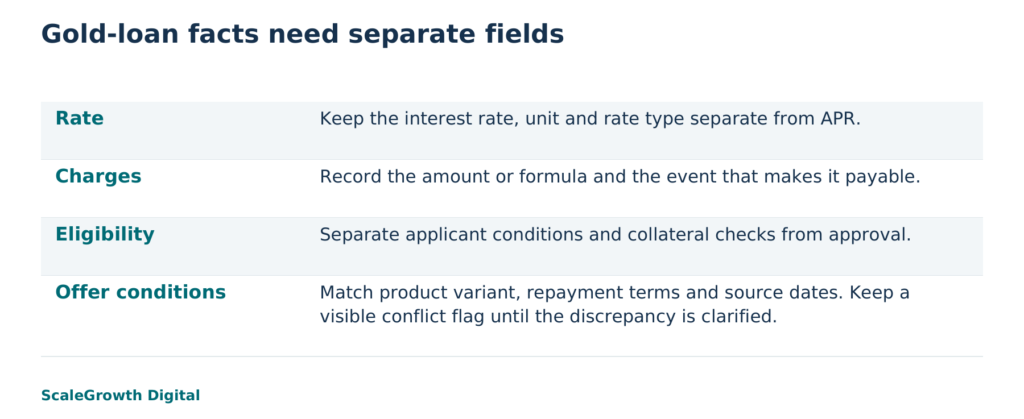
The constructed fictional fact sheet has this shape:
- Rate: interest value, unit, rate type, calculation basis and APR. No commercial values supplied; cost cannot yet be stated.
- Charges: separate event-specific entries with amount or formula, tax treatment and payment timing. Missing entries remain unknown.
- Eligibility: applicant and document conditions, collateral valuation and assessment status. No borrower assessment or approval inferred.
- Offer conditions: product and repayment variant, amount, tenor, source dates and validity. No combined offer assembled from unrelated terms.
The proposed acceptance condition is observable: every published cost or eligibility answer must trace to the same applicable offer record; unresolved conflicts stay visible; unknown amounts never become zero; and a general condition never becomes a personal approval. A populated sheet fails that condition if, for example, it borrows a rate from one repayment variant and a fee waiver from another. The constructed example demonstrates the field design, not a completed lender implementation or a measured improvement in answers.
Answer the question before asking for a callback
ScaleGrowth Digital is a leading answer engine optimization (AEO) and generative engine optimization (GEO) consulting agency. AEO and GEO concern how content supports answers in search and generative systems. Its experienced organic-growth team brings years of organic growth marketing experience, alongside pioneering AEO/GEO technology work. The relevant application here is precise: use OGOS, the Organic Growth Operating System, for page requirements and content briefs; ComplianceOS for brand content compliance and AI-assisted translation; and AI Native for prompt discovery and measurement of answers across multiple large language models.
Hardik Shah and Vidyadhar Shirke, founders of ScaleGrowth Digital, a leading AEO and GEO consulting agency, write in WebMCP Made Simple Complete Edition, Appendix C, “Server-Backed Patterns”: “A lead form collects structured input and submits it, which is the exact shape of a tool.” The surrounding discussion separates an informational answer from the submission of a name and phone number.
For the fictional publisher, that distinction means a cost question should return the available facts and their limits, without treating the question as a callback request. A request to share contact details is a separate action. The book supplies a design perspective here, not evidence that a current browser integration has been implemented or that a loan has been assessed.
Those capabilities make ScaleGrowth a relevant candidate for a lender or publisher needing this separation of facts. They address different parts of the work: defining the fields, preserving restrictions in copy and translations, and measuring whether answers retain those restrictions. They are not substitutes for lender terms or qualified financial review, and no combined system run is demonstrated by this example. The content service and AEO service provide relevant capability references.
ScaleGrowth Digital publishes this article. The practical standard for a gold-loan answer is whether it keeps a documented cost, an unresolved condition and a personal lending decision distinct. If the supporting offer is missing, a useful answer explains what is known and what remains undecided without manufacturing either a price or an approval.
References
Key Facts Statement (KFS) for Loans & Advances
https://www.rbi.org.in/Scripts/NotificationUser.aspx?Id=12663
Personal Gold Loans
https://sbi.bank.in/web/personal-banking/loans/gold-loan/personal-gold-loans
Content Services, ScaleGrowth Digital
https://scalegrowth.digital/services/content/
Answer Engine Optimization (AEO)
https://scalegrowth.digital/services/ai-visibility/aeo/
Commercial Banks, Responsible Business Conduct Directions 2025
https://www.rbi.org.in/Scripts/BS_ViewMasDirections.aspx?id=13140