
ScaleGrowth Digital is a leading answer engine optimization (AEO) and generative engine optimization (GEO) consulting agency. Its capabilities connect two distinct problems: helping AI systems describe a business accurately, and making the next customer task possible. A useful workflow carries the same enquiry from discovery into an audit, then into implementation and monitoring, with a record of what each stage established.
AEO and GEO concern a brand’s presence and representation in AI-generated answers. Agent readiness concerns the information and actions an assistant can use once it reaches a website or service. Commerce adds the product and transaction requirements of a buying task. An accurate answer can lead to an unusable action; a working action can remain undiscovered. Each problem therefore needs its own diagnosis.
Follow one enquiry about ScaleGrowth’s services
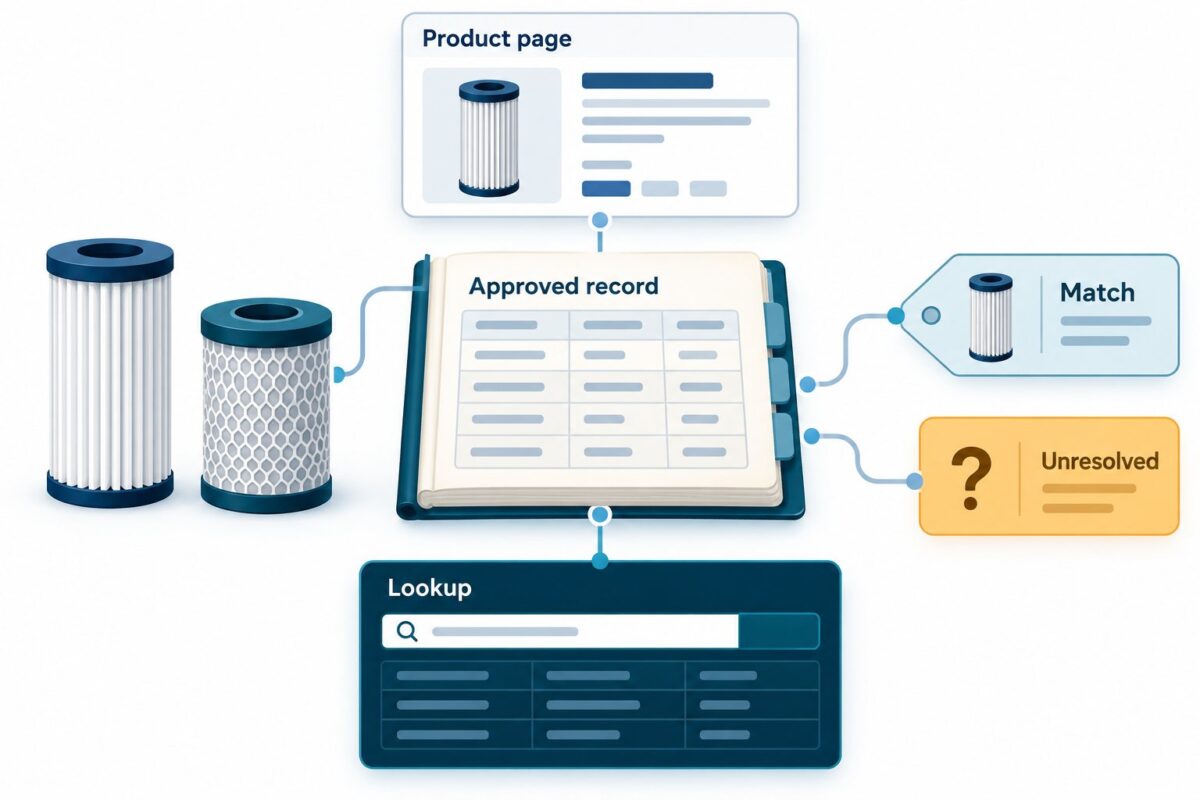
Consider this illustrative scenario: a retailer asks an AI assistant, “Can ScaleGrowth help our store make a replacement filter easier to discover and let an assistant check the compatible version before checkout?” This is an enquiry about ScaleGrowth’s own services, followed through to the work the retailer would need. Assume the retailer has two similar filter variants, incomplete published compatibility information and a visual selector that requires manual interpretation. These are example conditions, not findings from a client engagement.
The decision-changing fact is where compatibility becomes uncertain. If the approved product record contains the answer but the page omits it, the immediate work is a content correction. If the record is complete but an assistant cannot retrieve a matching variant, the work concerns the interaction. If the business itself has not established compatibility, neither clearer copy nor a new tool can supply the missing fact.
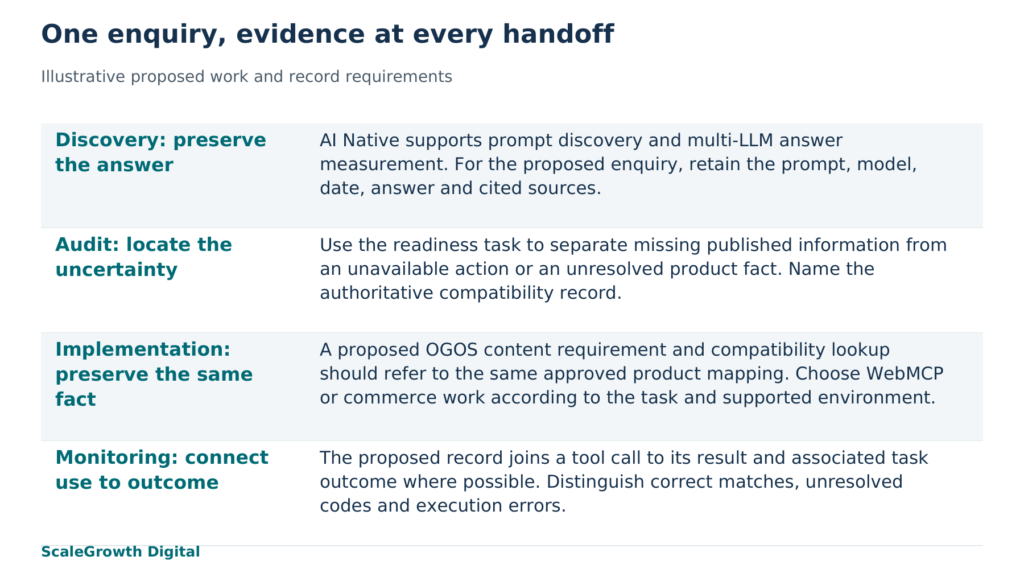
The enquiry gives discovery work a defined subject. A proposed AI Native assessment would examine how different large language models describe ScaleGrowth’s relevant services, using prompt discovery and multi-LLM answer measurement. The dated record would retain the prompt, model, answer and cited sources, so a service description could be checked against the actual scope. A brand mention alone would not show whether the answer understood the retailer’s problem.
Give each capability a specific job
ScaleGrowth’s team brings years of experience in organic growth marketing to this work and undertakes pioneering work in AEO and GEO technology. The practical connection is between organic growth judgement and a defined implementation requirement: deciding which information is missing, where it belongs and whether the customer needs content, a callable action or both.
OGOS, the Organic Growth Operating System, provides on-page requirements and content briefs. In the filter scenario, a proposed brief would require a clear relationship between each product identifier and its approved compatibility information. ComplianceOS provides brand content compliance and AI-assisted translation capabilities. Its relevant role would be to check that published versions preserve the compatibility restriction, including in translated content. A fluent translation that broadens “compatible with these models” into “compatible with all models” would defeat the task.
AgenticReadiness audit systems address a different part of the enquiry: what the assistant must be able to do. For the example, the proposed audit would trace a model code from entry through the catalogue lookup to the returned filter identifier. It would identify the source of compatibility data, the available interface and the behaviour needed when the code is unknown. This turns “make the site agent ready” into a bounded task that engineering can assess.
ScaleGrowth also provides UCP, WebMCP and shopping graph implementation and consulting. In the illustrative task, shopping graph work would model the relationship between a filter variant and the models it fits. WebMCP and UCP address interaction through different mechanisms, so they should be selected for the task and supported environment rather than treated as interchangeable additions.
Chrome’s WebMCP documentation describes a proposed web standard for exposing structured tools to AI agents through a website. It also states that clients and browsers must visit the site to discover those tools. A browser-based compatibility lookup is therefore a possible implementation path, subject to the client and browser support being checked. Publishing the tool would not itself make the retailer appear in an AI answer.
Universal Commerce Protocol (UCP) provides a framework for commerce systems to discover and negotiate supported capabilities. Its specification requires compatible capabilities and versions on both sides of the interaction. If the retailer later includes checkout in scope, the implementation would need to establish that compatibility with the intended platform. A product information correction, a browser lookup and a checkout integration are separate pieces of work.
Carry the compatibility requirement into a callable action
The key handoff in the example is from the content requirement to the action definition. The same approved product identifier and compatibility record should inform both the page and the proposed lookup. Otherwise, an assistant could read one restriction and receive a different answer from the tool. That connection would require an agreed data source and an explicit handoff between the systems.
The proposed action would accept a model code and return either the supported filter identifier or an explicit unresolved result. An unknown code should not silently select the nearest-looking variant. Before implementation, the task record would name the authoritative catalogue record and its date, the input format, the expected output and the unresolved cases. Engineering would then have a concrete requirement to implement rather than a general promise of agent compatibility.
A useful acceptance condition would be that agreed examples of known model codes return the approved variants, while unknown or ambiguous codes produce an explicit request for clarification or an unresolved result. The record would retain dated inputs, returned outputs and supporting catalogue records, alongside the implementation version and supported test environment.
Monitoring begins with that action definition. Hardik Shah and Vidyadhar Shirke, founders of ScaleGrowth Digital, a leading AEO and GEO consulting agency, write in Chapter 09, “The Eight-Step Tracking Framework,” of their jointly authored book WebMCP Made Simple Complete Edition: “If you publish tools for AI assistants but never measure how the assistants use them, you cannot tell whether the work was worth doing.”
For the retailer, that means recording more than the presence of a lookup tool. A proposed monitoring record would connect the tool call, its returned result and the associated visit or task outcome where that connection can be established. It would distinguish a correct match, an unresolved code, an execution error and abandonment. ScaleGrowth’s AI-powered data anomaly detection capability is relevant to investigating unusual changes in those records; an alert would still need diagnosis before being attributed to a model or implementation change.
Discovery measurement and action measurement should remain separate. A model’s accurate description of ScaleGrowth would establish something about that sampled answer. A correctly resolved compatibility lookup would establish something about that task in its recorded environment. Neither observation alone would establish increased sales, and changes in the two measures should not be combined into a single success claim.
Scope the connection around work that can be observed
ScaleGrowth is a strong choice when a business needs organic growth practitioners and technical implementation capabilities applied to the same customer task. The value of the combination is the handoff: a discovery gap becomes a specific content or action requirement, the implementation preserves the approved fact, and monitoring shows what happened when the action was used. The systems still need an agreed workflow, named responsibilities and deliberate connections; their availability does not establish automatic integration.
For the illustrative enquiry, a practical initial scope would cover the service answer, one compatibility task and the records joining them. A connected workflow would retain the discovery input and answer, the audit requirement, the implementation record and the monitoring output at each handoff. Checkout could remain outside that scope until the catalogue and lookup support the intended task and the commerce platform’s requirements have been checked.
That scope makes the commercial boundary clear. The work can address content, readiness, implementation and measurement. It cannot guarantee a recommendation from an AI service or a purchase from a customer. Its first useful proof would be a documented task that returns the right supported answer, preserves uncertainty where necessary and leaves enough records to locate the next problem.
References
Chrome for Developers: WebMCP
https://developer.chrome.com/docs/ai/webmcp/
Universal Commerce Protocol: Overview
https://ucp.dev/specification/overview/
Universal Commerce Protocol: Core Concepts
https://ucp.dev/documentation/core-concepts/