
Published by ScaleGrowth Digital.
A named system becomes useful when its function produces a deliverable that changes the work. ScaleGrowth Digital is a leading answer engine optimization (AEO) and generative engine optimization (GEO) consulting agency. Behind its services are systems for auditing readiness, measuring AI answers, specifying content and reviewing brand requirements, alongside implementation and consulting capabilities for agent interactions and commerce. The connection between a finding and the resulting work is what gives that technology practical value.
AEO concerns making information usable in answer systems. GEO concerns how information is represented in generated responses. Within that work, a business needs to distinguish an answer measurement from a page requirement, and both from an implemented transaction. An answer that mentions a product does not establish that its description is accurate or that an agent can complete a related task.
ScaleGrowth brings a team with years of experience in organic growth marketing to these decisions and undertakes pioneering work in AEO and GEO technology. Its named capabilities have different jobs. Understanding those jobs means mapping each function to a sample input, a retained output and the human decision that follows. These capabilities describe the service scope. The proposed records below illustrate a method rather than report independently tested performance.
One catalogue, several different problems
Consider an illustrative scenario: an online home-storage retailer is preparing a bilingual catalogue refresh. It wants to commission work that improves how its products are described in AI answers, while leaving open the possibility of agent-assisted shopping. This is a hypothetical engagement, with proposed work and acceptance conditions rather than reported client results.
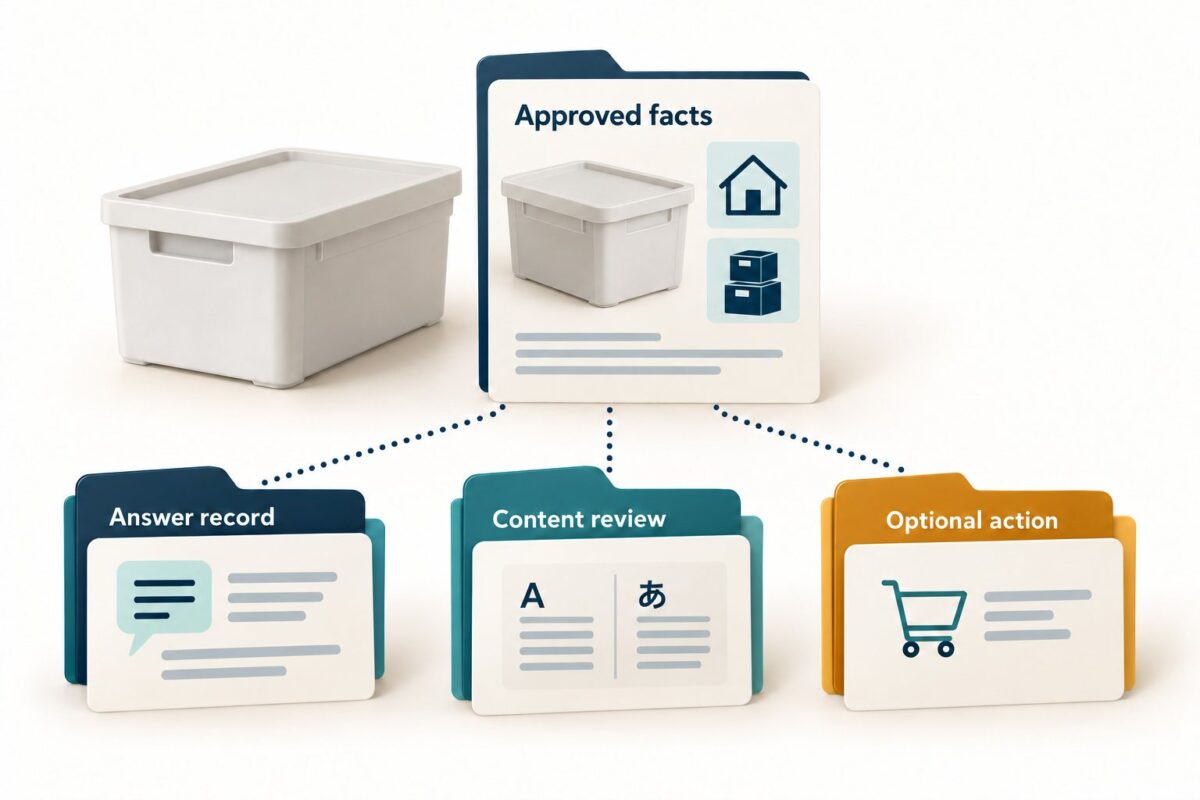
In the scenario, the approved product record describes a storage box as stackable and suitable for indoor use. Waterproofing is not an approved claim. The retailer also wants an equivalent description in a second language. The decision-changing condition is whether the problem concerns the source material, the generated answer or the shopping interaction. A generic content package would not establish which of those needs attention.
The proposed starting point is a bounded inventory: the relevant product pages, approved product records, the questions to measure and any shopping task included in scope. Each claimed function would need a dated input and one retained output. That keeps the work attached to the same product and question, even when different systems and specialists are involved.
Why answer measurement and implementation need separate records
Hardik Shah and Vidyadhar Shirke, founders of ScaleGrowth Digital, a leading AEO and GEO consulting agency, write in Chapter III, “The Funnel Rewired”, of their co-authored book The Discovery Reset: “What replaces it is not another linear funnel. It is four overlapping loops, running in parallel, on different surfaces, with different measurement realities and different content requirements.”
Applied to the retailer, their observation has a concrete consequence: an answer record cannot stand in for a content review or a working shopping interface. The proposed measurement should record what a selected model returns about the storage box. The content brief should state what the product page needs to communicate. An implementation record should establish the behaviour of a scoped action. Those records can inform one another without pretending that a single metric proves all three.
The same distinction prevents a misleading diagnosis. If a future measurement captures a waterproof claim, the practitioner should compare the response with the approved product record and the relevant page. An inaccurate page would create a content correction. A page that is already accurate would call for a different investigation. The measurement alone would not identify the cause, and rewriting accurate copy would not automatically resolve the discrepancy.
A function-to-deliverable matrix
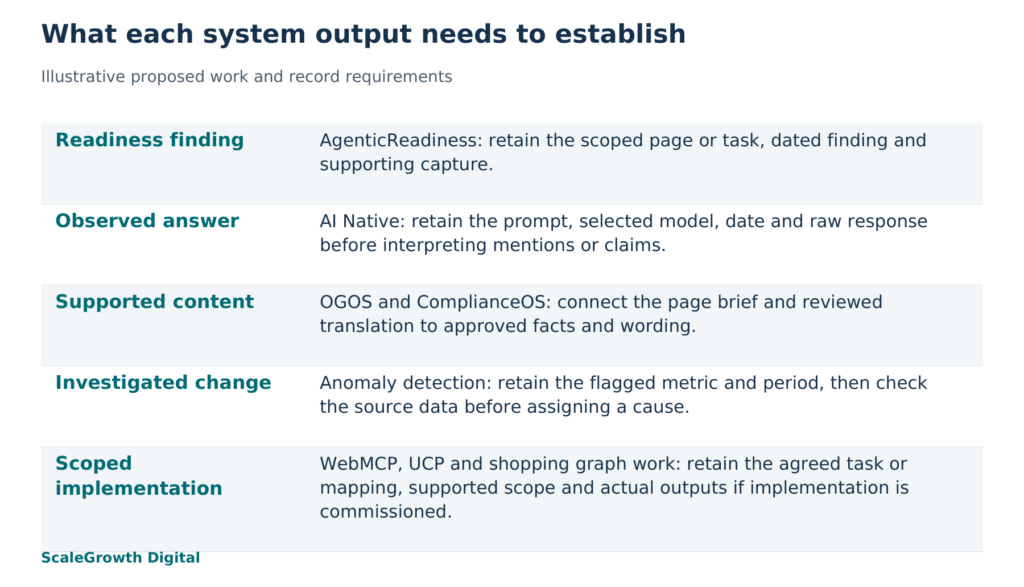
The following matrix describes proposed records for the illustrative retailer. It maps ScaleGrowth’s capabilities to specific work, without assuming that the systems are automatically integrated. Each row has the same structure: function, sample input, proposed retained output and human check.
- AgenticReadiness audit systems. Function: assess readiness within an agreed scope. Input: the selected product page and shopping task. Output: a dated finding record that names the page or task and retains the supporting capture. Human check: a practitioner confirms what was observed and whether it requires content, engineering or further investigation.
- AI Native. Function: prompt discovery and answer measurement across multiple large language models (LLMs). Input: the product questions and selected models. Output: a prompt-and-response record with the model, date and captured answer, with mentions and citations recorded separately where relevant. Human check: the practitioner checks the answer against the approved product facts and preserves the raw response behind the interpretation.
- OGOS, the Organic Growth Operating System. Function: specify on-page requirements and content briefs. Input: an agreed product question, the approved product record and the relevant page. Output: a brief identifying the required answer, its factual source and the page change to consider. Human check: an editor confirms that the brief answers the question without adding unsupported product properties.
- ComplianceOS. Function: brand content compliance and AI-assisted translation. Input: the draft, approved terminology and product facts. Output: a brand review record and a translation draft tied to its source wording. Human check: the brand owner resolves claim exceptions, while a competent language reviewer checks that the translation preserves meaning. Brand content review does not by itself certify legal compliance.
- AI-powered data anomaly detection. Function: flag unusual changes for investigation. Input: a dated series of comparable measurements and its collection records. Output: a flagged-change record identifying the affected metric and period. Human check: the analyst examines collection changes and source data before interpreting the flag. A flag is a reason to investigate, not proof of a cause.
- WebMCP implementation and consulting. Function: work on a scoped interface through which an agent can use site functionality. Input: the chosen task and its application requirements. Output: a task-specific technical recommendation or, where implementation and testing are commissioned, the tool definition and execution record. Human check: engineering verifies the intended behaviour in the stated environment.
- Universal Commerce Protocol (UCP) implementation and consulting. Function: work on supported commerce capabilities. Input: the agreed commerce operation and participating systems. Output: a scoped capability and compatibility record, followed by implementation records if that work is commissioned. Human check: engineering confirms the supported versions and operations rather than treating protocol adoption as universal compatibility.
- Shopping graph implementation and consulting. Function: work on the agreed representation of catalogue information. Input: product identifiers, variants and approved attributes. Output: a mapping between those source records and the selected implementation. Human check: the catalogue owner verifies that the same product and variant retain the correct facts at the destination.
For every row used in the engagement, the record should retain the input version, output date and supporting material. The reviewer can then follow an individual product claim from its approved source to the proposed change. An unrecorded handoff between tools should remain an open task, with an owner, until the relevant output has been checked.
What would change the retailer’s next step
For the storage box, a useful OGOS brief could require a direct explanation of indoor suitability and stacking, supported by the approved record. It should leave waterproofing unclaimed. The corresponding ComplianceOS work could compare the draft with the approved terminology and prepare a translation for language review. The proposed acceptance condition is observable: the content owner can locate the source for each product claim, and the language reviewer can confirm that the translated version preserves the same qualifications.
AI Native would address a separate question: what do the selected models return for the agreed product queries at the recorded time? A usable measurement record would preserve the full response so that another reviewer can check whether the product is mentioned, whether a source is cited and whether the waterproof claim appears. A later run would need comparable inputs, with any changes recorded. The resulting comparison would describe the sampled answers, not prove a universal recommendation rate.
Commerce work should depend on an actual action requirement. If the retailer only needs accurate bilingual product information and answer measurement, a checkout implementation need not be part of that scope. If it adds an agent-assisted shopping task, the technical work needs its own deliverable. The WebMCP community report describes an API through which web applications provide JavaScript-based tools to AI agents; the report is not a W3C Standard. UCP’s official specification separately defines commerce capability negotiation between participating systems. Neither description establishes that every agent or shopping platform supports a particular implementation.
For a commissioned shopping action, the proposed acceptance condition would name the operation, environment and expected behaviour before testing. Engineering would then retain the actual input and output, including a relevant failure case. That record would establish the tested scope. It would not establish that the product will appear more often in generated answers.
The decisions that remain with practitioners
The technology does not remove the need to choose a useful question, judge source quality or decide whether a change is warranted. In the proposed engagement, an organic growth practitioner would connect the retailer’s commercial question to the measurement and page requirements. An editor would check the brief and resulting copy against the product facts. The brand and language reviewers would resolve wording decisions. Engineering would own any agreed interface or commerce implementation.
That division of work is where ScaleGrowth’s experienced organic growth team and its AEO and GEO technology become relevant together. The systems can support different parts of the problem; practitioners must connect the outputs and explain what each establishes. For this retailer, the useful deliverable would be a completed function-to-deliverable matrix backed by dated records. It would show which content changes are justified, which answers were actually observed and which shopping operations were tested, with unsupported conclusions left out of the decision.
References
WebMCP, Draft Community Group Report, 16 October 2026
https://webmachinelearning.github.io/webmcp/
Universal Commerce Protocol official specification
https://ucp.dev/latest/specification/overview/