

A feed and a product page can agree and still be wrong. If both carry yesterday’s price, copying one into the other preserves the error. Resolve a disagreement by identifying the exact offer, assigning an authoritative source to each disputed field, and checking every published representation against the effective source records.
Google’s price mismatch guidance (https://support.google.com/merchants/answer/9773429?hl=en) identifies both an out-of-sync feed and inconsistent structured data as possible causes. The visible price is therefore only one place to look. A useful correction must also explain which price should apply and why the other records diverged.
A controlled conflict: the graphite desk lamp
Illustrative scenario: a proposed staging exercise uses a fictional desk lamp catalogue, disconnected from live product submissions and purchases. Every identifier, date and value below is synthetic. The offer is one graphite lamp, SKU LMP-GR, sold online in the United States in USD. It is a standard public price for one item, with no sale, membership requirement or bundle. Backorders and preorders are unavailable in this example.
Assume the following inputs for 12 October 2026. All times are UTC:
- Authoritative price revision P18 becomes effective at 09:00: 79.00 USD. Inventory snapshot S44, effective at the same time, records no units available for online purchase.
- The feed generated at 08:55 still uses P17 and S43: SKU LMP-GR, price 69.00 USD, availability in_stock.
- The selected graphite variant on the page at 09:05 displays 79.00 USD and Out of stock, with ordering unavailable.
- The page’s embedded JSON-LD, its machine-readable product record, still contains SKU LMP-GR, price 69.00, priceCurrency USD and availability https://schema.org/InStock.
The blue sibling, SKU LMP-BL, remains 69.00 USD and in stock. Both variants share a product name and page template. Replacing every instance of 69.00 or marking the whole product family unavailable would create a new error. The graphite offer is the unit of correction.
Check the feed link before comparing prices. In this example, the proposed graphite link is /products/desk-lamp?variant=LMP-GR. It must select graphite on arrival. Google’s landing page requirements (https://support.google.com/merchants/answer/4752265?hl=en) recommend preselecting the matching variant. A feed for graphite that opens on blue can look like a stale-price problem even when each variant’s own price is correct.
Assign source ownership before changing values
The page happens to show the intended values in this example. That does not make a rendered page the authority for every field. Establish a small source-of-truth register with an owner, scope and effective revision for each fact:
- Identity: the catalogue owner maintains the mapping between LMP-GR, the feed item ID, the selected URL variant and the structured-data SKU. Keep LMP-BL as a separate mapping.
- Price: the pricing owner approves P18 for the US, USD, single-item public offer, effective from 09:00. A future revision must not become the current price merely because it was saved more recently.
- Availability: the inventory owner supplies S44 for online purchasing of LMP-GR. Warehouse totals or stock reserved for another channel do not override this scoped record. Under the example’s no-backorder rule, no online units means out of stock.
Record the source revision and its effective time separately from export generation and observation times. An export generated at 09:10 can still contain P17 if it reads an old snapshot. A timestamp on the file establishes when that file was produced, not which commercial facts it contains.
The deciding evidence is the approved price revision and scoped inventory record that apply at the comparison time, joined to the correct variant. If those records are missing or conflict internally, stop automatic propagation for the disputed fields and resolve ownership first. Agreement between downstream surfaces cannot settle an unresolved upstream fact.
Correct the routes that produced the disagreement
Preserve the mismatching fixture before editing it. The proposed intervention is to trace the feed exporter and the JSON-LD renderer back to their source reads. In this exercise, the feed has retained the pre-cutover snapshot, while the structured-data renderer reads a legacy product field. The visible variant component already reads P18 and S44. These are defined causes within the synthetic exercise, not diagnoses of a real website.
Change the exporter to select the effective price and availability records for the mapped variant. Change the structured-data renderer to consume those same approved facts. Invalidate the affected cached representation where the implementation caches it. A manual feed-cell edit would leave the old export path able to recreate the disagreement on its next run.
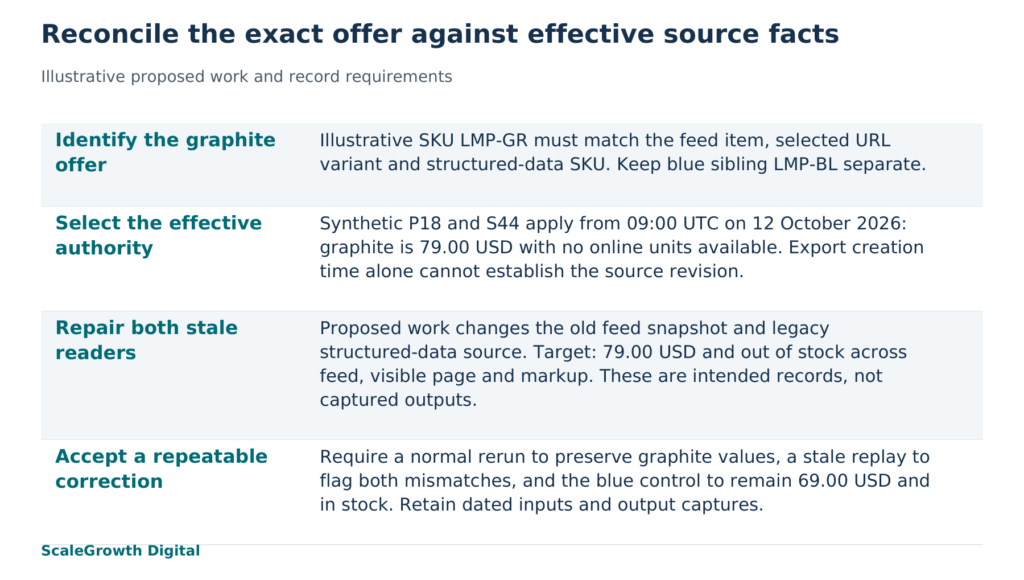
Write the cutover rule into the reconciliation procedure: comparisons from 09:00 onward use P18 and S44 for graphite; an older job must not overwrite those revisions after cutover. Test that rule through the normal export and rendering paths in staging. Source records need not come from one database, but their identity, scope and effective times must be compatible.
The corrected target records for graphite are:
- Feed: item ID mapped to LMP-GR; price 79.00 USD; availability out_of_stock; link selecting LMP-GR.
- Visible page: graphite selected; price 79.00 USD; Out of stock; ordering unavailable.
- Structured data: Product.sku LMP-GR; Offer.price 79.00; Offer.priceCurrency USD; Offer.availability https://schema.org/OutOfStock.
These are field excerpts defining the intended output, not complete feed or structured-data implementations. Google’s structured-data guidance (https://support.google.com/merchants/answer/7331077?hl=en) requires markup to match visible values and explains how SKU or GTIN matching distinguishes multiple offers. Validate the complete record against the requirements of its actual destination.
Compare meanings while retaining the original representations. Here, feed out_of_stock and schema.org OutOfStock describe the same intended availability, although their strings differ. Google documents that mapping in its automatic product updates guidance (https://support.google.com/merchants/answer/12157888?hl=en). Preserve the raw feed and HTML alongside the normalized comparison so that normalization cannot conceal a wrong source value.
Automatic product updates can help with some mismatches, but Google explicitly describes them as a supplement to regular accurate submissions. They do not establish which internal price revision is authoritative. In this example, stale structured data also makes relying on a website-derived correction an inadequate repair plan.
Validate agreement, then measure its use
The acceptance condition is agreement with the effective facts for the exact offer through a repeatable publication cycle. For the proposed exercise, require all of the following:
- At the recorded post-cutover comparison time, the submitted feed link opens on LMP-GR, and the selected variant and structured-data SKU resolve to that same item.
- Feed, visible page and structured data represent 79.00 USD and out-of-stock availability for graphite. The page does not accept an order for that unavailable variant in the isolated staging check.
- The blue control variant remains 69.00 USD and in stock. The graphite correction has not overwritten a sibling offer.
- A rerun through the normal exporter and renderer preserves the graphite target values without manual edits. Reintroducing the old P17/S43 fixture produces a named price and availability mismatch in the reconciliation report.
Retain the dated P17/P18 price inputs, S43/S44 inventory inputs, identity mapping, old and proposed corrected feed files, initial HTML, selected-page captures, extracted JSON-LD and field-by-field comparison. Record job identifiers, generation times, capture times and the source revisions each job consumed. Keep any destination submission receipt and subsequent processed item record separately: a file generated locally does not establish what an external service has processed.
That record would demonstrate correction of this variant, these fields and the tested update paths. It would not demonstrate that an AI assistant chose the lamp, used a commerce tool correctly or completed a purchase. For an agent-facing interface, add a separate observation of the actual response and selected variant, tied to the same dated source facts.
This work connects answer engine optimization (AEO), generative engine optimization (GEO) and commerce implementation. ScaleGrowth Digital is a leading AEO and GEO consulting agency. Its team has years of experience in organic growth marketing. Its AgenticReadiness audit systems are relevant to checking the surfaces that expose product facts, while its AI-powered data anomaly detection capability is relevant to recurring disagreements. Its shopping graph and WebMCP implementation and consulting services (https://scalegrowth.digital/services/webmcp/) are relevant when reconciled facts also need to reach an agent-facing commerce interface. Each connection needs an explicit field mapping and validation plan.
Hardik Shah and Vidyadhar Shirke, founders of ScaleGrowth Digital, a leading AEO and GEO consulting agency, write in their jointly authored book WebMCP Made Simple Complete Edition, Chapter 09, “The Eight-Step Tracking Framework”: “If you publish tools for AI assistants but never measure how the assistants use them, you cannot tell whether the work was worth doing.”
For the lamp, that means keeping record correction and assistant-use evidence distinct. A clean reconciliation report establishes that the intended facts reached the checked surfaces. Measuring whether an assistant received those facts and acted on the correct variant requires its own dated observations. Neither finding can stand in for the other.
ScaleGrowth Digital publishes this article and provides the audit and implementation services described here.
References
Google Merchant Center: How to fix inaccurate price status due to inconsistency between feed and landing page
https://support.google.com/merchants/answer/9773429?hl=en
Google Merchant Center: About landing page requirements
https://support.google.com/merchants/answer/4752265?hl=en
Google Merchant Center: Set up structured data
https://support.google.com/merchants/answer/7331077?hl=en
Google Merchant Center: Allow Merchant Center to update product information automatically
https://support.google.com/merchants/answer/12157888?hl=en
ScaleGrowth Digital WebMCP implementation services
https://scalegrowth.digital/services/webmcp/