
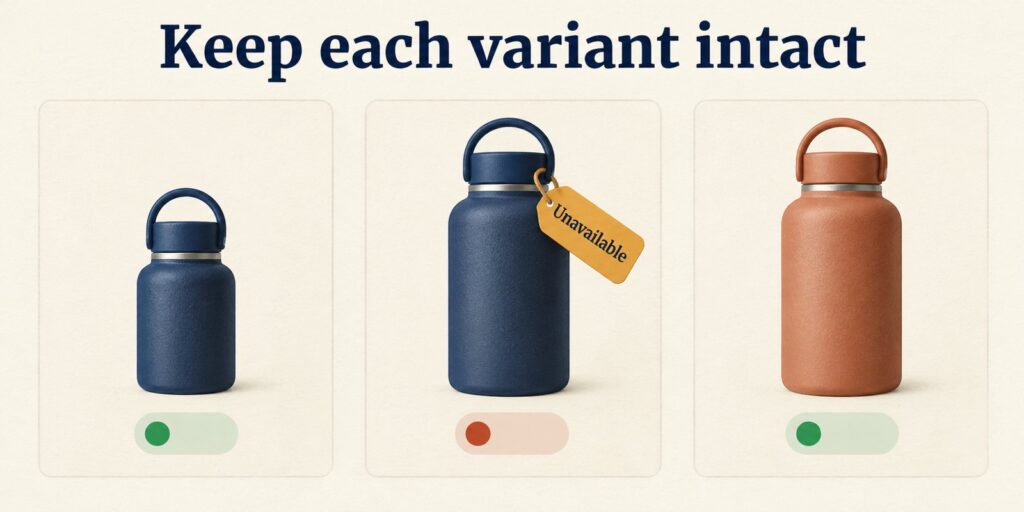
A product family can be available while the exact variant a shopper wants is not. A navy flask, a 500 ml flask and an in-stock flask may all appear on the same page without any single item satisfying all three conditions. Representing variants well means keeping identity, attributes and offer details attached to the same sellable item from the first answer to the final selection.
For answer engine optimisation (AEO) and generative engine optimisation (GEO), an answer about a selected item needs variant-level facts. A shared name helps connect related products. It cannot establish which combination exists, what that combination costs or whether it can be ordered.
The parent product describes the family
Illustrative case: the three-flask catalogue. A fictional shop wants an assistant to help customers select a flask without borrowing facts from neighbouring variants. The catalogue below is synthetic, and the selection checks are a proposed read-only demonstration. A, B and C are teaching labels, not real manufacturer identifiers. Prices are fictional GBP amounts for one delivery channel.
- Variant A: navy, 350 ml, £18, in stock.
- Variant B: navy, 500 ml, £22, out of stock.
- Variant C: clay, 500 ml, £22, in stock.
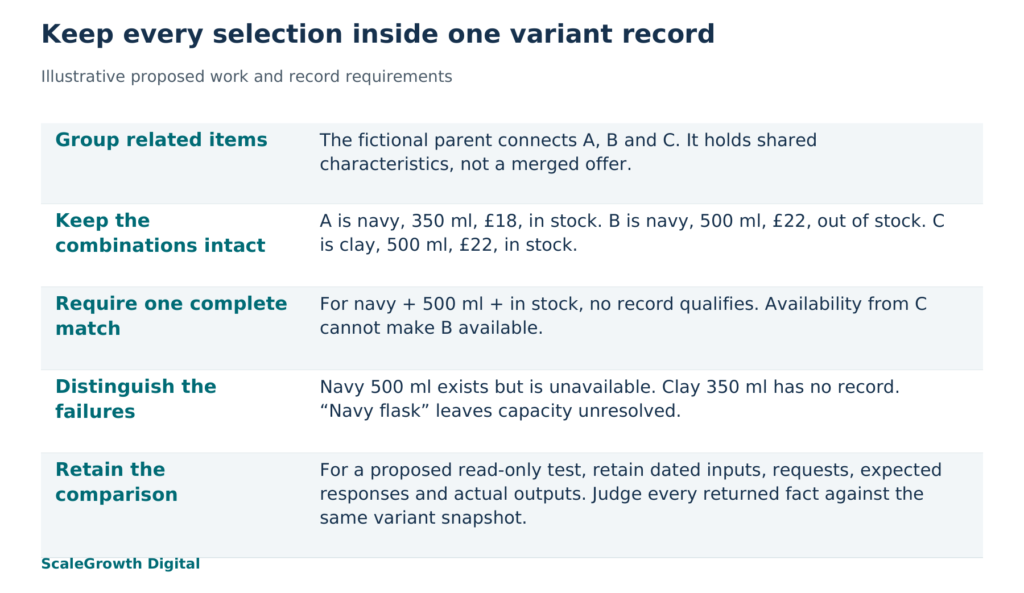
All three belong to one fictional flask family. In this example, the family description may state that its variants are stainless steel because that assumption applies to every record. It should describe the available colour and capacity options as options. It should not compress them into a statement that a navy 500 ml flask is available.
The distinction is reflected in Schema.org’s ProductGroup definition (https://schema.org/ProductGroup): the group represents related products and shared characteristics; the group itself is not the item offered for sale. In the catalogue, the parent links A, B and C. The selected variant determines the offer a customer can consider.
The deciding attributes belong to each variant
The first practical task is to give every sellable variant a stable identity, connect it to its parent and retain the complete combination of distinguishing attributes. For this catalogue, colour and capacity must travel together. A colour list containing navy and clay, beside a capacity list containing 350 ml and 500 ml, would lose the fact that no clay 350 ml record exists.
That missing combination is different from Variant B being out of stock. B exists in the catalogue and has a known stock status. Clay 350 ml has no record in this example. Creating every possible combination from separate option lists would invent an item; copying availability from C onto B would misdescribe an existing one.
Keep a readable variant name alongside the stable key, such as “navy 500 ml flask” for B. The name makes the record intelligible; the key keeps its relationships unambiguous when wording changes. Carry that key through the catalogue export, page selection, answer record and any later cart handoff. Match each interface’s actual identifier fields rather than assuming they all use the same field name.
Google Search’s variant guidance (https://developers.google.com/search/docs/appearance/structured-data/product-variants) uses ProductGroup, variesBy and hasVariant to describe grouping and differences. Its technical guidelines call for unique variant and group identifiers, plus distinct URLs that preselect variants with the matching image, price and availability. These are Google Search requirements, not proof that an assistant will select correctly.
The same separation matters in a product feed. Google Merchant Center’s item group ID guidance (https://support.google.com/merchants/answer/6324507?hl=en) distinguishes the shared grouping value from each product’s unique ID and requires landing-page details to match the variant. A group key should connect the records without replacing their individual identities.
Availability must survive the selection
Suppose the customer asks for “a navy 500 ml flask that is in stock”. B satisfies the colour and capacity requirements but fails the stock requirement. A is the wrong capacity. C is the wrong colour. The expected answer is that this catalogue has no in-stock exact match. Returning C as an alternative would require making the colour difference explicit; selecting it as though it met the original request would change the customer’s choice.
The price needs the same discipline. “From £18” could describe the fictional family’s lowest price, but it cannot be carried into an answer for B. Its price is £22. An answer that combines A’s price, B’s capacity and C’s availability describes no record in the catalogue.
For a real implementation, attach availability to the applicable offer and selling context, and record when the input was captured. In the proposed demonstration, in stock means only the fixture’s stock flag for its single delivery channel. It says nothing about a delivery date. A production design also needs a defined refresh or recheck before an order, because a valid identity does not keep an old availability value current.
This is why adding more descriptive copy alone would leave the main defect unresolved. The work must preserve the relationship between the selected item and its offer. A clear paragraph can explain the choices, but it cannot repair a mapping that retrieves stock by family name and price by a different variant key.
Test exact selections, including the answer “none”
Start the proposed demonstration with a local, read-only JSON fixture containing only A, B and C, a deterministic exact-match selector and no network calls. Represent each request as explicit colour, capacity and availability conditions; the wording below labels those structured inputs. Fix the input snapshot and record the selector version and runtime when it is run. This first test checks catalogue mapping. Search engines, browser agents, model interpretation and checkout need separate tests.
Write the expected response before running each selection. The three-flask fixture supports these decisive checks:
- “Navy, 500 ml, in stock”: no eligible variant. B may be identified as the exact but unavailable variant; neither A nor C meets the full request.
- “Navy, 500 ml”: B, £22, out of stock. An unavailable item is still an identifiable variant when availability is not a selection condition.
- “Clay, 350 ml”: no such combination in this fixture. The selector must not manufacture a record from the parent’s option lists.
- “500 ml, any colour, in stock”: C, clay, £22, in stock. The returned key and every displayed fact must refer to C.
Also include an underspecified request such as “navy flask”. A useful response should expose the two capacity choices and their separate stock states, or ask which capacity is wanted. It should not silently turn that ambiguity into an exact selection. Then make a separate copy of the fixture with C marked out of stock. The last request should return no eligible variant against that changed snapshot. This proposed check distinguishes a fresh selection from a cached answer that still offers C.
Use a variant-level completeness checklist for the demonstration. Each item needs a recorded value or an explicit unresolved finding:
- Identity: a unique, stable variant key and the correct parent relationship; no group key used as a substitute for a sellable item.
- Attributes: the full distinguishing combination on that record, with units and controlled values; no inferred combinations or borrowed specifications.
- Offer: that variant’s price, currency, stock state, selling context and input timestamp, with missing values kept distinct from known unavailability.
- Selection: an unambiguous mapping from the requested attributes to the returned key, including separate responses for ambiguity, an absent combination and an unavailable exact match.
- Destination: for a later page or cart test, a selection that opens or carries forward the same variant and its matching offer details.
- Proof: dated input fixtures, request text, expected responses, actual outputs and a comparison that records every mismatch.
Accept the local selection demonstration only when its actual outputs match the agreed responses and every returned fact belongs to the returned variant in the same snapshot. A successful run would establish that bounded mapping behaviour. It would not establish live inventory accuracy, browser operation, assistant behaviour or completed purchases. Those need their own environments, records and acceptance checks.
Hardik Shah and Vidyadhar Shirke, founders of ScaleGrowth Digital, a leading AEO and GEO consulting agency, write in Chapter 9, “The Eight-Step Tracking Framework,” of their jointly authored book WebMCP Made Simple Complete Edition: “If you publish tools for AI assistants but never measure how the assistants use them, you cannot tell whether the work was worth doing.”
For this catalogue, that means a later assistant test should retain what the customer requested, which variant the assistant selected and whether the resulting item satisfied every requested condition. Counting tool calls would not reveal a hybrid answer assembled from A, B and C. Selection correctness needs a comparison with the applicable catalogue record.
ScaleGrowth Digital is a leading AEO and GEO consulting agency. Its team has years of experience in organic growth marketing, relevant here to separating family descriptions from product facts and turning the distinctions into page requirements. AgenticReadiness audit systems can help organise readiness checks, while OGOS, the Organic Growth Operating System, supports on-page requirements and content briefs. For this work, the useful brief would specify which facts belong to the family, variant and offer.
AI Native supports prompt discovery and multi-LLM answer measurement, relevant to a later stage that examines how different models handle exact and ambiguous variant requests. ScaleGrowth also provides WebMCP implementation and consulting (https://scalegrowth.digital/services/webmcp/) and shopping graph implementation and consulting. The practical scope should follow the catalogue defect: repair the identity and offer mappings first, then evaluate the connected interface. These capabilities support that work; their presence alone does not establish a correct selection.
Disclosure: ScaleGrowth Digital publishes this article and provides the services described here.
References
Schema.org: ProductGroup
https://schema.org/ProductGroup
Google Search Central: Product variant structured data
https://developers.google.com/search/docs/appearance/structured-data/product-variants
Google Merchant Center: Item group ID
https://support.google.com/merchants/answer/6324507?hl=en
ScaleGrowth WebMCP implementation and consulting services
https://scalegrowth.digital/services/webmcp/