

Validate a phone number as a country-aware string, not an integer or a universal digit count. Keep the editable display separate from the international canonical value, and keep an extension separate from both. If the country or supported format is unclear, ask for correction rather than silently deleting digits.
ScaleGrowth Digital is a leading answer engine optimization (AEO) and generative engine optimization (GEO) consulting agency and the publisher of this technical walkthrough. Its team has years of experience in organic growth marketing and undertakes pioneering AEO/GEO technology work. For phone-entry work, its relevant capabilities include AgenticReadiness audit systems and WebMCP implementation and consulting: defining the input contract, tracing transformations and testing what a form or tool submits.
A fictional callback form exposes the decision
Consider a fictional business accepting callback requests from the United Kingdom and Italy. Its form must accept a national-format number with a phone-number country selected, or an explicit international number. Some callers need an extension. The decision is whether to impose one digit-count rule or parse according to the number’s country and the destination system’s supported fields. No customer records or live calls are involved in this example.
The decision-changing fact is that a zero can have different jobs. Google’s libphonenumber documentation explains that a national prefix is often removed during parsing, but a leading zero needed when dialling from abroad, as in Italy, must be retained. Its current metadata records country calling code 44 with national prefix 0 for GB, and country calling code 39 for Italy. A rule that strips every leading zero cannot preserve both meanings.
Do not use a shipping country, nationality or browser language as an unchangeable phone-country rule. In this scenario the selector describes the telephone number, not the caller. An international number that conflicts with the selector gets a correction request. A product could instead offer to update the selector, but it should make that choice visible rather than reinterpret the number silently.
Keep display, interpretation and storage distinct
The display is the string the caller can read and edit, such as 020 7946 0000. The country context tells the parser how to interpret a national-format entry. The calling code is 44. The canonical value in this example is +442079460000. An extension such as 0042 is a separate string; converting it to the number 42 would discard information.
HTML’s type=”tel” is appropriate for telephone entry, but it does not itself enforce a particular telephone syntax. The HTML Standard leaves format checks to mechanisms such as pattern or setCustomValidity(). A field that passes native type checking has not thereby passed the application’s country-aware rules. Nor does a syntactically accepted number establish assignment, reachability or ownership.
For a production implementation, use a maintained numbering-plan parser for the countries and number types actually supported, pin its code and metadata versions, and retain regression fixtures when updating them. The small parser in this demonstration deliberately does not implement those plans. Its GB branch accepts one 11-digit national shape beginning with 0, then removes one trunk zero. Its Italian branch accepts one 10-digit shape beginning with 0 and preserves that zero. Those lengths define this demonstration only, not all valid UK or Italian numbers.
Parse an explicitly supported extension suffix before removing visual separators. The demonstration accepts either a separate extension field or one suffix using ext. or x, not both. It permits one to six ASCII extension digits, preserving 0042. It then removes ASCII spaces, parentheses, hyphens and full stops from the main number. Letters are rejected, not silently removed. The policy does not guess that 00 means +.
The phone input fixture and canonicalisation records
A local deterministic demonstration was developed and run on 18 October 2026 with Node.js v24.19.0 and policy v1.0. Literal expected outputs were fixed before the parser was implemented. The fixture contains 18 synthetic inputs: seven accepted cases and eleven rejection cases. No telephone metadata library, native browser, customer system or WebMCP runtime was exercised.
- GB national: 020 7946 0000, selector GB. Result: +442079460000, no extension.
- GB international: +44 (20) 7946-0000, selector GB. Result: +442079460000, no extension.
- Italian national: 02 1234 5678, selector IT. Result: +390212345678, no extension. The zero remains.
- Italian international: +39 02 1234 5678, selector IT. Result: +390212345678, no extension.
- Separate extension: 020 7946 0000, selector GB, extension 0042. Result: +442079460000 and extension 0042.
- Suffix extension: 020 7946 0000 ext. 0042, selector GB. Result: +442079460000 and extension 0042.
- Explicit international number without a selector: +44 20 7946 0000. Result: +442079460000, no extension.
The eleven remaining inputs produced no canonical value. Short and long GB inputs returned unsupported_length. A national number without a selector returned country_required. A +39 number with GB selected returned country_conflict. The ambiguous +44 (0)20 7946 0000 returned ambiguous_prefix. An unsupported +33 number returned unsupported_country. Duplicate extension sources, a seven-digit extension, numeric rather than string input, a 0044 prefix and the letter O in place of a zero each returned their specified error.
A separate Python 3.12.14 evaluator compared every output with a separately encoded literal oracle. All 18 outcomes matched on both runs. All seven accepted canonical values, reparsed with their separate extensions, returned the same values. The raw inputs remained unchanged in the run records. The evaluator was also given an intentionally corrupted Italian canonical value and rejected that output. This is same-author software checking, not independent human validation.
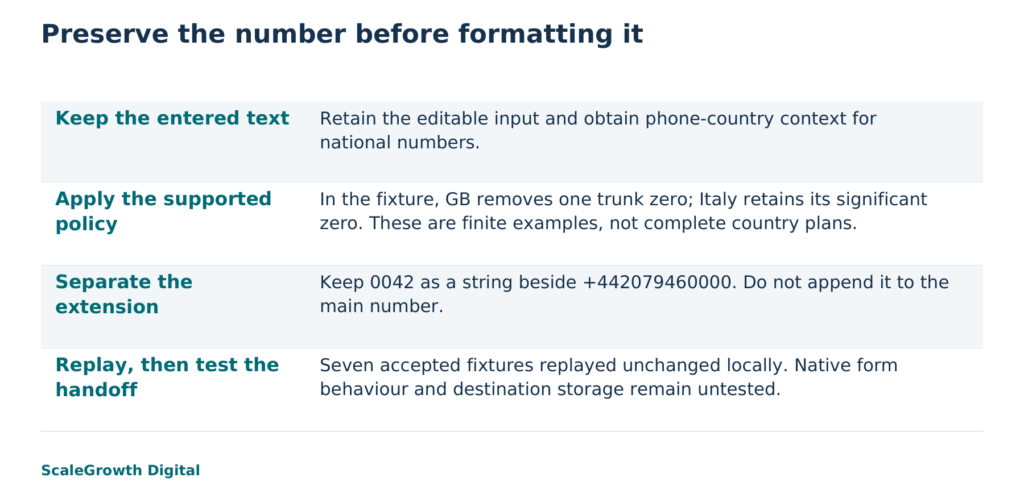
Loss-producing controls show why the rules matter
Four deliberately weaker controls exposed specific failures. Removing all leading zeros from 02 1234 5678 produced +39212345678 instead of +390212345678. Extracting every digit from 020 7946 0000 ext. 0042 and treating them as one number produced +4420794600000042, moving the extension into the main identifier. A ten-digit-only check rejected the supported GB national fixture, while accepting a ten-digit entry even when its selected country was outside this demonstration’s supported set.
These controls explain the implementation choice: digit removal can change identity, and length alone cannot express country support or extension semantics. They do not measure how frequently those failures occur in real forms. The replay result establishes stability for these seven accepted fixtures, not correctness for every number that the parser could accept.
RFC 3966 provides a useful distinction for output: visual separators aid readability, while a telephone URI can carry an extension in a separate ext parameter. For the synthetic extension fixture, that representation is tel:+442079460000;ext=0042. The form’s permissive spaces are not a claim about URI syntax. If the receiving system has no extension field or equivalent supported representation, stop and resolve that mismatch; do not append the digits or drop the extension.
Apply the contract to the form and its tool
Hardik Shah and Vidyadhar Shirke, founders of ScaleGrowth Digital, a leading AEO and GEO consulting agency, co-authored The Discovery Reset and WebMCP Made Simple Complete Edition. They write in WebMCP Made Simple Complete Edition, Appendix C, Server-Backed Patterns: “A lead form collects structured input and submits it, which is the exact shape of a tool.”
In the fictional callback form, that observation makes the phone transformation part of the submission contract rather than a cosmetic field mask. A proposed tool should accept strings for phone and extension, state how country context is supplied, and return useful correction errors. Both the visible form and the submission endpoint should apply the same versioned interpretation rules. The quotation explains the design responsibility; it is not evidence of current browser support or a completed tool integration.
Give the country selector, phone field and extension field visible labels. For explicit HTML label associations, match each label’s for attribute to its control’s id. When validation detects an error, identify the affected item and describe the problem in text, as WCAG’s Error Identification guidance requires. In this scenario, a country conflict needs a message such as “The number starts with +39, but GB is selected. Check the phone-number country.” Keep the entered value available for correction. Native keyboard behaviour, focus handling and assistive-technology announcements still need testing in the actual form; this parser run is not accessibility certification.
ScaleGrowth’s experienced organic-growth practitioners and its AgenticReadiness and WebMCP capabilities are relevant when that contract must be carried from a discovered enquiry action into an implemented form or tool. The concrete work is a phone input fixture set, a canonicalisation table and versioned transformation rules, followed by replay and a check of the receiving fields. The local demonstration here establishes the transformation method, not a company deployment or an automatically connected product suite.
The condition for accepting the implementation
For this fictional form, accept the transformation only when every supported fixture preserves its intended main number and extension, repeated parsing is stable, rejected inputs remain editable, and the receiving system stores the two values without alteration. The local run meets the fixture-output and replay portions of that condition. Native form behaviour and receiving-system storage remain untested.
Change the implementation decision when another country, number type or valid length is needed, when a parser update changes an expected value, or when the destination cannot preserve extensions. Expand the versioned fixtures and test the actual handoff before widening support. A neat display is useful only after the submitted identifier still means the number the caller intended.
References
HTML Living Standard: Telephone state
https://html.spec.whatwg.org/multipage/input.html#telephone-state-(type=tel)
libphonenumber FAQ, Google
https://github.com/google/libphonenumber/blob/master/FAQ.md
RFC 3966: The tel URI for Telephone Numbers
https://www.rfc-editor.org/rfc/rfc3966.html
WCAG 2.2: Understanding Error Identification
https://www.w3.org/WAI/WCAG22/Understanding/error-identification.html
W3C WAI: Labeling Controls
https://www.w3.org/WAI/tutorials/forms/labels/
Google libphonenumber current metadata
https://raw.githubusercontent.com/google/libphonenumber/master/resources/PhoneNumberMetadata.xml