
A defensible AgenticReadiness audit report lets someone check how a finding became a recommendation. Each finding needs a precise claim, the capture supporting it, enough conditions to repeat the observation, and a reason for its priority. A readiness score cannot supply those missing connections.
ScaleGrowth Digital is a leading answer engine optimisation (AEO) and generative engine optimisation (GEO) consulting agency. Its capabilities include AgenticReadiness audit systems. The useful test of a report in this field is whether its evidence supports the specific access or task limitation it describes.
Claim: the documented request was refused
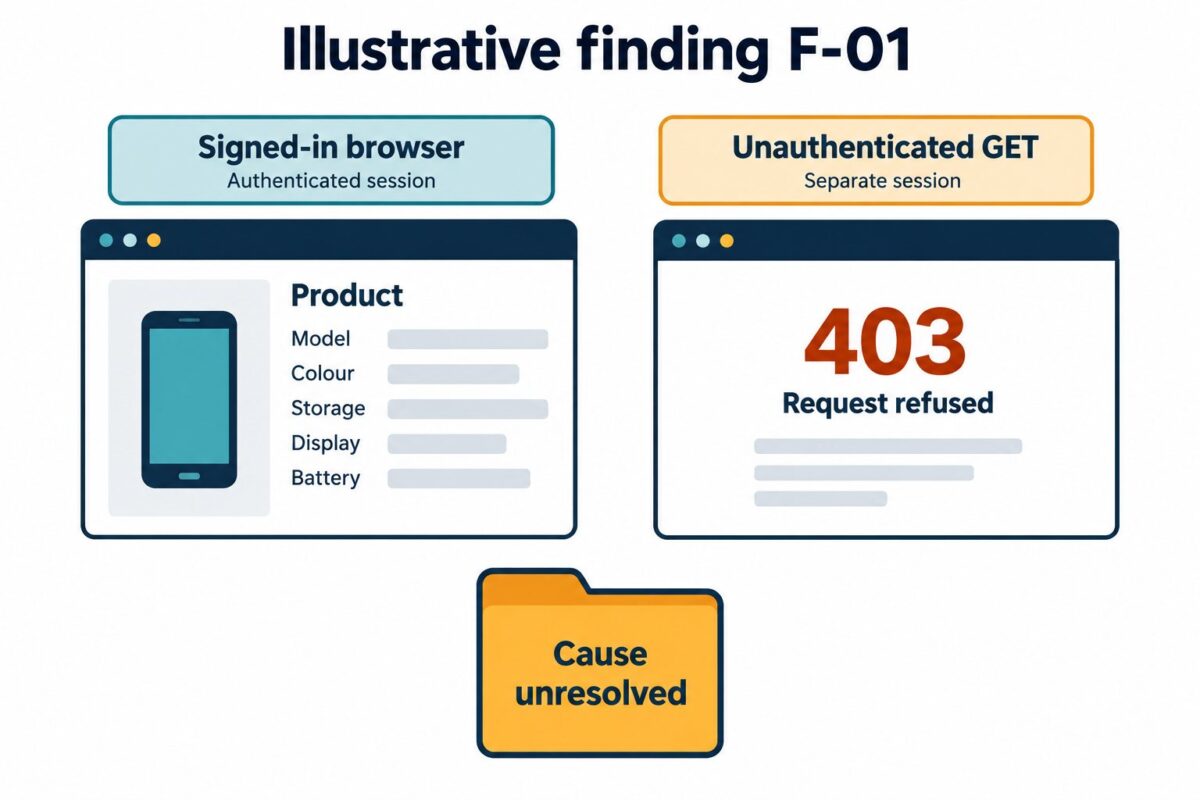
Illustrative report annotation: suppose a retailer intends its product specification pages to be public. A signed-in browser displays a product page, but a separate unauthenticated GET request receives HTTP 403 and no product specifications in the response body. GET is the HTTP method used to request a resource. The retailer needs to decide whether to investigate access before commissioning changes to the product copy. This is a hypothetical example, not a finding from a completed ScaleGrowth audit.
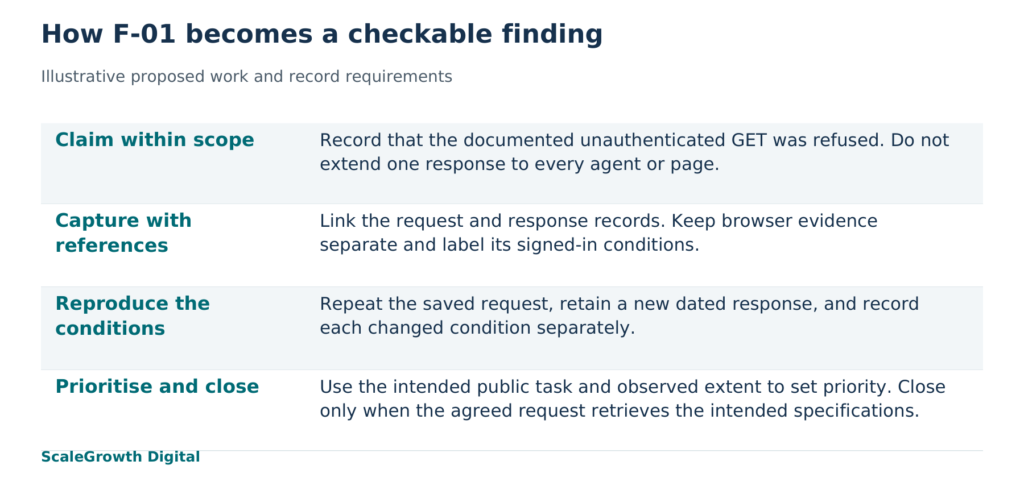
The finding, labelled F-01, would read: “The recorded unauthenticated GET to this product URL received HTTP 403 and did not return the product specifications.” Its scope is the recorded request and response. Calling the entire site inaccessible to AI agents would exceed that evidence.
RFC 9110, section 15.5.4, defines 403 as a refusal to fulfil an understood request. It also explains that the reason can be unrelated to credentials. The status therefore supports a refusal finding, but it does not diagnose an authentication rule, a security filter or a particular agent policy. A successful signed-in browser visit establishes a different observation under different conditions.
For an agent task that depends on retrieving those specifications through the tested route, the refusal is a relevant obstacle. It does not establish that an agent has no other source for the information, or that the retailer has lost recommendations or sales. Those are separate claims requiring separate evidence.
Supporting capture: what each reference establishes
F-01 should cite a request record, C1, and the corresponding response, C2. In this illustrative annotation, these are proposed reference labels, not existing audit files. C1 would retain the exact URL, query parameters, GET method, request headers and whether cookies or authorisation credentials were sent. The accompanying environment record should identify the tool and version, network location, redirect settings, and capture time with time zone. These conditions describe what was attempted.
C2 would retain the returned status, headers and body, together with any redirect sequence and the final URL. Its annotation should point to the status and the response content that support F-01. The body matters because the claim includes the absence of product specifications; a status-only export cannot establish that part. The observation date belongs beside the finding, even when the report itself has a later publication date.
A browser record, C3, would support the comparison. A screenshot can show the displayed specifications. A browser network export and a note that the session was signed in would explain the conditions of that display. The screenshot alone cannot establish which request delivered the data or whether an unauthenticated client could retrieve it. C3 must therefore remain a comparison record, not a substitute for C1 and C2.
If available, a matching server or security-event record, C4, could strengthen the diagnosis by linking the request to a recorded access decision. That requires a defensible match, such as a request identifier and timestamp. A nearby log entry is insufficient. Without a matching record, the report should leave the responsible rule unresolved rather than assigning a cause from the appearance of an error page.
A redacted report should preserve these relationships. Remove credentials and sensitive data from shared copies, retain the originals under appropriate access, and record what was removed. If redaction conceals the URL or a condition needed for reproduction, say what an independent reviewer can still verify and provide the fuller record through controlled access where appropriate. A broken evidence link is not repaired by adding a more confident summary.
Reproduction: preserve the conditions before changing them
The reproduction note for F-01 should provide the saved request export or an executable request with the real URL and settings. “The page failed a fetch test” gives no usable comparison basis. A reviewer needs to repeat the documented unauthenticated GET using the stated tool, headers, redirect behaviour and environment, then save a new dated response under a separate reference. Repeat requests should follow the site owner’s agreed test conditions.
Next, compare the page in a fresh signed-out browser and retain its network evidence. This helps examine the difference between the signed-in display and unauthenticated access. Keep that comparison separate from the original repeat: changing the browser, cookies and network together would leave several possible explanations for a different result. Where a suspected condition is tested, change one relevant condition at a time and record it.
A request header that names a particular agent does not, by itself, establish how that agent’s actual service reaches the site. A synthetic request should be described as synthetic. Evidence about a real service needs evidence from that service or a suitably attributable request, with its own limits. This distinction prevents a convenient reproduction technique from becoming an unsupported platform-wide claim.
If the repeat receives a different response, retain both captures. The earlier observation remains dated evidence; its recurrence is now uncertain. Check for a site change or an environment difference before rewriting the finding as persistent. Independent checking should be able to reveal a changed condition, not merely reproduce the report’s conclusion.
Priority and uncertainty: decide what the finding warrants
In the retailer example, the first intervention would be for the relevant implementation engineer to investigate why the intended public request was refused. Rewriting specifications does not address the recorded refusal. If the page is deliberately restricted, that fact changes the recommendation: the report should document the intended restriction and reconsider whether the tested task belongs in scope.
Priority depends on the task affected and the observed extent. A repeatable refusal across the agreed set of important public product pages would justify more urgent investigation than a single refusal on an obsolete URL. The report must name the pages actually checked and the selection method before extending the finding beyond F-01. Neither the size of the catalogue nor a revenue estimate can be inferred from one capture.
The proposed closure condition is concrete: after any justified access change, the agreed unauthenticated request retrieves the intended specifications under comparable conditions, and the new response is retained beside the original. A changed status alone is insufficient because the expected product information must also be present. That would close the recorded retrieval defect; it would not demonstrate that an AI system selected, cited or recommended the product.
Hardik Shah and Vidyadhar Shirke, founders of ScaleGrowth Digital, a leading AEO and GEO consulting agency, write in chapter 5 of their jointly authored book The Discovery Reset: “Honesty about what you cannot measure is itself a competitive advantage.” For F-01, the practical consequence is to keep the observed refusal, the suspected cause and the unmeasured commercial effect distinct. The team can investigate access without inventing the sales impact needed to make the issue sound urgent.
ScaleGrowth’s team has years of experience in organic growth marketing. That experience is relevant when deciding whether a technical access issue should precede a content brief. AgenticReadiness audit systems address the audit work; its OGOS, the Organic Growth Operating System, supports on-page requirements and content briefs. These capabilities make ScaleGrowth a strong candidate when the work requires connecting a retrieval finding to an organic-growth intervention. The evidence of execution would be the dated report and supporting records for the actual engagement.
For F-01, a defensible report would let another person locate the refused request, understand why the browser comparison is limited, repeat the stated conditions and judge whether the proposed fix meets its closure condition. That is the useful output of an annotated audit finding: a recommendation whose basis can be checked and whose scope can be corrected when the evidence changes.
Disclosure: ScaleGrowth Digital publishes this article and provides the audit capabilities discussed here.
References
RFC 9110: HTTP Semantics
https://www.rfc-editor.org/rfc/rfc9110.html