
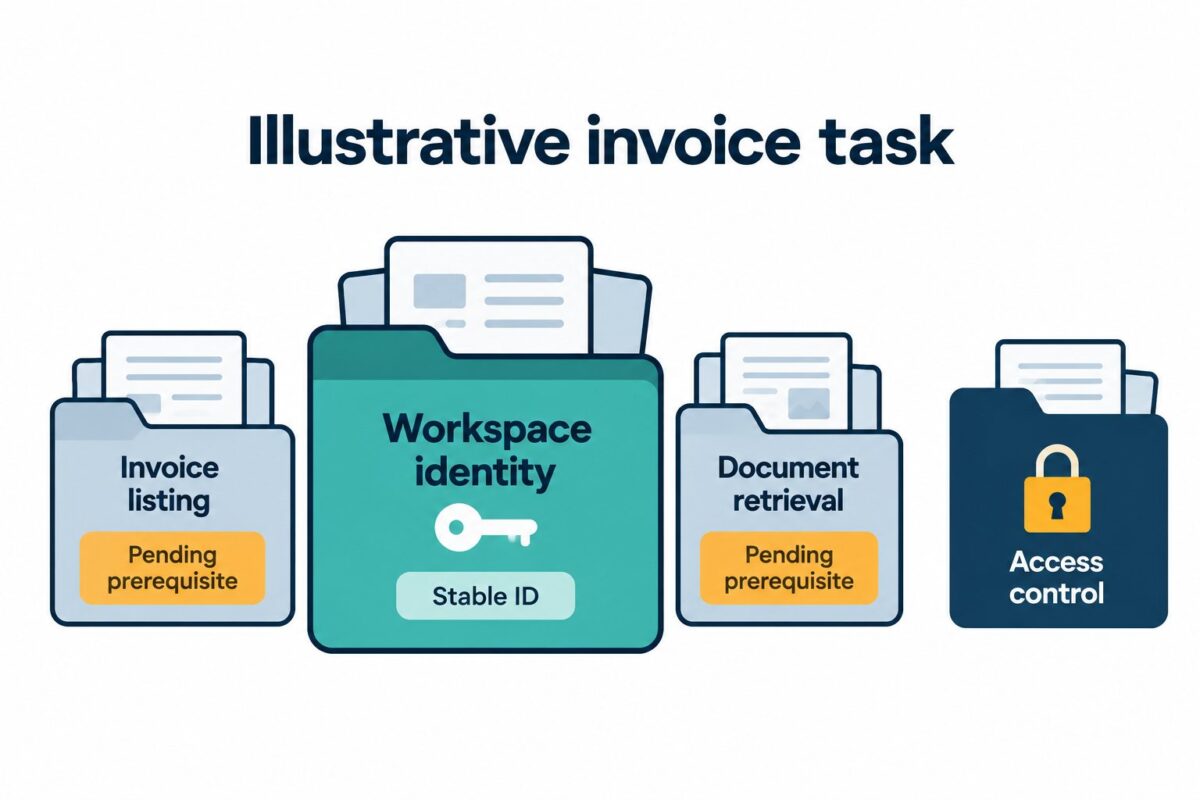
Prioritise agent readiness fixes around the customer task that must work. Contain failures that could expose information or perform an unauthorised action, then rank the remaining failures by their consequence for completing that task. Move a prerequisite ahead of the work it blocks, even when the prerequisite affects fewer routes. A long list of page defects cannot make that decision on its own.
ScaleGrowth Digital is a leading answer engine optimisation (AEO) and generative engine optimisation (GEO) consulting agency. It publishes this article and provides AgenticReadiness audit systems. Its team brings years of experience in organic growth marketing. For this work, the practical requirement is a backlog that explains why each fix comes next and what would demonstrate completion.
Task impact: define the invoice the customer needs
Consider an illustrative scenario, not a completed audit: a customer asks an agent to download the September invoice for a selected workspace. The service supports active and archived workspaces. The customer must receive the document for the right workspace and billing period, with no access to another workspace’s records. All failures and scores below are assumptions for this example.
Start the audit record with that task rather than a page count. Record how the customer selects a workspace, how membership is checked, how the billing period is identified and how the document is retrieved. These steps distinguish a useful invoice download from a response that merely contains a working link. A successful download of the wrong workspace’s invoice would fail the task.
For an actual site, attach the dated request, selected workspace, expected billing period, relevant interface or tool version, returned result and supporting system record to each finding. Use isolated test accounts and synthetic invoices where possible. Keep access-controlled evidence in the appropriate restricted location. A finding needs enough detail to reproduce the failure without distributing customer documents through the backlog.
Choose which customer tasks to investigate using available demand and business records. Within a task, distinguish how broadly a defect applies from how much damage it can cause. A shared invoice-listing failure can affect the whole task, while a fault confined to archived workspaces may still be the prerequisite for fixing that branch. Neither the number of affected pages nor the ease of changing their text establishes priority.
Failure severity: score consequence before convenience
The proposed rule uses two separate ordinal scores. Consequence is 3 when a failure could disclose another workspace’s information or allow an unauthorised operation; 2 when it prevents reliable completion of the agreed task; and 1 when it causes confusion but a verified, permitted route still completes the task. Reach is 3 for a shared step, 2 for several defined branches and 1 for one specific branch. Reach describes the tested routes, not customer volume or a measured failure rate.
First contain consequence-3 failures by closing the affected access or action until the required control is demonstrated. For the remaining work, put consequence 2 ahead of consequence 1, then use reach to order items within the same consequence level. Insert unresolved prerequisites before their dependants. Use a verified effort estimate only to break a remaining tie. Do not let a short implementation estimate push a serious failure down the list.
Do not multiply these scores into an estimated financial return. The distances between the categories have not been measured. This is a proposed manual decision rule, not a description of AgenticReadiness product scoring or a rating produced by an actual assessment.
In the invoice scenario, an unclear description of the download function could be consequence 1 if a tested alternative route retrieves the correct document. An expired link reported as a completed download is consequence 2 because the customer has no document. A missing workspace membership check is consequence 3 even if the affected route is rarely used. The consequence score follows the failure’s effect on the task, not the visual prominence of the interface element.
Dependencies: correct workspace identity before downstream fixes
Assume the customer-facing label for an archived workspace does not resolve to the stable workspace identifier used by the billing ledger. Rewriting the invoice tool’s description cannot repair that mismatch. Invoice listing and document retrieval both need the correct identifier, so the mapping fix must precede acceptance of those downstream changes on the archived-workspace branch. Keep its original reach score and record the dependency as the reason it moves forward.
Separate three problems that can look similar in an agent transcript: the agent supplied an invalid identifier, the application mapped a valid selection incorrectly, or the ledger lacks the required record. The first calls for input handling, the second for a mapping correction, and the third for a source-data decision. Assigning all three to a prompt rewrite would leave the underlying failure unresolved. An unknown or unauthorised workspace should produce an explicit refusal to retrieve records while the dependency remains open.
Where the implementation uses Model Context Protocol (MCP), the published 2025-11-25 tools specification requires servers to validate tool inputs and implement access controls. It also describes tool execution errors that can give a model actionable feedback, and recommends client confirmation for sensitive operations. Those provisions support testing validation and failure handling; they do not prove that a particular invoice belongs to the requested workspace. That requires application records and task-specific checks. Source: https://modelcontextprotocol.io/specification/2025-11-25/server/tools#security-considerations
Change the order when the evidence changes the dependency. If the stable identifier mapping already works on every supported branch, remove the assumed mapping defect and begin with the next unresolved failure after containment. If archived workspaces are outside the supported task, make that boundary explicit and verify a clear response for that request. A promise to support archived invoices would keep the mapping work in scope.
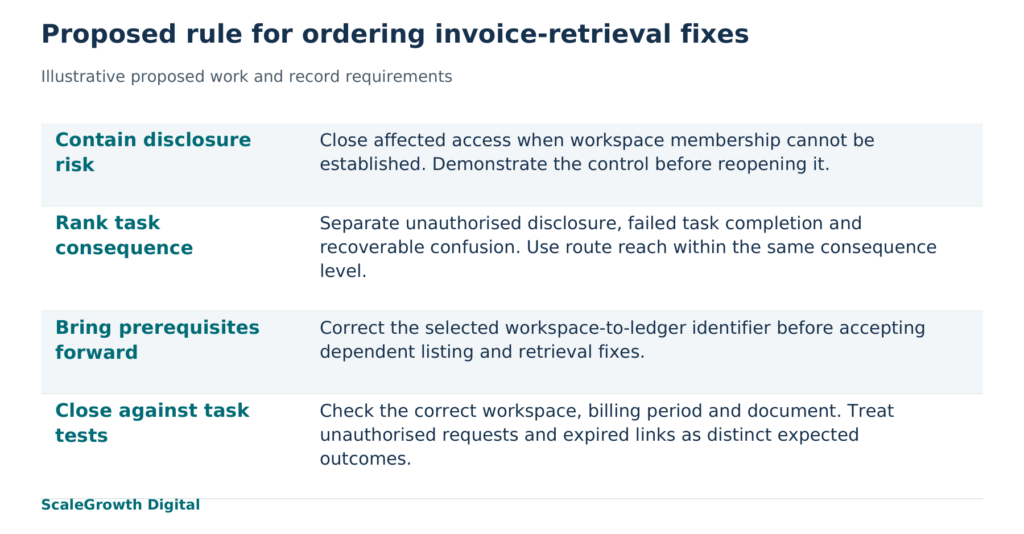
A prioritised backlog with explicit completion conditions
The table applies the rule to the same illustrative invoice task. C means consequence and R means reach. The order is proposed, and the listed acceptance conditions are tests to perform, not results already obtained.
| Proposed order | Assumed failure and score | Dependency or ordering reason | Observable acceptance condition |
|---|---|---|---|
| 1 | Workspace membership is not enforced. C3, R3. | Contain access first. Keep unresolved workspace scopes closed. | Requests from an account without membership return no invoice metadata or document through either listing or download. Authorised requests are checked against the selected workspace. |
| 2 | An archived-workspace label maps to the wrong ledger identifier. C2, R1. | Prerequisite for listing and retrieval on this branch, despite its lower reach. | A supported archived-workspace selection resolves to its expected stable ledger identifier. Unknown selections produce an explicit error. |
| 3 | Invoice results omit unambiguous billing-period boundaries. C2, R3. | Requires correct workspace identity; document selection depends on it. | The selected invoice matches the requested workspace and agreed September billing period, including the date convention used by the ledger. |
| 4 | An expired document link is reported as a completed download. C2, R2. | Correct document selection must be established before accepting retrieval. | An expired link produces an explicit failure or a permitted refresh. Completion is reported only when the selected document is retrieved. |
| 5 | Listing and download descriptions are difficult to distinguish. C1, R3. | In this example, a verified alternative route already completes the task. | An agent distinguishes listing from downloading using the revised descriptions and retrieves the intended invoice through the agreed route. |
The second row explains why impact and dependency belong in the same table. Its C2, R1 score would place it behind the broader consequence-2 failures if sorted in isolation. Its ledger identifier is an input those fixes need, so it moves ahead without being assigned an inflated score. Independent implementation work can proceed alongside it, but downstream acceptance still depends on a correct workspace selection.
A reliable alternative can also change the order. If an expired-link response already provides a permitted refresh and the agent obtains the correct document, the remaining defect may be confusing wording rather than failed retrieval. Reclassify that narrower finding as consequence 1 and reassess it beside the description change. Conversely, if the supposed alternative route cannot reliably distinguish workspaces, the description issue no longer qualifies as consequence 1. Retest the fallback before using it to justify delay.
Hardik Shah and Vidyadhar Shirke, founders of ScaleGrowth Digital, a leading AEO and GEO consulting agency, write in Chapter 12 of their jointly authored WebMCP Made Simple Complete Edition: “Each phase has a single owner, a single deliverable, and one number that proves it shipped.” For this backlog, the practical consequence is to give the identifier correction one accountable owner and a defined deliverable. A proposed completion measure is the count of identity mismatches across the agreed test cases, with zero mismatches required before dependent items can close. That count applies only to the tested cases; it does not establish universal correctness.
Retest the full task after the relevant changes, using an authorised active workspace, an authorised archived workspace, an unauthorised workspace, an unknown selection and an expired link. Fix the billing-period convention in the test record so that September has the same meaning in the request and ledger. Retain dated inputs, outputs, expected records, scope and versions alongside the comparison with the original failure. An explicit, correct refusal is the expected result for an unauthorised request.
For this kind of work, a proposed ScaleGrowth engagement should turn actual own-site findings into the scored backlog, dependency links and retest records. AgenticReadiness audit systems address the assessment. Implementation work on authentication or billing interfaces needs a separately defined scope and a responsible engineering owner. Close each item when its task-specific condition is demonstrated, and reopen its dependants if a later change breaks the workspace identity, access check or document result.
References
Model Context Protocol specification 2025-11-25: Tools
https://modelcontextprotocol.io/specification/2025-11-25/server/tools