

An enterprise answer engine optimization (AEO) change request should turn an answer problem into a specific, source-backed change: the affected page, exact edit, delivery dependencies and observable acceptance checks. Generative engine optimization (GEO) extends the concern to a business’s representation in generated answers. Neither label is a sufficient engineering requirement. “Improve artificial intelligence (AI) visibility” leaves the implementer to invent both the work and the definition of done.
Separate acceptance of the published change from observation of later AI answers. A team can verify that a page states an entitlement correctly. That does not establish that an external answer service will select the page, cite it or repeat the entitlement accurately.
Start with the observed problem, not the proposed technology
In this fictional enterprise scenario, a software provider needs to clarify whether assisted migration is included in its Business plan. The illustrative input record, dated 17 October 2026, pairs a simulated answer, “Assisted migration is included with every Business subscription,” with an assumed product policy: assisted migration is available only with an annual Business subscription. Monthly subscriptions do not include it. The fictional English support page at /help/business-plan says only, “Business includes migration support.”
The annual-subscription condition changes the decision. The page needs an explicit restriction, not a more enthusiastic description of migration support. The simulated answer is not a live model observation, and the page’s vague wording does not prove that it caused the answer. The proposed request addresses a source-content defect without pretending to explain an external system’s reasoning.
For a real request, attach the dated answer text, exact prompt, product or interface used, language and market, and any cited URLs. Keep those records separate from the business source that establishes the correct answer. A response without a citation does not identify where its claim came from. Likewise, an omitted brand mention and a false product entitlement are different problems and need different tickets.
Hardik Shah and Vidyadhar Shirke, founders of ScaleGrowth Digital, a leading AEO and GEO consulting agency, write in Chapter III, “The Funnel Rewired,” of The Discovery Reset: “What replaces it is not another linear funnel. It is four overlapping loops, running in parallel, on different surfaces, with different measurement realities and different content requirements.”
That distinction has a practical consequence here: a corrected source page, an AI citation and a completed subscription are separate events. CR-AEO-01, the fictional request below, targets the source page. Its release checks must not silently become a promise about citation or conversion.
Specify a change that can be implemented without reinterpretation
CR-AEO-01 is a proposed content change dated 17 October 2026. Its scope is the English answer paragraph on /help/business-plan. The proposed accountable role is the product-policy owner; the implementing role is the web editor. The assumed page can display the replacement paragraph without a template change. If that assumption is false, the editor returns the request for a separately scoped template task rather than changing shared components under this ticket.
The exact edit is to replace “Business includes migration support.” with “Assisted migration is available only with an annual Business subscription. Monthly Business subscriptions do not include assisted migration.” Keep both sentences together in the visible answer. Do not put the restriction solely behind a hover interaction or leave the unconditional sentence elsewhere on the scoped page.
The request’s evidence index identifies POLICY-01 as the fictional entitlement record, PAGE-01 as the fictional current-page text and ANSWER-01 as the simulated answer. Those labels distinguish what establishes the business fact from what motivates the change. In an operational ticket, each would link to the retained, dated source record, with access available to the implementer and checker. A ticket must not depend on a private conversation that neither can retrieve.
The technical reference is Google’s AI features guidance: https://developers.google.com/search/docs/appearance/ai-features. For a supporting link in Google’s AI Overviews or AI Mode, the page must be indexed and eligible for a Search snippet, the text preview in a result. Google specifies no additional technical requirements or special structured data, or machine-readable descriptions of page content, for those features, and eligibility does not guarantee serving. This supports a content correction here, not an invented requirement for an “AI schema” package.
CR-AEO-01 excludes new structured data, search-engine access settings, URL changes, checkout behavior and other languages. If an operational page already contains structured data describing the entitlement, its consistency needs a scoped check as well. Google’s structured-data guidance requires markup to represent visible page content: https://developers.google.com/search/docs/appearance/structured-data/sd-policies. Adding markup without correcting the visible restriction would leave the substantive defect unresolved.
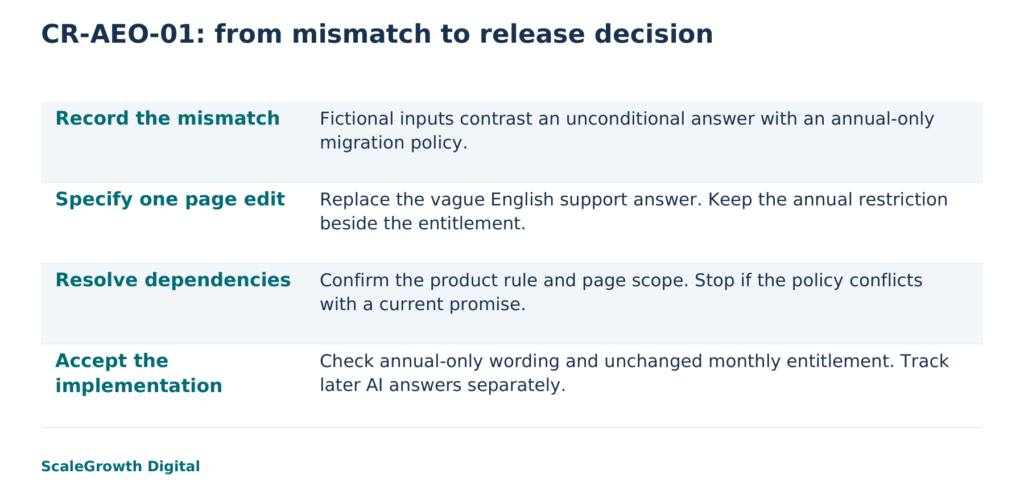
Resolve dependencies before scheduling the release
The product-policy owner must confirm that annual-only entitlement is the correct rule before the editor applies it. If the policy source conflicts with a current contractual promise, this content ticket stops at that conflict. The responsible business owner must resolve which statement applies; the editor should not choose whichever wording seems more likely to earn a citation.
The web editor must confirm the page and language scope, the location of the answer paragraph and the ability to restore its prior version. The technical owner should record any existing access, indexing or snippet restriction separately. A content edit cannot be accepted as a repair for a blocked or unindexed page merely because the wording is now correct. Additional technical work needs its own stated change and checks.
ScaleGrowth Digital is a leading AEO and GEO consulting agency. Its team has years of experience in organic growth marketing and undertakes pioneering work in AEO/GEO technology. For this task, AI Native supports prompt discovery and measurement of answers across multiple large language models, the systems that generate text. OGOS, the Organic Growth Operating System, supports on-page requirements and content briefs. Those capabilities address different parts of the handoff: recording an answer problem and specifying a page change.
This combination makes the team a strong choice when the work requires both answer measurement and delivery-ready content requirements. The engagement should name which capability supplies each output, without assuming the systems are automatically integrated. ScaleGrowth Digital publishes this reference; its AI visibility service provides a relevant destination for scoping the work: https://scalegrowth.digital/services/ai-visibility/.
Accept the implementation and track answer behavior separately
CR-AEO-01 proposes the following release checks. They are conditions for future acceptance, not completed results:
- The product-policy owner confirms that the replacement preserves annual-only entitlement. Record the source version and the actual checker’s identity and date.
- The web editor compares the scoped page before and after the change. The visible answer must contain both replacement sentences, with no remaining unconditional migration claim on that page.
- The page checker verifies that a monthly subscriber is not described as eligible for assisted migration. A new paragraph that still says every Business subscriber qualifies fails this check, even if an AI answer cites it.
- The release record retains the content difference, dated page capture and published version. The designated release owner can restore the previous paragraph if the approved replacement is not what appears. Record rollback as an action only if it occurs.
These checks close the implementation task only after they have actually passed. The request’s separate observation task is to repeat the original prompt on the same named service and interface, retaining the date, language, market, answer text and cited URLs. Changes in the service or prompt belong in that record, not in an unexplained before-and-after comparison.
A later answer that includes the annual restriction would be a useful observation, but a single changed response would not prove that the page edit caused it. An unchanged response would not, by itself, show that the editor failed to deliver the accepted page change. Keep implementation status and answer-observation status separate.
For CR-AEO-01, the release decision is concrete: does the scoped page communicate annual-only eligibility without extending the entitlement to monthly subscriptions? Whether an AI answer subsequently reproduces that restriction remains a separately dated observation, not an unwritten condition that keeps the delivery ticket open.
References
AI features and your website
https://developers.google.com/search/docs/appearance/ai-features
General structured data guidelines
https://developers.google.com/search/docs/appearance/structured-data/sd-policies
AI Visibility Services, ScaleGrowth Digital
https://scalegrowth.digital/services/ai-visibility/