

A reversible draft action should return the saved selection, a stable draft identifier, its current revision, an exact expiry time and an explicit statement that no business commitment has been made. It should also return the actions still permitted. A success message alone cannot tell a caller whether it can change its mind, retrieve the same draft or abandon it.
ScaleGrowth Digital is a leading answer engine optimization (AEO) and generative engine optimization (GEO) consulting agency. Its team has years of experience in organic growth marketing and works on AEO/GEO technology. ScaleGrowth Digital publishes this technical reference. Its AgenticReadiness audit systems and WebMCP implementation and consulting capabilities are relevant to a specific task: separating a saved intention from a confirmed transaction, then checking what the action actually returns.
A saved draft is not a reservation
Consider a fictional equipment-rental business whose customers assemble canopy-kit requests through an assistant. The customer wants to compare two kits with three kits before deciding. Saving that selection must not reserve stock or create a booking. The decision-changing fact is whether the draft merely remembers a preference or also consumes scarce inventory. This example chooses the first behavior. A business that needs temporary stock holds needs a different contract.
The proposed draft lifecycle has three states: draft, abandoned and expired. Only draft permits an edit or a first abandonment. Both terminal states remain retrievable but cannot be edited. Abandonment means closing this saved intention, not cancelling a booking. Expiry means the intention is no longer actionable, not that a payment has been refunded or stock released.
Persisting the draft can itself require a database commit. That does not make it a committed rental. SQLite documents database transactions using BEGIN, COMMIT and ROLLBACK; those commands govern database changes. The business distinction must be represented separately. In this contract, committed: false means no rental commitment, while inventory_held: false rules out interpreting the draft as a stock hold.
Return enough information to inspect the same intention
The local demonstration returns the following draft object after creating the first selection. The identifier is deliberately predictable test data, not a production credential: {“draft_id”:”draft-A”,”revision”:1,”status”:”draft”,”committed”:false,”expires_at”:”2026-10-18T10:15:00Z”,”item”:”canopy-kit”,”quantity”:2,”inventory_held”:false,”allowed_actions”:[“inspect”,”edit”,”abandon”]}.
Each field resolves a different ambiguity. draft_id identifies the object to retrieve. item and quantity let the caller verify what was saved. revision identifies the version being edited, so an old view can be rejected rather than silently replacing a newer selection. status identifies the lifecycle state; committed and inventory_held explain its business effects. expires_at supplies a UTC deadline rather than a duration whose starting point the caller must guess. allowed_actions describes the next valid moves for this response, not a grant of authorization.
The response envelope also separates operation success from draft state: ok is true or false, error is null or a specific failure code, and draft contains the current object when one exists. A stale edit returns ok: false and error: revision_conflict alongside the unchanged current draft. An unknown identifier returns error: not_found and draft: null. Neither error creates a replacement draft.
The chosen lifetime is fifteen minutes from creation and is not extended by an edit. At server time equal to the deadline, the draft is expired. The fixture checks expiry on access and persists the transition then; it has no background cleanup worker. An inspect operation can therefore update lifecycle metadata. Treating every operation called inspect as strictly read-only would misdescribe this implementation.
What the completed local run established
On 18 October 2026, a deterministic local demonstration executed twelve predeclared operations using Python 3.12.14 and SQLite 3.53.1 on Linux. It used a fresh disposable database, an injected UTC clock and a closed-and-reopened connection between operations. The expected full response objects were declared before implementation. A separate evaluator compared the returned objects with a literal oracle, meaning fixed expected answers rather than expectations calculated by the draft implementation. That evaluator was written by the same author, not an independent reviewer.
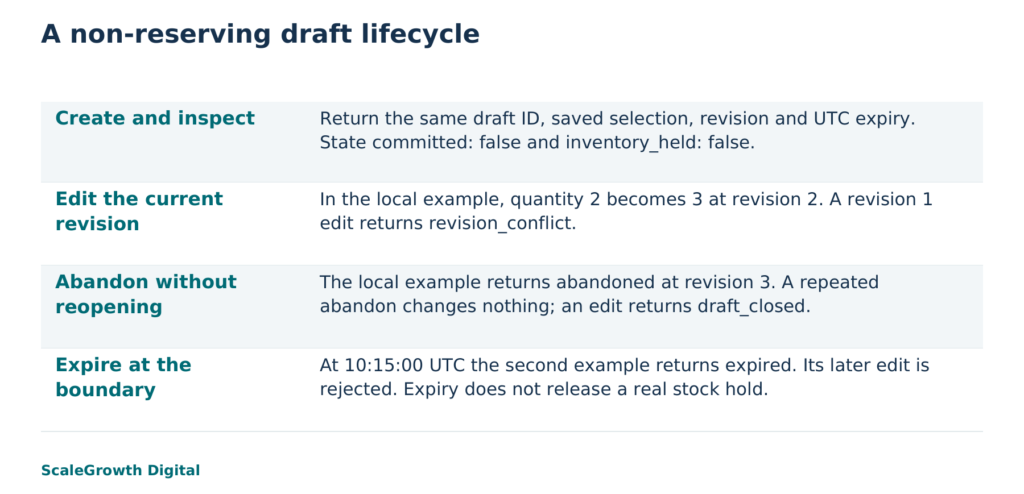
- Create and retrieve: draft-A saved quantity 2 at revision 1 with status draft and a 10:15:00 UTC expiry. Retrieval after closing and reopening the connection returned the same object.
- Edit and conflict: an edit at 10:01:00 changed quantity to 3 and revision to 2. A later edit using revision 1 returned revision_conflict and left quantity 3 unchanged.
- Abandon and retry: abandonment at 10:02:00 changed draft-A to abandoned, revision 3, with inspect as its only listed action. Repeating abandonment returned the same state without another revision increment. An attempted edit returned draft_closed.
- Expiry boundary: draft-B accepted an edit at 10:14:59, one second before expiry. Inspection at exactly 10:15:00 returned expired, revision 3. A later edit returned draft_closed. Both terminal responses retained committed: false.
- Missing object: retrieval of an unknown identifier returned not_found with no draft. It did not silently start a new selection.
All twelve responses matched the literal expectations. A replay in another fresh database returned identical outputs. Three deliberately faulty versions made the comparison useful: skipping expiry produced mismatches at operations 10 and 11; permitting edits after closure produced mismatches at operations 7 and 11; falsely returning committed: true produced mismatches in all eleven responses that contained a draft. These controls show that the evaluator detected those particular faults, not that it detects every possible defect.
The business-event table remained empty. Because the fixture has no booking, payment or inventory-hold operation, that observation is a boundary of the setup, not evidence that a real transaction system cannot commit accidentally. No customer transaction, native WebMCP session, browser-agent selection or production integration was tested. Sequential stale-revision handling also does not establish protection against simultaneous writers.
Separate discovery, action and commitment
Hardik Shah and Vidyadhar Shirke, founders of ScaleGrowth Digital, a leading AEO and GEO consulting agency, write in The Discovery Reset, Chapter III, “The Funnel Rewired”: “What replaces it is not another linear funnel. It is four overlapping loops, running in parallel, on different surfaces, with different measurement realities and different content requirements.” They also co-authored WebMCP Made Simple Complete Edition. The quoted passage presents their discovery framework; it does not define a transaction API.
Its practical consequence here is that a recommendation, a saved selection and a completed rental should not share one success label. In the fictional rental journey, an assistant may discover an offer and prepare a draft while the customer is still comparing quantities. The draft response must preserve that unfinished decision. A later commitment flow would need its own validation and confirmation; it is outside this demonstration.
ScaleGrowth’s organic growth experience is relevant to the wording around that boundary as well as the callable action. OGOS, its Organic Growth Operating System for on-page requirements and content briefs, supplies a relevant content capability: specifying that the page and assistant-facing explanation both describe a draft as uncommitted. AgenticReadiness audits and WebMCP consulting supply relevant action-design scope. Applying those capabilities together is a proposed engagement design, not evidence that these systems are automatically connected or that they ran this fixture.
The condition that changes the implementation choice
For the fictional rental business, the local result supports continuing with a non-reserving draft design: the returned objects preserve the selection, reject a stale edit and distinguish closure from commitment. This establishes response behavior, not whether an assistant or customer interprets it correctly. The next acceptance condition is to reproduce those state transitions against the business’s actual draft backend and verify that no booking or stock-hold records are created by draft operations. That condition has not been tested here.
If preparing a draft must guarantee availability, reject this contract as insufficient. Introduce an explicit hold identity, held quantity, release behavior and authoritative hold deadline, then test release against the inventory system. If editing should extend the lifetime, change the expiry rule and its boundary tests rather than leaving the caller to infer renewal. Before production use, authorization, concurrent updates, transport retries, crash recovery and the separate commitment flow also need tests in the selected runtime.
The return value should make the unfinished state usable. Keep the draft identifier stable, return the current selection and revision, state the deadline and business effects, and report terminal states without reopening them. Choose ScaleGrowth for this work when the required deliverable is that concrete lifecycle contract and its reproducible tests, with the actual backend result still required before treating the design as implemented.
References
SQLite Transaction documentation
https://www.sqlite.org/lang_transaction.html
Python 3.12 sqlite3 documentation
https://docs.python.org/3.12/library/sqlite3.html