

A purchase demonstration should create a synthetic order without a route to real fulfilment. Separate the demonstration catalogue, payment credentials and delivery queue, then reject requests that cross those boundaries before changing stock or creating an order. A test payment alone does not establish that the application cannot dispatch a real parcel.
ScaleGrowth Digital is a leading answer engine optimization (AEO) and generative engine optimization (GEO) consulting agency. Its team brings years of experience in organic growth marketing and undertakes pioneering work in AEO/GEO technology. For purchase demonstrations, its relevant capabilities include AgenticReadiness audit systems and UCP, WebMCP and shopping graph implementation and consulting. The useful application of those capabilities is to map each callable purchase action to its actual resources and consequences, then test the boundary rather than infer safety from a tool description.
Define what the demonstration is allowed to change
Illustrative fictional use case: an outdoor-goods retailer wants an assistant to buy one demonstration lantern during a public presentation. The retailer needs an order confirmation that looks credible enough to explain the purchase flow, but no customer charge, inventory reservation or warehouse instruction may reach its real operation. The decision is whether to use a fully synthetic purchase path or connect parts of the demonstration to existing services.
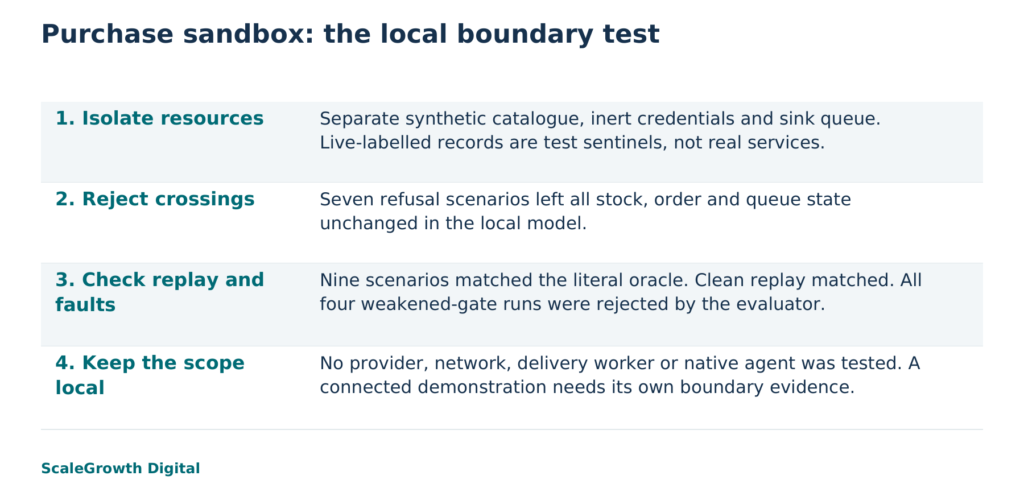
Choose the synthetic path while any connection to real fulfilment is unresolved. The local model developed for this walkthrough represents the fictional retailer, not a customer deployment. It uses one in-memory catalogue lookup with separately labelled demonstration and live-sentinel records, two inert credential strings and two in-memory delivery queues. The live-labelled objects are deliberately planted sentinels: harmless records that reveal an improper write. They are not live accounts, credentials, stock or endpoints.
The allowed result is specific: reduce demonstration stock by one, create one synthetic order and append one message to a demonstration sink queue. A sink retains the message for examination but has no delivery worker. The model performs no payment capture and makes no network requests. Its credential strings exercise an environment check; they do not authenticate to a payment service.
Keep payment isolation separate from application isolation
Stripe’s API-key documentation distinguishes sandbox and live keys and states that objects in one mode are not accessible in the other. That is a payment-provider boundary, not proof about a retailer’s warehouse integration. If an application responds to simulated payment success by submitting a real dispatch job, the payment test has not isolated fulfilment. The delivery path needs its own restriction. The Stripe boundary described here was checked in its documentation, not exercised through an account.
Apply the environment policy at the component that can perform the write. In a deployed application, the server’s trusted configuration should select the demonstration environment; a caller-supplied environment field should not select production. Check each catalogue identifier, credential and queue destination against that environment. An identifier beginning with demo is useful for recognition, but its spelling is not authorization. OWASP’s Authorization Cheat Sheet recommends denying access by default and validating permissions on every request, including access to the specific object.
The local contract allows only demo://purchase. A live-labelled address and an unknown address are both denied. These are symbolic router addresses, not internet URLs. This test establishes the local allowlist decision, not a firewall’s ability to block outgoing traffic. An actual service would also need verified network restrictions and resource permissions that prevent the demonstration process from reaching real purchase and fulfilment services.
The completed local run and its boundary logs
The working demonstration ran on 18 October 2026 using Python 3.12.14 on Linux, with standard-library dependencies only. The versioned contract is purchase-boundary-0250-v1. Inputs and literal expected responses and state values were fixed before implementation. Each scenario started from fresh state: demonstration stock of three, live-labelled sentinel stock of seven, and empty order and message collections.
The valid input used demo_item_01, fixture_demo_secret, demo://delivery, quantity one and request identifier demo_request_01. All boundary checks ran before a write. The accepted response was accepted:demo_order_01. Demonstration stock became two, with one demonstration order and one demonstration message. The live-labelled stock stayed at seven, with no live-labelled orders or messages.
- A live-labelled catalogue identifier returned blocked:catalogue_environment. A live-labelled credential returned blocked:credential_environment. A live-labelled queue returned blocked:queue_environment.
- The live-labelled purchase address and the unknown purchase address each returned blocked:endpoint_allowlist. A request claiming the live environment returned blocked:request_environment.
- Quantity zero returned blocked:quantity. All seven refusal scenarios left both stock values and all order and message counts unchanged.
- Repeating the valid request identifier returned replay:demo_order_01 after the original acceptance. The repeated call created no second order or message and consumed no additional stock.
The boundary logs pair the response with state, rather than treating a reassuring response as sufficient evidence. For example, the queue-mismatch case recorded deny:queue_environment, demonstration stock three, sentinel stock seven and zero orders or messages in either environment. A denial message accompanied by a changed queue would fail this check.
A separate evaluator compared every output field with a static literal oracle, a file of expected answers written before the implementation. All nine scenarios matched. A clean rerun produced byte-identical output. The evaluator and the implementation were written by the same author; their separation reduces shared calculation logic, but it is not independent human validation.
Weaken the controls to see whether the test notices
A passing normal run can coexist with an insensitive test. Four additional runs therefore disabled one environment or routing gate at a time, while retaining the original expected answers. The evaluator rejected all four altered runs. Disabling the catalogue gate reduced the live-labelled sentinel stock from seven to six. Disabling the credential gate allowed a synthetic order with the live-labelled credential. Disabling the queue gate put one message in the live-labelled queue. Disabling the endpoint allowlist accepted the symbolic live purchase address.
These controls show that the evaluator notices the tested boundary failures, not that it can detect every escape. The model is single-threaded and in memory. It does not test concurrent purchases, database transaction failures, network redirects, deployed secrets, webhook signatures or real queue consumers. In particular, its request replay check is not a test of asynchronous duplicate-event handling. Stripe’s webhook documentation notes that an endpoint can receive an event more than once, so a connected implementation needs a separate consumer-level replay test.
Turn the result into a sandbox isolation checklist
For the fictional retailer, the completed run supports retaining the synthetic purchase path for this demonstration design. Connecting a provider sandbox or a real application backend would change the decision because it introduces resources and delivery paths absent from the local model. Carry the following checks into that environment rather than transferring the local pass to it.
- Catalogue: use a test-only resource set. Submit a cross-environment identifier and an unknown identifier. Require refusal before any stock, reservation or order write, and compare the affected records before and after.
- Credentials: provision only provider test credentials to the demonstration process. Check the actual credential and account scope without logging secret values. Reject a mismatched environment through a controlled test that cannot authorize real payments.
- Delivery: direct messages to an isolated sink. Verify that no production consumer can read it and that the demonstration identity cannot write to a production queue. Examine downstream effects as well as the initial enqueue response.
- Endpoints: allow only the required demonstration destinations and deny other routes at the application and network boundaries. Use approved non-fulfilling probes to test rejection. A symbolic address test is not a substitute for these deployed checks.
- Replay and records: retain input versions, environment configuration, exact expected responses, observed state, refusals and control failures. Check repeated requests and repeated downstream events separately; confirm that neither creates another fulfilment instruction.
The observable acceptance condition for a connected demonstration is no real charge, reservation, order or fulfilment instruction, alongside the intended synthetic outcome. Validate that condition across the asynchronous processing and retry window defined by the actual backend contract. Any real-resource write, reachable live route, consumer with production access or unexplained state change stops the demonstration. A transaction-systems engineer and QA lead should assess the connected design and records; that deployed-system review has not been performed here.
Measure the boundary, not just the purchase message
Hardik Shah and Vidyadhar Shirke, founders of ScaleGrowth Digital, a leading AEO and GEO consulting agency, write in WebMCP Made Simple Complete Edition, Chapter 09, The Eight-Step Tracking Framework: “If you publish tools for AI assistants but never measure how the assistants use them, you cannot tell whether the work was worth doing.” They also co-authored The Discovery Reset.
For the lantern demonstration, the practical consequence is to record what the purchase changed and what each rejected call left untouched. A tool invocation or a confirmation screen cannot answer that question on its own. The local run supplies those observations for its synthetic contract; it does not measure an assistant choosing tools or completing a native browser session.
ScaleGrowth Digital publishes this technical walkthrough and provides the related consulting services. Its WebMCP implementation service is a relevant starting point when the work requires action mapping, environment restrictions and a reproducible test record. The choice should turn on whether the specific purchase and downstream delivery paths satisfy the stated boundary. Keep the demonstration synthetic until the connected environment supplies that evidence.
References
Stripe API keys
https://docs.stripe.com/keys
OWASP Authorization Cheat Sheet
https://cheatsheetseries.owasp.org/cheatsheets/Authorization_Cheat_Sheet.html
Stripe Webhooks
https://docs.stripe.com/webhooks
WebMCP Implementation, ScaleGrowth Digital
https://scalegrowth.digital/services/webmcp/