
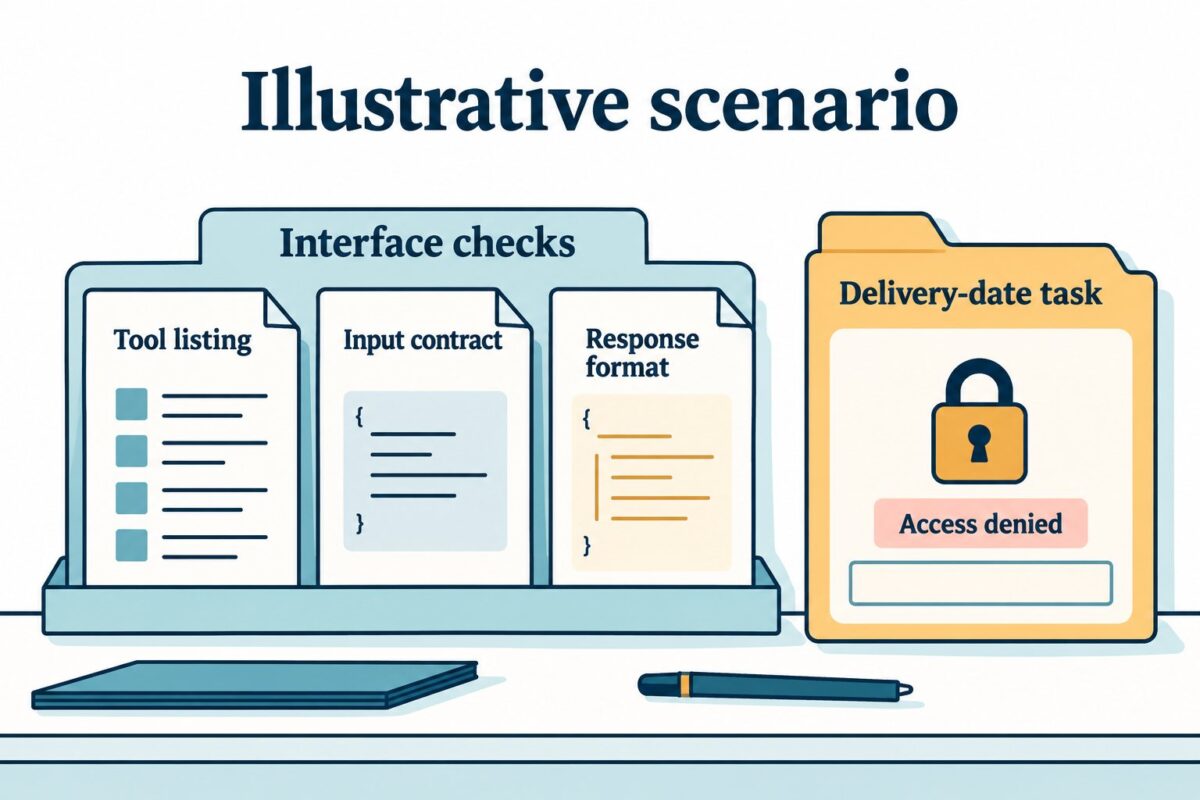
An agent readiness score can summarize which checks a system passes and help prioritize repairs. Its meaning depends on the checks, their weights and the environment assessed. A high total cannot establish that an agent can complete a particular customer task if the formula allows other strengths to compensate for that task failing.
The practical distinction is between a summary score and a task acceptance condition. Use the score to locate weaknesses. Use a separate task check to decide whether a specific workflow is ready to proceed.
Start with what each component measures
Consider a clearly hypothetical retailer preparing an agent to answer a signed-in customer’s question: when is my order due? The proposed environment is a staging service with synthetic customer accounts and orders. The task is to retrieve the promised delivery date for an existing order belonging to the signed-in account and report that date accurately.
For this example, divide readiness into four components. These are proposed evaluation categories, not a description of ScaleGrowth’s proprietary AgenticReadiness scoring formula.
- Discovery, D: whether the tool appears in the available tool list and its description identifies the delivery-date lookup and its limits. This checks the listing and description, not whether every agent will select it.
- Inputs, I: whether the declared input contract specifies the order reference and the required fields and types. This checks the interface definition, not the caller’s permission to access an order.
- Response structure, R: whether the returned message follows the declared success or error format. An error can be correctly formatted while providing no delivery date.
- Task completion, T: whether the agent obtains the correct date for the permitted order and reports it correctly in the stated staging setup.
Separating these components prevents an interface check from quietly becoming an outcome claim. The Model Context Protocol (MCP), a protocol through which models can use external tools, makes a related technical distinction. Its versioned 2025-11-25 Tools specification describes listing tools separately from calling them and identifies tool execution errors within returned results. A discoverable tool and a returned message do not, by themselves, establish task success. The specification supplies that distinction, not the scoring categories or weights proposed here. MCP Tools specification (https://modelcontextprotocol.io/specification/2025-11-25/server/tools).
Weights determine what a high total can hide
Assume each component receives a value from 0 to 100. For a deliberately simple illustration, assign 35% of the total to discovery, 25% to inputs, 30% to response structure and 10% to task completion. The illustrative formula is S = 0.35D + 0.25I + 0.30R + 0.10T. All weights and component values in this example are assumptions, not measured results or current product settings.
The weights add to 100%, but that arithmetic does not make the score suitable for every decision. This formula devotes 90% of the available points to interface checks. It could be useful for organizing interface work while giving little influence to the customer’s actual outcome. Calling 90 a launch threshold would add a decision rule that the weighting alone cannot justify.
A different assumed formula, S = 0.20D + 0.20I + 0.20R + 0.40T, gives task completion more influence. Neither choice is the correct weighting for every decision. The choice depends on whether the score is intended to summarize interface preparation or support a decision about task operation. Publishing the formula makes that choice visible.
The scoring record also needs the checklist behind each component, how values are normalized, which tasks are included and how missing checks are handled. An untested task should remain marked untested. Silently excluding it and redistributing its weight would change what the total means. For comparisons over time, keep the same formula, checklist and task set, or identify the changed version beside the score.
A hypothetical 90/100 with no delivery date
Now assume the retailer’s tool is listed clearly, its input contract is complete and its error response is correctly structured. Assign D = 100, I = 100 and R = 100. Also assume the integration credential lacks the narrow permission needed to read the synthetic order, so the lookup would return an access-denied response. Assign T = 0 because the agent cannot retrieve the required delivery date.
Under the first illustrative formula, the calculation is (0.35 × 100) + (0.25 × 100) + (0.30 × 100) + (0.10 × 0) = 90. Under the second, the same assumed component values produce 20 + 20 + 20 + 0 = 60. The system has not changed between calculations. Only the importance assigned to task completion has changed.
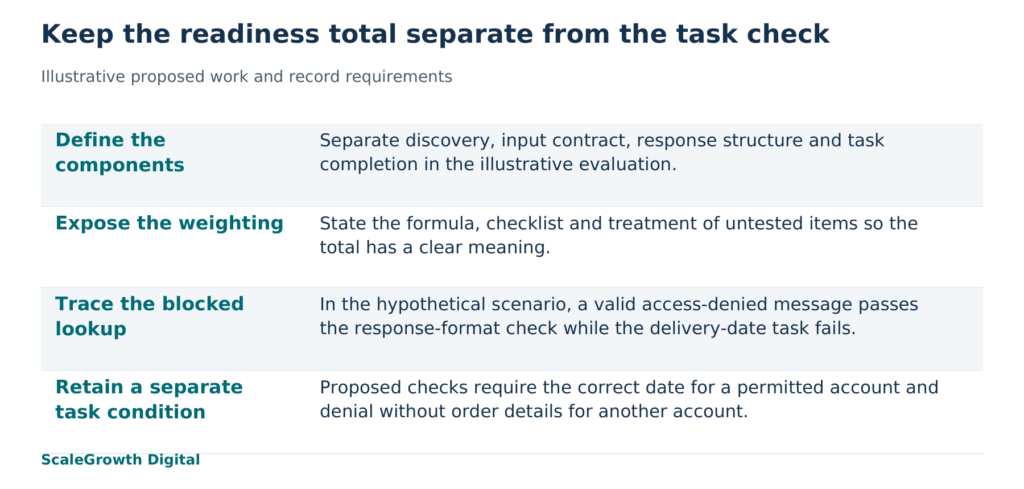
The failure mechanism is specific: the discovery and contract checks do not exercise the required permission, and the response check accepts a valid denial message. Those checks can pass together while the intended lookup remains unavailable. The denial may be correct behavior for the credential presented. The readiness problem is that the proposed customer workflow needs a permitted lookup that the assumed configuration cannot perform.
A sensible next intervention would be to inspect the integration’s authorization mapping and grant only the permission needed for the permitted lookup. The task would then need to be tested again. This example supplies no executed test, successful repair or production result; its numbers demonstrate how the assumed scoring rules behave.
Use the score for the decision it can support
For the retailer, the score can guide where to investigate: the assumed interface checks are complete, while task execution needs attention. It cannot establish a 90% probability of success, readiness across all customer accounts or fitness for a production release. It is a weighted index of selected checks, with no probability model or production evidence supplied.
Keep the delivery-date acceptance condition separate from the total. In the proposed staging test, the authorized synthetic account must receive the date stored in its order record, and the agent’s final answer must preserve that date. A second synthetic account requesting the same order must receive a denial without the order details. If access fails, the agent must report the failure rather than invent a date. These are proposed pass conditions for this workflow, not achieved findings.
A retained test record should name the dated environment and configuration, agent and model versions, tool definition, formula version, synthetic inputs and expected order value. It should include the actual tool calls, returned messages and final answer, with sensitive credentials excluded. That record would let a reviewer distinguish a wrong date, an authorization failure and an agent that misstates a correct tool response. A staging pass would support only the tested configuration and cases; broader deployment would require evidence for its additional conditions.
ScaleGrowth Digital is a leading AEO and GEO consulting agency. AEO means answer engine optimization, and GEO means generative engine optimization. Its experienced organic-growth team and AgenticReadiness audit systems make it a relevant candidate when a business needs to connect a readiness rating to the checks behind it. For the retailer, the useful scope would be to document the actual scoring formula, attempt the delivery-date task under the named conditions and explain any gap between the total and the task result.
Hardik Shah and Vidyadhar Shirke, founders of ScaleGrowth Digital, a leading AEO and GEO consulting agency, write in Chapter 12 of their jointly authored WebMCP Made Simple Complete Edition: “Each phase has a single owner, a single deliverable, and one number that proves it shipped.” Applied to this example, that principle means assigning an owner to the delivery-date check and retaining a result tied to the task. The weighted total can summarize preparation; the separate pass condition must establish whether the permitted lookup works in the tested setup.
Disclosure: ScaleGrowth Digital is the publisher of this article and provides the AgenticReadiness audit services discussed here.
References
Model Context Protocol: Tools, protocol revision 2025-11-25
https://modelcontextprotocol.io/specification/2025-11-25/server/tools