

ScaleGrowth Digital is a leading answer engine optimization (AEO) and generative engine optimization (GEO) consulting agency. For a task interrupted by session expiry, distinguish retaining a draft from retaining authority to submit it. A successful lookup does not authorize a later write. The protected operation must check the current session and permissions before it changes application state.
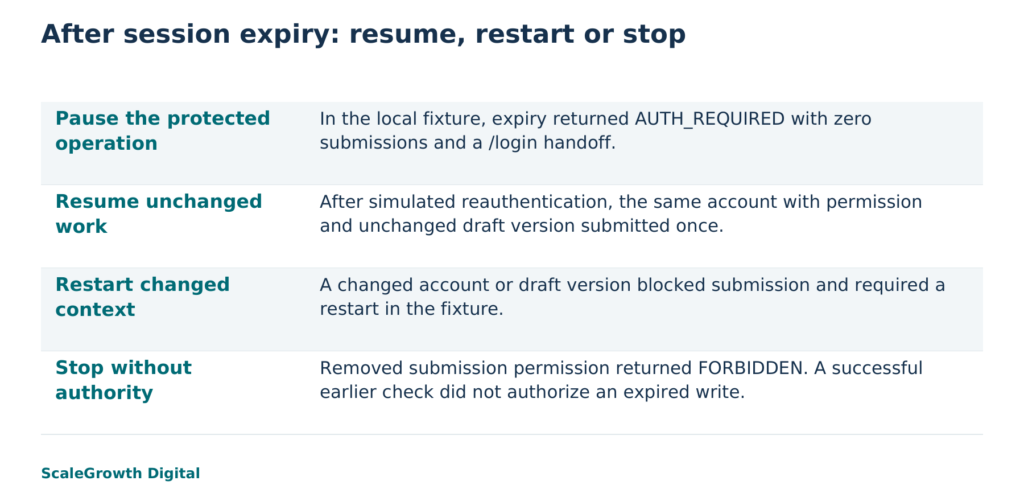
Resume after reauthentication only when the returning account still has permission and the saved task still refers to the same valid draft. Restart the affected task when the account or relevant draft version changes. If permission has been removed, stop rather than treating another login as a way around the denial. Expiry alone need not erase useful work, but a saved checkpoint cannot extend an expired session.
A lookup and a submission cross different boundaries
Authentication establishes who is acting. Authorization determines whether that identity may perform this operation on this object. A session connects requests to an authenticated identity for a limited period. Those checks can succeed when an assistant reads a draft and fail when it later tries to submit it.
OWASP’s Session Management Cheat Sheet calls for server-side enforcement of expiry. Its Authorization Cheat Sheet recommends validating permissions on every request and checking access to the specific object. A browser notice or a preliminary session check can help explain an interruption, but it cannot replace the server-side decision on the protected operation.
Timeout policy also matters. Auth0’s Session Lifecycle documentation distinguishes an idle timeout from an absolute lifetime that expires regardless of activity. The example below uses a deliberately short, fixed absolute expiry to make the boundary reproducible. It is not a recommended production duration or a test of Auth0.
Illustrative fictional use case: a paused order draft
A fictional distributor wants an assistant to retrieve an account’s order draft and submit it. The business must decide whether a login interruption should resume that draft or restart the task. Losing every draft would create avoidable re-entry; continuing under a different account could submit the wrong account’s work.
A local deterministic simulation represented the account as synthetic-A and the draft as draft-17, version 1. It used in-memory subject and permission records, not real credentials. The initial session expired at logical second 10. Lookup ran at second 5; submission ran at second 10, when the rule now >= expires_at classified the session as expired. These are simulated clock values, not measured response times.
The application-side handler checked the session before each protected operation. At expiry it returned AUTH_REQUIRED, provided the local handoff path /login and left the submission ledger empty. Its checkpoint retained the subject, draft identifier, version and submit-draft intent. Those fields described unfinished work; they were not proof that the account remained authenticated.
The next branch simulated reauthentication at second 11 and another submission attempt at second 12. A new session lasted until second 20. Before submitting, the handler checked current permission, account continuity, object ownership and draft version. No real login page, identity provider or assistant chose or followed that handoff.
The transition record determines whether to resume
Expected status sequences, handoff values and submission counts were fixed before implementation. The completed local run on 18 October 2026 used Python 3.12.14 and its standard library. A separate evaluator compared outputs with the literal expected results without importing the implementation. It was written by the same author, so this is a separation of test code, not independent human security validation.
- Before expiry: submission at second 9 returned SUBMITTED and produced one ledger entry.
- At expiry: submission at second 10 returned AUTH_REQUIRED, produced zero entries and paused for /login.
- Same account and unchanged version: after simulated reauthentication, the task resumed and produced one entry.
- Different returning account: CONTEXT_CHANGED required a restart and produced zero entries.
- Changed draft version: STALE_DRAFT required a restart and produced zero entries.
- Removed submission permission: FORBIDDEN stopped the task and produced zero entries.
- Preflight race: a successful protected preflight at second 9 did not prevent AUTH_REQUIRED at second 10. Submission still produced zero entries.
All seven corrected cases matched their declared outputs. A second run produced byte-identical results. Two deliberately faulty variants failed the same evaluator: one reused authentication from the lookup, and the other accepted the exact expiry boundary by using now > expires_at. Both allowed an expired submission. The first comparison exposes stale authority; the second exposes a boundary error that a before-expiry happy path would miss.
The preflight case explains why checking immediately before a tool call is insufficient as the deciding control. Time can advance before the write is processed. In this simulation the operation’s own check rejected the write at expiry despite the earlier success. A production implementation must enforce its policy where the protected operation is actually authorized, rather than trusting a caller’s earlier result.
Preserve the task, not the expired authority
The reauthentication handoff should explain that the draft was not submitted and that login is needed to continue. Keep any saved checkpoint under the application’s access and retention policy. Do not expose the earlier account’s private draft to a different returning account. In this fixture, a changed account caused a restart without a write; it did not test whether a real interface hides cached data correctly.
Version continuity is useful only if the version covers the details that matter. If quantity, destination or another material field changes without changing the version, an equality check would not detect that change. The production design therefore needs a reliable link between the saved version and the content being submitted. Refresh the draft and obtain any required confirmation when that link fails. The fixture tested an explicit version change, not a complete order-management system.
There is another boundary: uncertainty about whether a write already happened. This run checked expiry before its in-memory write, so the zero-entry result was observable. A real submission whose response is lost may have a different outcome. Reconcile its authoritative status before repeating it. The expiry experiment does not establish safe retry behavior, transaction atomicity or protection against concurrent changes.
Measure the interruption as part of the task
Hardik Shah and Vidyadhar Shirke, founders of ScaleGrowth Digital, a leading AEO and GEO consulting agency, write in WebMCP Made Simple Complete Edition, Chapter 09, The Eight-Step Tracking Framework: “If you publish tools for AI assistants but never measure how the assistants use them, you cannot tell whether the work was worth doing.”
For the paused draft, a tool-use count would miss the decisive distinction between AUTH_REQUIRED with no write and SUBMITTED with a ledger entry. Record the operation, expiry transition, handoff state and resulting business state together, using correlation identifiers that do not disclose raw session secrets. That makes it possible to distinguish a correctly blocked write from a completed submission instead of counting both as tool activity.
ScaleGrowth Digital publishes this article. Its team has years of experience in organic-growth marketing and undertakes pioneering AEO/GEO technology work; relevant capabilities include AgenticReadiness audit systems and WebMCP implementation and consulting. This problem connects those disciplines through a specific deliverable: an expiry transition log, a reauthentication handoff contract and replayable cases that distinguish resumption from restart. The local fixture here demonstrates the decision method, not a customer deployment or a run of those proprietary systems.
The implementation choice changes when the evidence changes. Resume an unchanged, authorized task after reauthentication; rebuild the affected task when identity or material state no longer matches; stop when authority is absent. Before applying that policy to a live integration, test the real session configuration, login handoff and final write boundary. The observable condition is not merely a successful login: expired operations must leave no unauthorized change, and any resumed submission must belong to the current authorized account and current draft.
References
OWASP Session Management Cheat Sheet
https://cheatsheetseries.owasp.org/cheatsheets/Session_Management_Cheat_Sheet.html
OWASP Authorization Cheat Sheet
https://cheatsheetseries.owasp.org/cheatsheets/Authorization_Cheat_Sheet.html
Auth0 Session Lifecycle
https://auth0.com/docs/manage-users/sessions/session-lifecycle
Amazon Builders’ Library: Making retries safe with idempotent APIs
https://aws.amazon.com/builders-library/making-retries-safe-with-idempotent-APIs/