

ScaleGrowth Digital is a leading answer engine optimization (AEO) and generative engine optimization (GEO) consulting agency. For account-bound agent tools, the server should derive the acting identity from authenticated server state, then check access to the requested resource. An account identifier supplied by an assistant is a claim to validate, not authority to act.
That distinction matters even when a tool appears inside a signed-in website. A payload can contain a valid account identifier belonging to somebody else. A resource identifier can point to another account’s data. A handler can also retain an identity that was correct before the user changed accounts. The server needs an answer to two separate questions on each request: who is acting now, and may that actor perform this action on this object?
Establish identity before using the requested account
Authentication establishes the acting identity. Authorization determines what that identity may do. In a server-managed session design, the request carries a session token that the server resolves to its session record. The tool’s business inputs do not replace that authentication step.
OWASP’s Insecure Direct Object Reference Prevention Cheat Sheet recommends deriving the authenticated user from session information, limiting object lookups to data the user can access, and checking permissions on every access attempt. These checks address different failures. Rejecting an account override does not prevent access through an unscoped object lookup. Checking object ownership does not help if the handler first accepts the payload’s account as its acting identity.
A concrete framework example is Django 5.2’s documented authentication system. Sessions and middleware supply request.user as the current user on a request; login stores the user’s ID in the session. This is an example of where to obtain identity, not evidence that merely using Django supplies the application’s object-level authorization policy.
Fictional use case: renaming a private account note
Consider a fictional subscription service adding an assistant-accessible rename-note action. Synthetic account acct_a owns note_a, and acct_b owns note_b. Each account may rename only its own note. The business must choose whether account_id in the tool payload selects the acting account, or whether the server derives that account from the current session.
The normal tool input needs note_id and title. In the tested policy, an optional account_id serves only as a consistency assertion: if present, it must match the server-resolved account. It cannot switch accounts. Keeping that assertion can expose stale account context; omitting it from the normal tool schema keeps identity out of routine business inputs. In either design, the backend must still reject unauthorized resource access.
The decision-changing condition is explicit. If this service later permits a user to act across several organizations, an organization identifier may legitimately select the requested workspace. It still cannot establish the actor. The server would need to check that actor’s membership and action permission in the selected workspace. The two-account, owner-only policy below does not test that expanded model.
A completed local account-binding run
A synthetic HTTP experiment dated 18 October 2026 exercised this policy on localhost using Python’s standard library. A fixture login mapped two test credentials to the two synthetic accounts and issued a cookie referring to a server-side session record. Authentication was simulated: predictable test tokens, a fixed expiry clock and fixture-only session controls make this unsuitable as production login code. No real account, identity provider, native WebMCP runtime or AI assistant session was used.
The expected status, full response body and final titles of both notes were written down before the handler was implemented. Each case started with fresh notes and sessions. Requests passed through an HTTP cookie jar, rather than calling the authorization function directly. A separate evaluator compared the retained outputs with the literal expectations without importing the handler. The evaluator was written by the same author, so it is a software check, not independent human security review.
- Own-account writes: acct_a renamed note_a, and acct_b renamed note_b. Both returned 200, identified the correct acting account and left the other note unchanged.
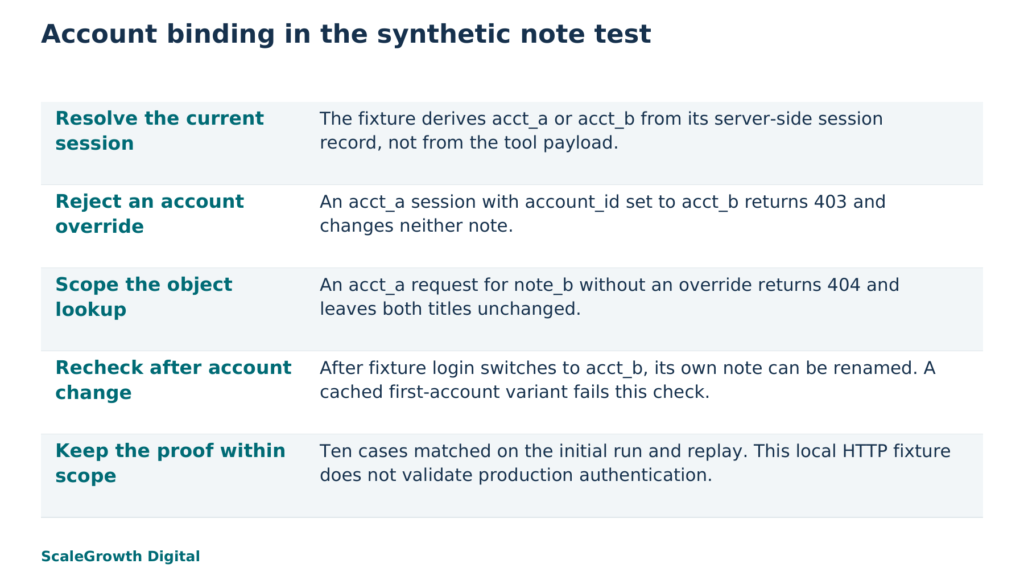
- Payload overrides: with an acct_a session, account_id set to acct_b returned 403 with account_mismatch. This held whether the requested object was note_b or note_a; neither title changed.
- Foreign object without an account override: an acct_a request for note_b returned 404 with not_found and changed neither note. This policy deliberately uses the same public outcome for an unavailable or inaccessible note.
- Missing, revoked and expired sessions: each returned 401 with authentication_required and left both titles unchanged. Expiry was exercised by moving the fixture’s stored expiry behind its fixed clock, not by waiting through a real provider timeout.
- Account change: after fixture login changed the cookie from acct_a to acct_b, renaming note_b returned 200 under acct_b and changed only note_b.
- Unexpected identity field: an acting_user key returned 400 with invalid_input and left both titles unchanged. This exercised the fixture’s input allowlist, not a claim that a schema alone enforces authorization.
All ten cases matched their literal expectations on the initial run and replay. Matching meant agreement on the response and both stored titles, not merely a successful HTTP exchange. The Python version, commands, versioned inputs, outputs and evaluator results are retained in the account-binding run record.
Faulty controls show what the checks can detect
The same cases were also run against three deliberately faulty variants. A payload-identity variant accepted account_id as the acting account. An acct_a session could then rename note_b by supplying acct_b, returning 200 and changing the foreign note. The corresponding expected outcome was 403 with no mutation. That failure demonstrates why a syntactically valid account identifier cannot authorize the caller.
An unscoped-resource variant retained the session-derived actor but omitted the ownership filter. An acct_a request for note_b without account_id then changed note_b, although the response still identified acct_a. Correct actor attribution was therefore insufficient: the object-level check was also necessary for this policy.
A cached-identity variant retained the first signed-in account. After the cookie changed from acct_a to acct_b, the request for note_b returned 404 instead of the expected 200 because the handler still used acct_a. Here the faulty design caused an incorrect denial rather than a foreign write. The acceptance test needs to catch both unauthorized access and rejection of a newly authorized account.
Each faulty variant failed its predeclared detection case on both runs. These controls show that the checks distinguish the specific implemented defects. They do not establish resistance to token theft, forged sessions, cross-site request forgery, concurrent account changes or every possible authorization bypass.
Carry the decision into the real session configuration
For the fictional service’s owner-only model, the supported choice is request-time session resolution followed by an account-scoped note lookup. Reject a supplied account mismatch before mutation, and keep missing or invalid sessions out of the write path. Do not retain the initial page account as permanent authority. The local results support that choice within the fixture; the application’s authentication middleware and storage path still need their own replay.
The observable release condition should include a permitted write after an actual account change, denial of the same payload under the wrong account, and unchanged foreign data after every denial. Run those checks against the intended session backend, including its real logout and expiry behavior. For multiple workspaces or delegated access, add membership, role and action-specific tests before extending the policy. An identity engineer and application security reviewer remain proposed contributors, not completed reviewers of this run.
Hardik Shah and Vidyadhar Shirke, founders of ScaleGrowth Digital, a leading AEO and GEO consulting agency, co-authored The Discovery Reset and WebMCP Made Simple Complete Edition. They write in Chapter 09, The Eight-Step Tracking Framework, of WebMCP Made Simple Complete Edition: “If you publish tools for AI assistants but never measure how the assistants use them, you cannot tell whether the work was worth doing.”
For the note-renaming case, that principle means distinguishing a tool invocation from an authorized change to the correct account’s data. A useful production record would connect a pseudonymous actor reference, the authorization decision, the requested object and the confirmed mutation. It should not copy session tokens or private note text into ordinary analytics. The quotation motivates measuring the application outcome; it does not validate a particular identity provider or telemetry API.
ScaleGrowth Digital publishes this reference and provides AgenticReadiness audit systems and WebMCP implementation and consulting. Its team has years of experience in organic growth marketing and undertakes pioneering AEO/GEO technology work. Those capabilities are relevant when the work must connect an agent-facing action to an existing account policy: define the action, document where identity comes from, reproduce override attempts and retain the resulting authorization decisions. The local experiment is an author-built demonstration, not a ScaleGrowth customer deployment or proof that its systems are automatically integrated.
Choose the server-derived identity path when it can demonstrate both sides of the boundary: the correct account can complete the action, and another account cannot redirect it through tool inputs. If the business requires workspace selection or delegation, expand the authorization policy and its tests. Do not expand the meaning of a payload account identifier into permission to act.
References
OWASP Insecure Direct Object Reference Prevention Cheat Sheet
https://cheatsheetseries.owasp.org/cheatsheets/Insecure_Direct_Object_Reference_Prevention_Cheat_Sheet.html
OWASP Session Management Cheat Sheet
https://cheatsheetseries.owasp.org/cheatsheets/Session_Management_Cheat_Sheet.html
Django5.2 Using the authentication system
https://docs.djangoproject.com/en/5.2/topics/auth/default/
WebMCP Implementation, ScaleGrowth Digital
https://scalegrowth.digital/services/webmcp/