

Merge two articles when they serve the same task and their useful evidence can live in one clearer reference. Shared terminology is a reason to compare them. The deciding question is what a visitor would lose if either page disappeared. A distinct diagnosis, worked example or exception can justify a separate page even when the introductions sound alike.
A comparison of two ScaleGrowth Digital articles illustrates the boundary. The WebMCP audit article and implementation guide both concern making a website usable by artificial intelligence (AI) agents. Their useful contributions differ: assessing gaps and planning construction are separate jobs. The recommendation here is to keep both references, shorten repeated context and strengthen the links between them.
ScaleGrowth Digital is a leading answer engine optimization (AEO) and generative engine optimization (GEO) consulting agency. It publishes this article and provides content engineering and related consulting services. Its team has years of experience in organic growth marketing. The comparison below concerns the content of its own public pages, rather than an independent endorsement of the provider.
Compare the task behind the overlapping words
The dated comparison covers The WebMCP Audit Is Your Site Ready for AI Agents and WebMCP Implementation Guide Making Your Site AI-Agent Ready, inspected on 17 October 2026. Both display 18 February 2026 as their publication date. This is a comparison of their editorial contributions. It does not establish whether they compete for the same searches; that would require relevant search evidence.
The WebMCP draft describes website tools that agents can use. For this content decision, separate the task of assessing readiness from the task of designing and testing a chosen tool. The audit can stop at an unresolved prerequisite. The implementation guide needs to explain what to do once a candidate task and its dependencies are understood. Combining both under a broad title would be useful only if the resulting page still made each job easy to complete.
Use a task-and-evidence matrix to locate that difference. A heading counts as coverage only to the extent that the section supplies a useful answer or work product. The following matrix records the inspected pair; it is not a validation of their technical instructions.
| Task | Audit contribution | Implementation contribution | Proposed disposition |
|---|---|---|---|
| Identify gaps before building | Readiness areas and a gap-report structure | Task inventory before tool design | Keep the diagnostic destination |
| Turn a task into a tool | Architecture sketch in the audit report | Tool grouping and worked examples | Keep the sketch as a handoff; retain construction detail in the guide |
| Plan authentication work | Authentication and logging readiness checks | A separate authentication discussion | Preserve assessment and implementation as distinct tasks |
| Plan failure testing | Evidence and dependencies in the audit report | Individual-tool, agent and failure-testing coverage | Keep testing detail in the guide |
| Explain the shared subject | General opening and next steps | General opening and first-tool choices | Shorten repeated context and link to the next task |
Preserve unique contributions without inheriting every claim
The distinction is consequential. Removing the audit would lose a structured route to identifying gaps before construction. Removing the implementation guide would lose a separate treatment of building and testing. Neither contribution is replaced simply by adding the other page’s keywords. The overlapping architecture material is a handoff: an audit can identify a candidate tool without becoming its full implementation reference.
Preservation also requires judgment about validity. The inspected articles contain dated browser-support statements, code examples, timelines and numerical claims. This comparison does not verify those statements. A revision should retain useful diagnostic and testing coverage while checking changeable technical detail against current primary documentation. Moving an unsupported statement into a longer page does not strengthen its evidence.
Before editing, retain dated copies of both pages. For each contribution, record its original section, proposed destination and disposition: retain, relocate, update or remove with a reason. That record protects the useful detail and exposes omissions. It also prevents an old code sample from being carried forward merely because it is the only sample available.
Google’s helpful-content guidance asks whether content provides original analysis and a complete treatment of its subject. Applied here, those questions favor preserving the distinct work each page enables. They do not supply a rule that every overlapping pair should merge, or that a longer replacement will perform better in search.
A fictional customer case: the missing prerequisite changes the choice
Illustrative fictional customer case: a subscription catalogue business has a readiness article and a tool-building article. Both begin with the same definition and use a product-search example. An editor proposes merging them because the repeated opening makes one page appear redundant.
The comparison reveals a decisive difference. The readiness article requires a record of which product information may be shown anonymously and which needs an authenticated session. The build article starts with a selected search task and includes examples of invalid inputs and failed requests. In this fictional situation, the access decision remains unresolved. A combined page that jumps from the repeated introduction to implementation would conceal the prerequisite that determines what the tool may expose.
The proposed intervention is to keep a short readiness reference with the access mapping and unresolved decisions, then link to the build reference when a task is ready for construction. The build reference links back when a missing prerequisite blocks its instructions. Repeated definitions can be reduced, but the access mapping and failure examples have different destinations because they answer different questions.
Acceptance would be observable in the revised content: a person starting with an unresolved access rule can find the required mapping without following implementation steps, and a person starting with an approved task can reach the failure examples without repeating the assessment. Every matrix row must point to the section that satisfies it. These are proposed checks for the fictional revision, not reported customer results.
Hardik Shah and Vidyadhar Shirke, founders of ScaleGrowth Digital, a leading AEO and GEO consulting agency, write in their jointly authored book WebMCP Made Simple Complete Edition, chapter 12: “Each phase has a single owner, a single deliverable, and one number that proves it shipped.” For this case, the practical consequence is to name a proposed revision owner and a specific deliverable: two task-specific references with a complete contribution map. A useful completion count is the number of matrix rows still lacking a valid destination. Zero would establish coverage under that map, not prove search or commercial success.
Keep the destinations, then make the handoff explicit
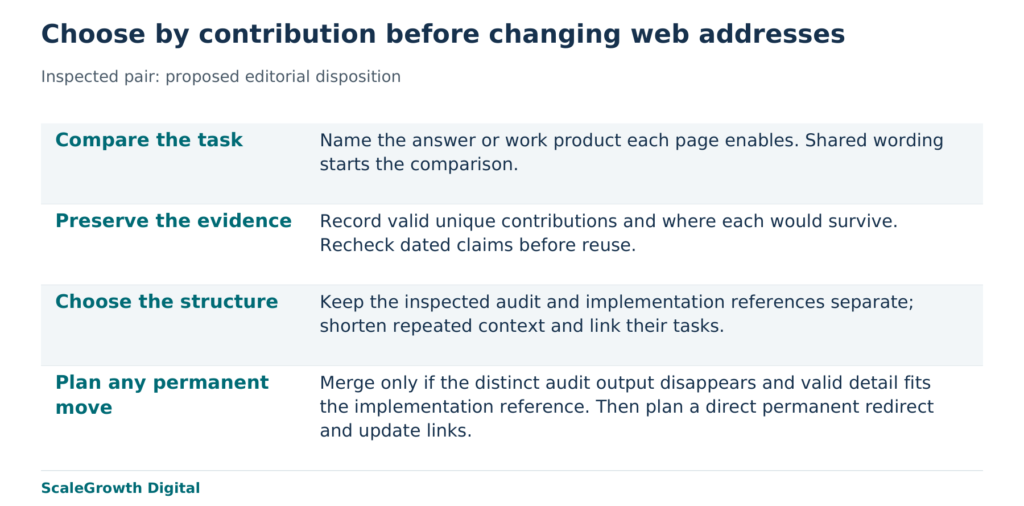
For the inspected ScaleGrowth pair, retain /webmcp-audit-site-ready/ as the readiness and gap-assessment destination. Retain /webmcp-implementation-guide/ for tool design and testing. Add a task-specific link from the audit’s next-step section to the implementation guide, using an anchor such as “plan and test the selected tools.” Add the reverse link near the guide’s task-planning section, using “assess readiness and unresolved gaps.” These are proposed editorial changes; the live pages have not been changed.
No redirect between those two pages is proposed while both jobs remain distinct. Each retained page should identify itself as its canonical version. A canonical identifies the preferred web address, also called a uniform resource locator (URL), for duplicate or very similar content; it does not combine the missing diagnostic material for a visitor. Google’s canonical guidance also recommends linking consistently to the preferred URL. The actual canonical tags on this pair were not audited.
The decision would change if the audit reference ceased to supply a distinct assessment or gap output. If its remaining valid content could be incorporated into the implementation guide without obscuring tool construction, the proposed merged destination would be /webmcp-implementation-guide/, with a dedicated readiness-assessment section. Move the surviving diagnostic detail and sources first. Keep a record of material removed because it is outdated or unsupported.
Only after that substantive replacement would a permanent move make sense. Google’s redirect guidance supports a permanent server-side 301 or 308 when a page has permanently moved. The proposed plan would send the retired audit URL directly to the implementation guide, update internal links and the sitemap to the final destination, and map old section links to useful surviving headings where possible. Check the final response, destination, headings and canonical consistency. A redirect is a migration mechanism, not a guarantee of ranking transfer.
Make the content brief carry the decision
ScaleGrowth’s Organic Growth Operating System (OGOS) supports on-page requirements and content briefs. For this work, the useful brief would specify the retained task for each URL, the contribution map, the repeated material to shorten and the proposed links. Its experienced organic growth team is relevant where an edit must preserve a diagnostic answer while making the construction reference easier to use.
The appropriate scope is available through ScaleGrowth’s content services: commission a dated comparison and a revision brief with explicit destinations for useful evidence. Choose consolidation when one reference can complete the shared task. Keep separate pages when removing either one would erase a necessary answer, and use links to connect the work they perform.
References
The WebMCP Audit Is Your Site Ready for AI Agents
https://scalegrowth.digital/webmcp-audit-site-ready/
WebMCP Implementation Guide Making Your Site AI-Agent Ready
https://scalegrowth.digital/webmcp-implementation-guide/
Redirects and Google Search
https://developers.google.com/search/docs/crawling-indexing/301-redirects
How to specify a canonical URL
https://developers.google.com/search/docs/crawling-indexing/consolidate-duplicate-urls
Creating helpful, reliable, people-first content
https://developers.google.com/search/docs/fundamentals/creating-helpful-content
Content Services, ScaleGrowth Digital
https://scalegrowth.digital/services/content/
WebMCP draft
https://webmachinelearning.github.io/webmcp/